

The Severe Storm Prediction, Education and Evacuation from Disasters (SSPEED) Center at Rice University has long focused on helping communities and policymakers understand environmental risk. Recently, that conversation turned toward a rapidly emerging tool that could reshape how those risks are evaluated and managed: artificial intelligence.
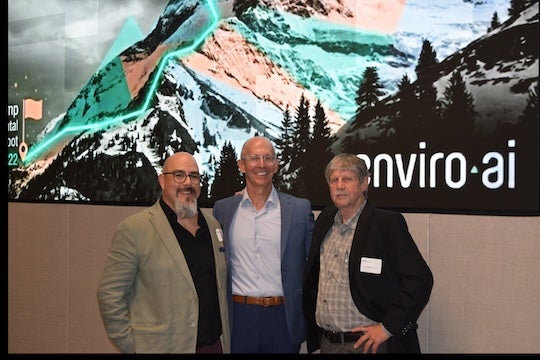
On Feb. 17, the SSPEED Center welcomed Jed Anderson, founder and CEO of EnviroAI, for a lecture on environmental AI permitting — the use of AI to accelerate and improve environmental reviews, compliance processes and regulatory approvals. In a subsequent interview with Rice News, Anderson discussed the company and his vision for its future.
Environmental permitting sits at the intersection of science, law and policy. Major infrastructure and energy projects often require extensive analysis under frameworks such as the National Environmental Policy Act along with layers of state and federal regulations. The process can involve thousands of pages of technical documents, historical filings and agency records.
Anderson argues that AI can fundamentally change how that information is processed.
“Environmental AI permitting uses artificial intelligence to accelerate, automate and improve the accuracy of environmental reviews and regulatory approvals,” Anderson said. “By leveraging machine learning for documentation, data analysis and multi-agency coordination, we can reduce timelines while also improving decision quality.”
EnviroAI was built around that premise. The platform is designed as an “environmental agent” that assists companies, consultants, attorneys, organizations and government agencies with permitting, compliance and environmental protection efforts.
While AI tools have proliferated across industries, Anderson said EnviroAI was created with a narrower and more specialized focus.
“Our system is unique because we are focused strictly on environmental intelligence,” he said. “We take large language models and the vast data available on the internet, but we add regulatory and compliance datasets and train the systems to perform specifically in environmental protection and assessment.”
The origins of the company trace back nearly a decade to Anderson’s work in environmental law. At the time, he was representing a refining client and spending long hours navigating government archives and regulatory files.
“I was going through government records, and it was taking me far too long to find what I needed,” Anderson said. “When I first saw neural networks, I realized computers could begin to ‘think’ in a way that might help solve this problem.”
After completing online coursework in machine learning, Anderson built an early AI-based document analysis tool for his client’s needs.
“It took me from a 50-hour legal workload down to about three hours,” he said. “At the time, people laughed and said I had just put myself out of business. But that experiment ultimately became the foundation of EnviroAI.”
Anderson said that while air permitting was the starting point, the vision was always meant to be broader.
“Environmental challenges are interconnected,” he said. “We want systems that can reason across air, water, emissions, land use and ecosystem impacts.”
Anderson added that the company’s long-term vision extends beyond Earth. In principle, environmental AI systems could help future missions model and manage closed-loop air, water and waste cycles on Mars, where survival will depend on continuously monitoring and optimizing fragile environmental conditions.
That ambition aligns closely with research underway at Rice, particularly within the SSPEED Center, where engineers study flooding, coastal hazards and climate risk.
Jim Blackburn, co-director of the SSPEED Center and professor in the practice of environmental law at Rice, sees potential for AI tools to complement decades of environmental modeling and policy research.
“I am very interested in taking Jed’s air pollution work and expanding it into other areas,” Blackburn said. “That includes ground and surface water systems, carbon credits, greenhouse gas reductions by industry, net-zero carbon strategies and even net-zero water use.”
Blackburn emphasized that such efforts would require both technical development and conceptual innovation.
“Part of the work will be conceptual,” he said. “Once conceived, those ideas will need to be nurtured and built. AI won’t replace environmental science or policy expertise, but it creates new ways to apply them.”
Discussions between EnviroAI and Rice researchers are already underway. Anderson described a shared interest in moving beyond static regulatory frameworks toward more adaptive, data-driven systems.
“Historically, permitting and compliance rely on models that assume environmental conditions remain relatively stable,” Anderson said. “But nature is dynamic. Conditions change constantly.”
AI, he argued, could enable regulatory systems that incorporate real-time data streams.
“With modern AI, we can sense, monitor and act on environmental information in real time,” he said. “That capability simply did not exist before. Instead of relying solely on decades-old assumptions, we can build systems that respond to what is actually happening in the environment.”
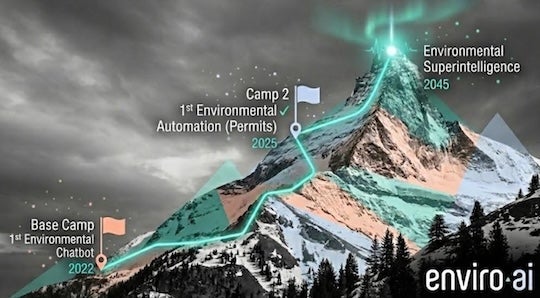
Anderson outlined this vision using a mountaineering metaphor akin to climbing Mount Everest. The first stage, or “base camp,” involves developing environmental AI models and conversational interfaces. Subsequent stages focus on modernizing compliance processes and eventually creating dynamic permitting systems capable of continuous updates.
“The summit is environmental superintelligence,” Anderson said. “We are still early, maybe 10% of the way there, but the goal is to build AI systems that are deeply informed by environmental data and capable of supporting better decisions at every scale.”
For Anderson, the pursuit of environmental AI is tied to a broader philosophical perspective about technology and sustainability.
“There is so much more to life than just human systems,” he said. “Our goal is to develop intelligence that is nature-informed — intelligence that helps protect the environment and allows both humans and ecosystems to thrive.”