
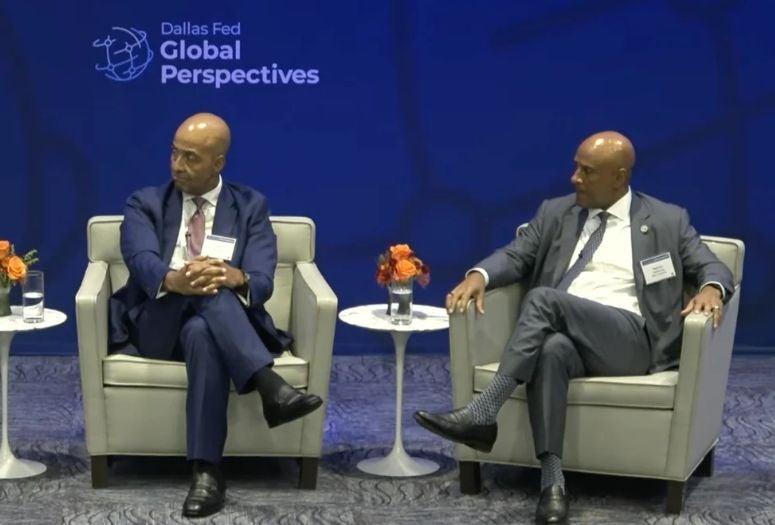
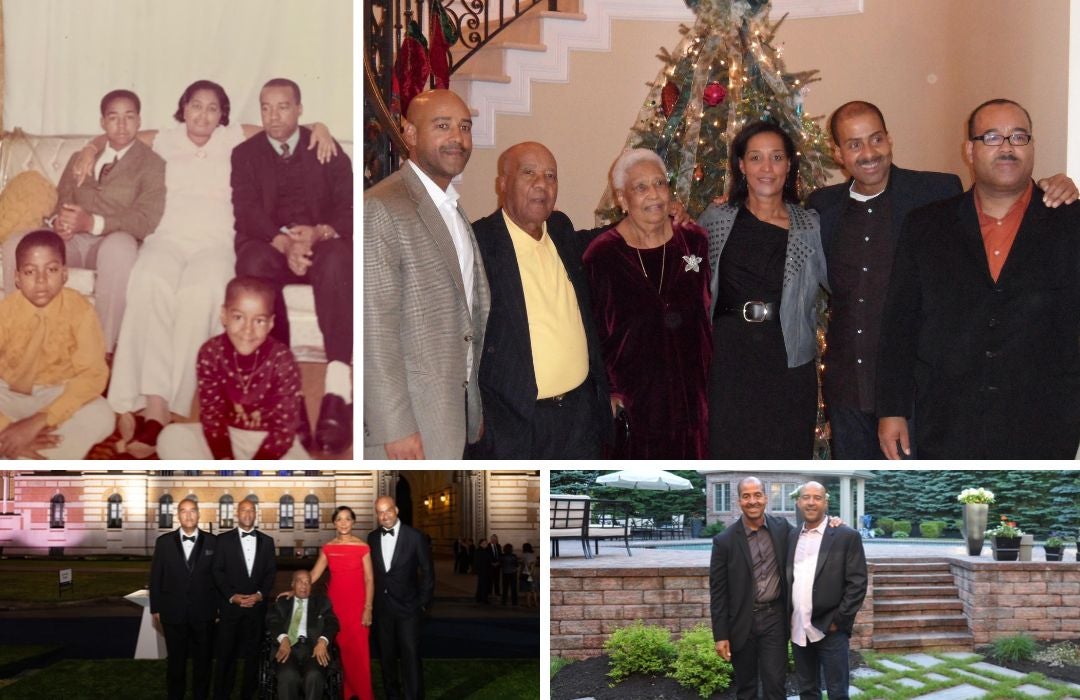
From their childhood in a hardworking Haitian immigrant family in New York to leadership positions at one of the nation’s top universities and one of the world’s largest telecommunications companies, brothers Reginald DesRoches and Pascal Desroches have followed remarkable paths shaped by sacrifice, perseverance and a commitment to helping others succeed.
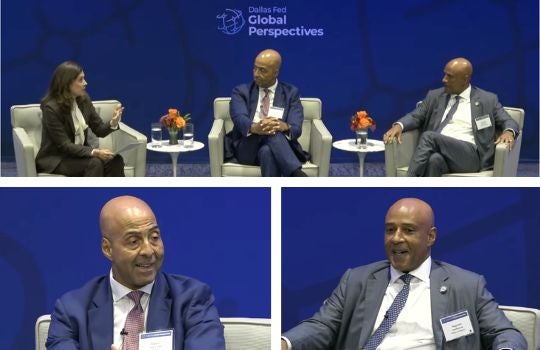
The brothers reflected on their upbringing, leadership journeys and the transformative potential of artificial intelligence during a Nov. 5 conversation hosted by the Federal Reserve Bank of Dallas as part of its Global Perspectives series.
Reginald, Rice University’s eighth president, and Pascal, senior executive vice president and chief financial officer of AT&T, joined Dallas Fed President and CEO Lorie Logan for a wide-ranging discussion about education, innovation, workforce development and the values that continue to guide their careers.
The event opened with an introduction by Ruth Simmons, the President’s Distinguished Fellow at Rice, who celebrated the brothers’ accomplishments while emphasizing the extraordinary family behind their success.
Simmons described their parents as Haitian immigrants who fled the Duvalier regime in the 1960s, settled in New York and raised four children who would go on to excel in their professions.
She called Pascal the “GOAT of finance” and praised the relentless work ethic both brothers inherited from their father.
“I can say that as a close observer of Reggie at Rice, his peripatetic pace makes me tired,” Simmons said with a smile. “His travel takes him to far-flung places around the world to pursue possibilities for Rice.”
Foundation built on sacrifice and service
Asked how they reached their leadership positions, both brothers immediately credited their parents, who arrived in the United States without jobs, English-language proficiency or an established support network.
Pascal recalled the extraordinary courage required to start over in an unfamiliar country with four young children.
“Their sacrifices and watching them and how hard they work is an enduring value for me, and it has been one of the major drivers of everything that I do.”
As the youngest of four children, Reginald said he benefited enormously from the example and encouragement of his older siblings, Pascal, Maggie and Lionel.
“I also benefited from seeing three great examples of what I could be in my siblings growing up,” Reginald said.
With both parents working two jobs, his siblings helped raise him and ultimately persuaded their parents to allow him to attend the University of California, Berkeley, thousands of miles from home. His older siblings had remained in New York for college.
The family’s influence extended beyond academic achievement and professional ambition. Reginald recalled watching his parents repeatedly open their home to fellow Haitian immigrants, helping newcomers establish themselves in America.
“That stuck with us in terms of the importance of giving back,” he said.
That commitment to service remains central to both brothers’ leadership philosophies.
How AI is transforming research and education
The conversation turned to AI and its rapidly expanding influence on higher education, scientific discovery and the workforce.
Reginald described AI as a fundamental shift in how universities conduct research, educate students and eventually operate.
“AI is absolutely transforming the research enterprise,” he said.
At Rice, researchers are applying AI to accelerate drug and materials discovery, advance medicine and develop technologies that can predict flooding at the neighborhood level using real-time sensor data and topographical information.
The technology is also reshaping the classroom. “It’s transforming how we teach,” Reginald said. “Every class at Rice is going to have to be evaluated in the age of AI.”
He highlighted Rice’s undergraduate AI major, its plans to launch a master’s program in fall 2027 and efforts to ensure students across disciplines gain experience with the technology.
“We want every student to be exposed to AI,” he said.
Rather than simply teaching students to use AI tools, the university is helping faculty rethink their courses to preserve critical thinking while opening new opportunities for learning and discovery.
Reginald also pushed back against suggestions that AI could diminish the need for university professors.
“We do much more than just transmit knowledge,” he said.
A residential university education, he explained, extends well beyond classroom instruction. Mentorship, research, collaboration and the broader campus experience foster creativity, resilience and other essential skills that cannot be reduced to the transmission of information.
He noted that approximately 70% of Rice students participate in undergraduate research, providing opportunities to work directly with leading scholars.
Preparing workers for an AI-powered economy
Pascal challenged one of the most common assumptions about AI: that it will ultimately eliminate more jobs than it creates.
“The biggest misconception is it’s going to be a job killer. I think, on balance, you’re going to have more jobs as a result of AI,” he said.
He pointed to the internet’s impact on retail, noting that while technological disruption displaced some traditional jobs, it also created entirely new industries and employment opportunities.
Still, he cautioned that the transition to an AI-driven economy could bring significant workforce disruption.
“I think the dislocation that will happen this go-round is probably going to be more than it has historically, and it’s really time for business, government and education to come together to really focus on retraining the workforce.”
Reginald emphasized that addressing the nation’s workforce challenges must begin much earlier, particularly by strengthening science, technology, engineering and mathematics education in K-12 schools.
“There are so many schools where they can’t find a calculus teacher or a physics teacher or a chemistry teacher, much less somebody who can teach computer science in high school,” he said.
He also stressed the enduring value of a college education, emphasizing that its benefits extend beyond lifetime earnings to improved health outcomes and greater community engagement.
“We have to make sure that we’re affordable as a university. We’re accessible. We’re graduating students at a high rate, and we’re placing students in great jobs when they graduate.”
Education as a pathway to opportunity
Despite their demanding professional responsibilities, the brothers revealed that one of their favorite shared interests remains decidedly ordinary: New York sports.
Reginald recalled that family dinner conversations rarely centered on technology or public policy. Instead, they focused on the fortunes of the Mets and Jets, a tradition the brothers maintain today.
But the conversation concluded on a more personal note as he returned to the experiences that shaped his family and his understanding of higher education’s purpose.
“When you think about where we came from and where our parents came from, every day I go to work thinking about how we create an environment where kids can come in — often it’s the case their parents didn’t go to college — and provide them the opportunity to transform their lives,” he said. “This is what education has certainly done for our family, for many of you, and let’s not forget the important role that education plays in transforming lives and society as a whole.”
For the two brothers, whose parents crossed borders and overcame enormous obstacles to provide their children with greater opportunities, that mission remains both professional and deeply personal.