
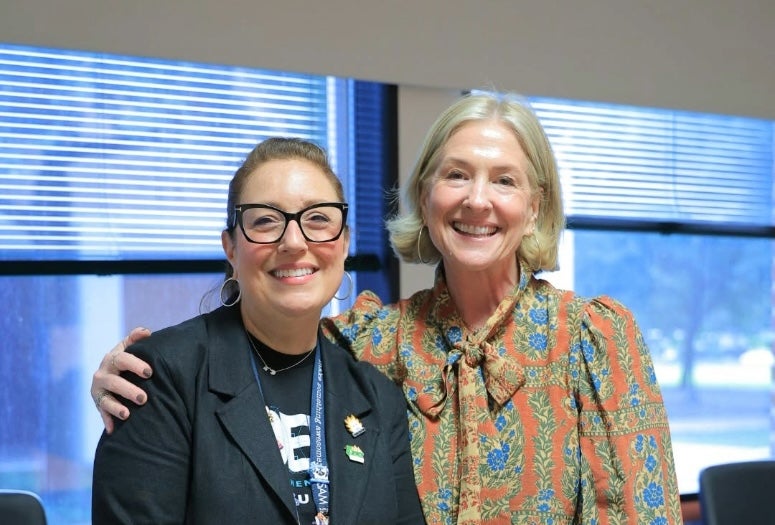
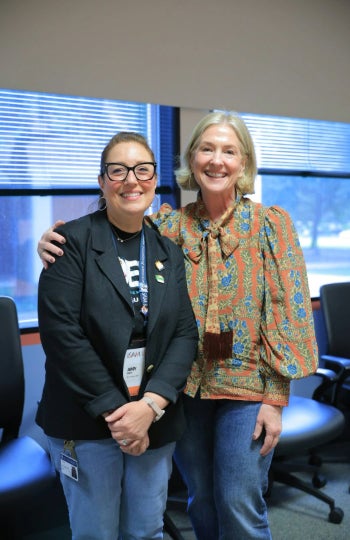
It was standing room only at Rice University’s McMurtry Auditorium as bestselling author Brené Brown challenged engineers, educators and makerspace leaders to rethink their approaches to problem-solving, failure and leadership in an increasingly complex world.
Brown was a featured speaker at the 2026 International Symposium on Academic Makerspaces (ISAM) held Oct. 11-13 at Rice. The conference brought together more than 300 faculty, staff, students, researchers and industry partners from around the world to explore how hands-on learning fosters collaboration and innovation.
In a fireside conversation with Amy Dern, executive director of Rice’s Oshman Engineering Design Kitchen (OEDK), Brown drew on decades of research into vulnerability, courage and leadership, as well as her work with executives at major organizations across the globe. She emphasized that the skills students develop in makerspaces, including navigating uncertainty, learning from setbacks, collaborating and asking difficult questions, are precisely what tomorrow’s leaders will need.
“I would say you’re probably mentoring and supporting the most important leaders that we’ll see in the next five to 10 years,” Brown told the audience, adding that while educators should continue to help students recognize the value of problem-solving, they should also help develop leadership skills along the way.
One of the most valuable leadership skills, Brown said, is identifying the right problem before rushing to solve it. Drawing on her work with executives across industries, she emphasized that effective leadership increasingly requires asking questions, challenging assumptions and navigating uncertainty rather than having all the answers.
“What you’re going to see, what I see now, is a tremendous demand ... not only for problem-solvers but problem identifiers,” Brown said. “That’s what we can’t find right now.”
For engineering students, combining technical expertise with the ability to identify underlying problems can open extraordinary leadership opportunities, Brown added.
Brown also challenged the familiar message that failure should be celebrated, arguing that it rings hollow when students face real consequences for mistakes (i.e., a failing grade). Instead, she encouraged educators to emphasize the learning, adaptation and resilience required to overcome setbacks.
“On the route to success will be many failures,” Brown said. What matters, she emphasized, is the ability to navigate those failures in terms of operational execution and leadership — whether students learn from mistakes, make corrections and maintain curiosity and collaboration.
Brown urged educators to make these lessons explicit. Rather than focusing solely on finished prototypes, they should help students recognize when they navigate conflict, seek help, support teammates or adapt to unexpected challenges — all essential leadership skills students can carry into their careers.
Brown also explored a tension in engineering: While the discipline seeks to minimize uncertainty and risk in systems, the people designing those systems must continually confront both.
“Vulnerability is uncertainty, risk and exposure,” Brown said, asking audience members to consider how frequently those conditions arise in their work.
For engineers, vulnerability does not mean compromising safety or technical rigor. Rather, it means creating environments where people feel comfortable admitting uncertainty, raising concerns and asking for help — particularly important in laboratories and makerspaces, where unreported mistakes can pose safety risks.
The conversation also explored practical leadership strategies, including project “premortems,” in which teams imagine a new project has failed and work backward to identify and address every potential problem that could have contributed to its ultimate downfall. Brown also stressed the importance of preparation, arguing that what people perceive as executive presence often reflects thorough research and an understanding of the broader context surrounding decisions.
“Never confuse executive presence with preparation,” she recalled telling a student once.
Rice President Reginald DesRoches welcomed Brown to campus, connecting her research to the values underlying engineering education. An engineer himself, DesRoches emphasized that makerspaces are a unique environment where students can learn to experiment, take risks and turn setbacks into opportunities for discovery.
“We want students to innovate, and we must create environments where it is OK to not get it right the first time, or the second time, or even the third time; where a failed prototype is not automatically viewed as a failure of the student; where students can say, ‘That didn’t work,’ and ask the question, ‘I wonder why,’” DesRoches said.
That philosophy is at the heart of Rice’s OEDK, which supports approximately 135 teams annually, giving students opportunities to collaborate across disciplines and learn through hands-on problem-solving.
The symposium offered an opportunity to share that approach with a global audience. Held in Houston for the first time, ISAM featured technical presentations, workshops, networking opportunities and keynote addresses from NASA’s Montgomery Goforth and Rice’s Maria Oden, director of the OEDK and co-director of the Rice360 Institute for Global Health Technologies.
Ultimately, the goal of the annual conference is to bring educators and makerspace leaders together to share resources, develop common approaches and expand hands-on learning across higher education. As Brown emphasized, the impact of that work extends well beyond the classroom or makerspace.
“At the core of design thinking is empathy and the ability to understand what’s on the heart and minds and in the pain of other people,” she said. “That’s what you’re building your career on — solving to make the world a better, kinder, more loving place.”