
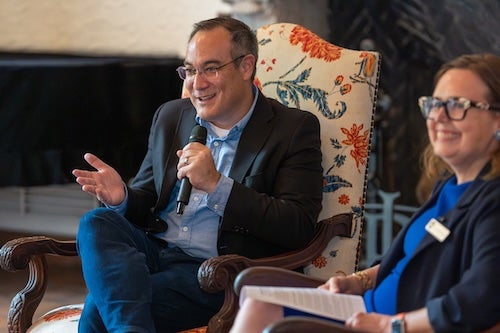
Rice University’s Boniuk Institute for the Study and Advancement of Religious Tolerance awarded its 2026 Senior Scholar Award to John Inazu, the Sally D. Danforth Distinguished Professor of Law & Religion and professor of political science at Washington University in St. Louis.
This prestigious award highlights scholars whose work has made significant and sustained contributions to the public understanding of religion and religious pluralism. “This award honors transformative voices shaping religion in public life,” said Elaine Howard Ecklund, director of the Boniuk Institute. “Inazu models principled, public scholarship on law, religion and pluralism.”
Inazu was conferred the honor after a public lecture that drew an audience of more than 50 attendees, including donors, faculty, university administrators, legal professionals and civic leaders.
Rice Provost Amy Dittmar welcomed Inazu to Rice, and Ecklund conferred the award and moderated questions after the talk.
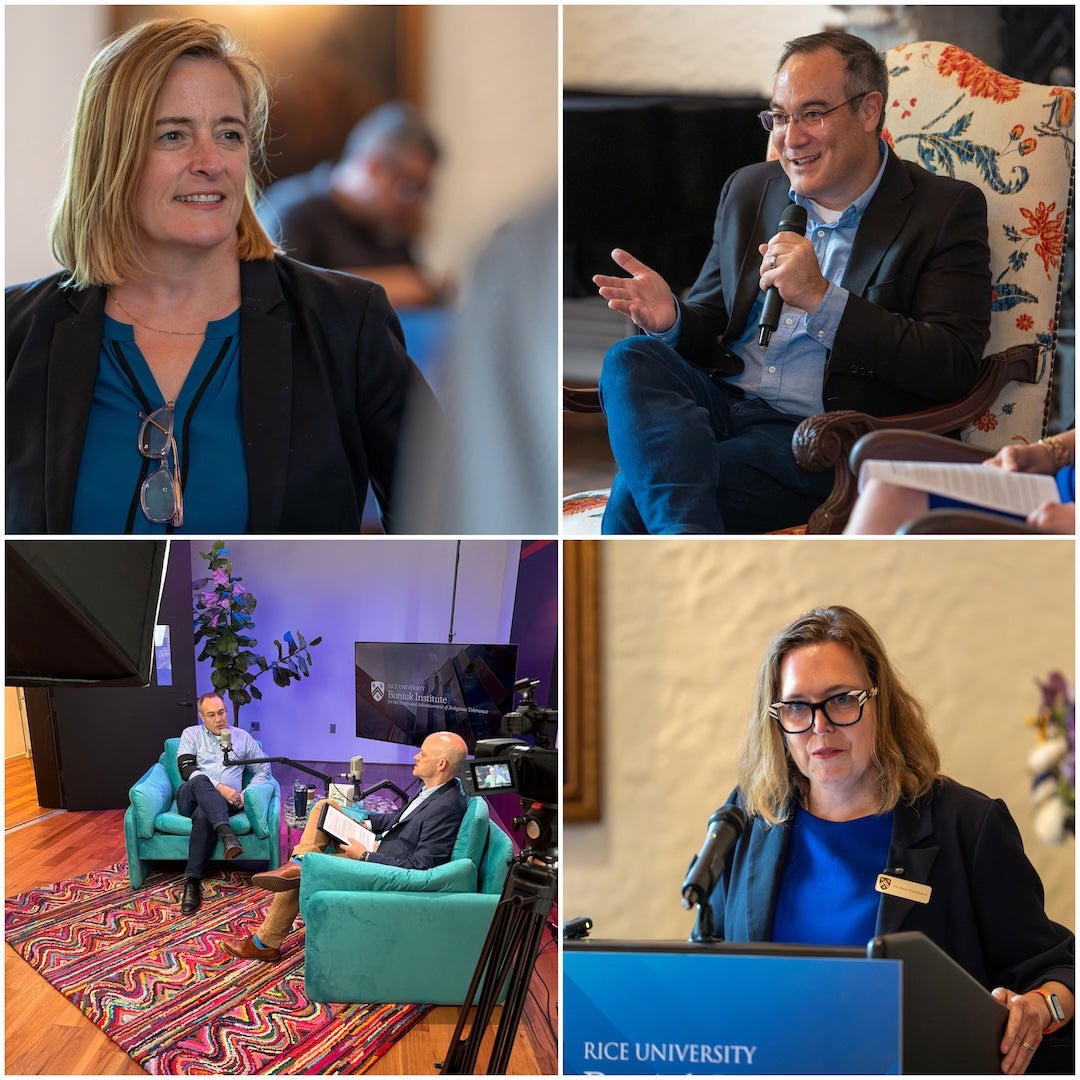
In his lecture, Inazu emphasized that “learning to disagree” is not optional but essential for civic life. He introduced the concept of “confident pluralism,” a framework that encourages individuals to remain grounded in their own beliefs while engaging openly and respectfully with others.
Central to this approach, he explained, is how we characterize those with whom we disagree.
“We must distinguish between seeing someone as wrong and seeing them as evil,” Inazu said. The former leaves room for dialogue and persuasion, while the latter often leads to exclusion or attempts at silencing.
Inazu also highlighted broader societal challenges shaping today’s discourse. While diversity is a lived reality for many Americans, particularly younger generations, trust in shared institutions has declined. This shift, he noted, has contributed to what he described as “moral polarization and epistemic fractures,” or fundamental disagreements about how we understand truth and knowledge.
Rather than avoiding these tensions, Inazu argued that they present an opportunity for growth.
“The goal is not simply to learn how to disagree but to learn through those disagreements,” he said. This includes fostering interfaith engagement rooted not in relativism but in a grounded confidence that enables meaningful exchange without the desire to control others.
He concluded by underscoring that this work requires patience and persistence.
“Learning to disagree is an ongoing practice, not a finite achievement,” he said. “It demands courage, a commitment to the long term and investment in the institutions we will rely on years from now.”
During the Q&A session, when asked how to respond when others view us as “evil,” Inazu offered a practical perspective: “Play a long and local game.”
Inazu also participated in a variety of institute and college-level activities, including the Rice Reflects series, where 15 undergraduate students, graduate students, faculty and staff convened over breakfast for a discussion on empathy, disagreement and academic life. The event was organized by the Boniuk Institute, the Office of the Provost and the Office of Access and Institutional Excellence, which also provided attendees with copies of Inazu’s latest book.
The conversation, facilitated by Alex Byrd, vice provost of access and institutional excellence, opened with a focus on empathy. It was a deliberate starting point in Inazu’s work. He explained that he structured his book around the arc of an academic year, noting that “the empathy question foregrounds so much of what [I do] in the academic setting,” where diverse perspectives and lived experiences intersect daily.
Byrd prompted further reflection by asking what makes universities uniquely suited for the work of “learning to disagree.” Inazu pointed to the sustained, intentional nature of academic engagement.
“We can spend an entire semester together discussing a book like this and building common ground,” Inazu said. “In what other place in the world is this possible? Very few places.”
Students engaged deeply with the topic, posing questions about cancel culture, interfaith dialogue and the potential limits of empathy — including whether it can, at times, be harmful.
Together, the events underscored the Boniuk Institute’s role as a space for thoughtful dialogue — one where disagreement, approached with intention and care, can become a catalyst for deeper understanding.