
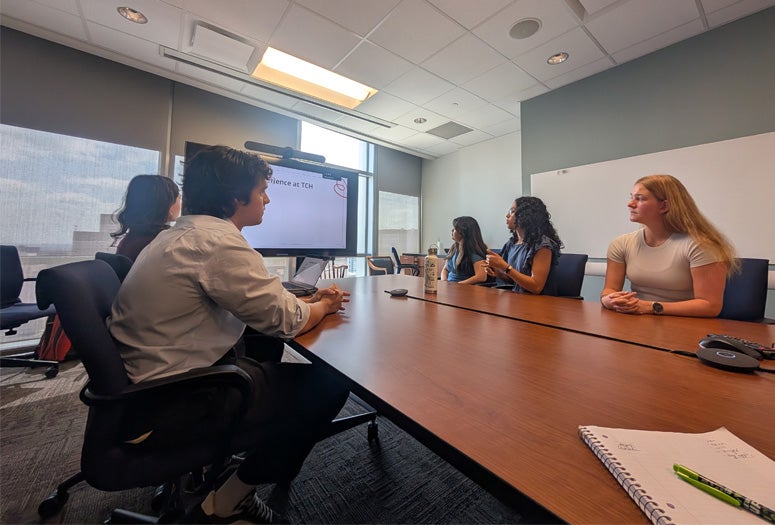
Trying to hold an ablation catheter steady against a papillary muscle inside a beating heart, one cardiologist told a group of Rice University students this summer, is like pressing against a blade of grass and expecting it not to bend away.
That image offered during rounds is now the potential seed of a senior design project. It represents one of five unmet health care needs identified by bioengineering students and seniors Christian Diaz, Giann Ruiz, Helena Song and Barbare Tetvadze and junior Daphne Mayer through the Co-Production Healthcare Innovation Program (CHIP).
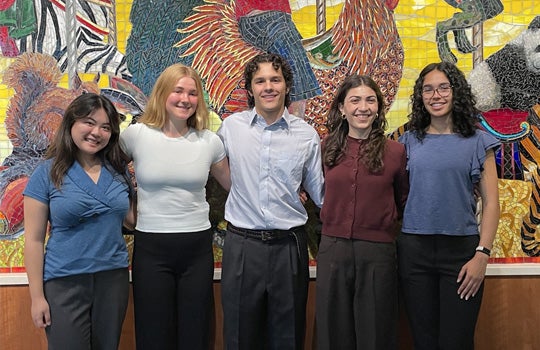
The eight-week clinical immersion program held in June and July at Texas Children’s Hospital and the Texas Heart Institute teaches students to identify and rigorously investigate health care needs before beginning to design solutions.
Supported by a National Institutes of Health grant, CHIP is coordinated by Rice’s Department of Bioengineering and Medical Humanities Research Institute (MHRI). Its needs-finding approach integrates engineering and clinical perspectives with attention to how patients, caregivers and health professionals experience care. Through faculty instruction, guided reflection and direct observation, students considered not only whether a problem could be addressed technically but also whom it affects, how it is shaped by its clinical and social context and whether a potential innovation could be implemented equitably.
The students initially documented 41 possible needs. They then investigated and screened them against criteria reflecting the program’s mission before selecting five to offer to senior design teams in Rice’s bioengineering capstone program.
“We were looking for projects that could be completed within a nine-month timeline using the resources available at Rice while still being complex enough to keep a team of engineering seniors engaged and that would have a measurable impact on patient outcomes while addressing a disparity in an underserved population,” Song said.
The students spent three weeks rotating through the transitional, cardiac, neuro and surgical ICUs at Texas Children’s and three weeks observing the catheterization lab and clinic at Texas Heart Institute. Daily observations were paired with physician Q&A sessions, interviews with nurses and medical device specialists and structured group reflections. Those conversations frequently complicated the students’ initial assumptions and helped them determine which problems warranted further investigation.
“We got so many different perspectives about the problems we were seeing,” Ruiz said. “Some people would say this may not be a problem for them, but it is for others. That helped us gauge the root of the issues and who is most affected.”
A storyboarding method introduced by MHRI director Kirsten Ostherr asked the students to map each interaction with a device frame by frame from both the patient and health care professionals’ perspectives.
“Because we had to detail every step along the way, we got a very clear picture of the gaps in our understanding, and we were able to use those as a jumping-off point for further research, whether through interviews or the literature,” Diaz said.
Ostherr encouraged the students to keep the method in their tool kit beyond the summer.
“That’s exactly the purpose of using this kind of technique,” Ostherr said to the students after a presentation of their findings. “I would encourage all of you as you go forward to come back to it periodically, so you get those nudges about having to get granular about what you do know and what you don’t know.”
Five needs across two clinical settings
At Texas Children’s, the students observed that pressure measurements can become inaccurate when a patient changes position, requiring nurses to manually relevel the transducers. The repeated task can add to clinicians’ workload, particularly in settings with limited staffing or less advanced monitoring equipment.
“Nurses are understaffed and may not have time to level each patient,” Mayer said. “Lower-resource hospitals also use water manometers rather than electronic transducers, so the technology is not as advanced.”
The students also identified a need for more effective preparation and ongoing support for families caring for children with gastrostomy or other surgically placed feeding tubes at home. Feeding-tube complications can lead to emergency department visits, some of which may be preventable through improved caregiver education, troubleshooting resources and access to timely support.
A third need concerns continuous renal replacement therapy for critically ill children weighing approximately 10 to 20 kilograms. These patients fall between the intended weight ranges of currently available pediatric and conventional systems, requiring clinicians to adapt equipment that was not designed specifically for this group. The limitations may be particularly consequential in hospitals with fewer pediatric specialists and technical resources.
“I remember the first day of our program, Dr. Abidi said that, ‘As you observe, you might find one need that feels like your baby, one you want to push through and carry with you the whole time,’” Tetvadze said. “I didn’t realize I would have something like that, but I feel so attached to this need.”
At the Texas Heart Institute, students identified the challenge of maintaining stable catheter contact with the papillary muscle during cardiac ablation. They also investigated microbubble formation in catheter sheaths, which may contribute to cerebral microembolization during some ablation procedures.
For the program’s clinical mentors, including Dr. Satid Thammasitboon, Dr. Khayri Shalhoub and Dr. Natasha Afonso at Texas Children’s and Dr. Mehdi Razavi at the Texas Heart Institute, the cohort’s insistence on validating problems before proposing technologies addresses a persistent failure mode in health care innovation.
“In health care, we have some tendency to try to solve the wrong problem,” Thammasitboon said. “Hearing the future generation trying to find the right problem is very, very promising.”
Sabia Abidi, associate teaching professor of bioengineering and director of Bioengineering Undergraduate Studies, concluded the students’ final presentation by emphasizing that the program’s value lay not only in the five needs identified but also in how the students learned to work together and engage with clinical stakeholders.
“Every student cohort is special for us, but among the beautiful qualities I saw this summer were your self-sufficiency and your ability to work together as a team,” Abidi said to the group. “It’s hard to work with others and with stakeholders and to do it in a kind and helpful way. You have really raised the bar for the next cohort.”
Senior design teams will begin evaluating the five needs this fall, carrying the students’ bedside observations into the next phase of engineering investigation and development.