
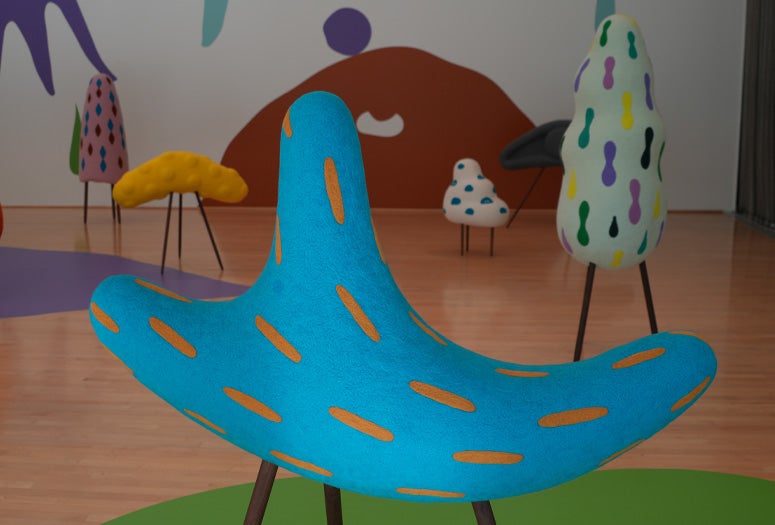
Walk into the Moody Center for the Arts’ central gallery this summer and you may find yourself unsure of who — or what — is watching you.
“Masako Miki: Shapeshifters, Sprites and Spirits,” the Japanese-born artist’s first solo exhibition in Texas, transforms the gallery into a landscape of supernatural beings drawn from Japanese folklore. The sculptures, which are roughly human scale, felted in vivid wool and grouped in ways that feel, as associate curator Claudia Mattos puts it, “almost conspiratorial,” do not simply occupy the room. They inhabit it.
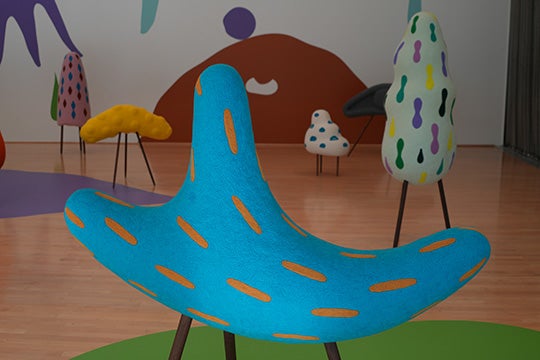
“The sculptures stand among visitors,” Mattos said. “Who is the sculpture? Who is the visitor?”
The exhibition draws on yōkai, a sprawling category of supernatural entities in Japanese tradition that encompasses everything from demons and guardian spirits to magical animals and enchanted household objects. Central to Miki’s practice is the Shinto concept of animism, the belief that all things carry a spirit or life force. An umbrella. A tree. A cloud. In Miki’s universe, each one is brimming with presence.
The work is also rooted in a folkloric legend from medieval Japan: “Night Parade of 100 Demons,” in which discarded household objects spring to life after being cast aside, parading through town to confront those who deemed them worthless.
“It’s a story about beings recognizing their value and asserting it,” Mattos said.
That tension between being seen and being overlooked, between belonging and displacement, gives the exhibition its contemporary charge. The “Night Parade” story at its core is about objects asserting their personhood after being discarded, and Miki does not let that metaphor stay safely in the past.
Her sculptures bring those questions into a present shaped by rapid cultural change, asking visitors to consider what it means to recognize the value of others, particularly those who are different from themselves.
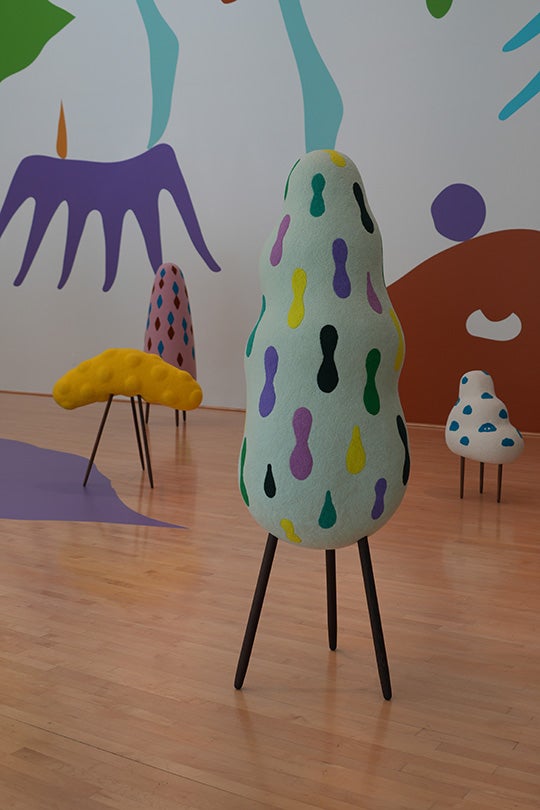
“The ambiguity is my intention,” Miki said. “I want people to start reading and figuring out and possibly make their own folklore and their own characters. I’m hoping this becomes an entry point, the first invitation for them to think about these stories, which I believe become the social narrative in the end.”
That invitation extends to the making of the work itself. Miki constructs her sculptures from wooden armatures covered in foam, then hand-felts wool over the surface in a process Mattos describes as meticulous and deeply laborious. The result is a tactile, almost creaturelike texture that rewards close looking. Every Saturday in June, the Moody’s Art Lab will offer public workshops where visitors can try the same needle-felting technique, producing their own small charms in the artist’s style.
Grounded in interdisciplinary research, the exhibition echoes Rice University’s focus on scholarship that has a real-world impact. While Miki’s resources range from Japanese cultural traditions to 20th-century art movements, including surrealism and manga, the questions they raise about multiculturalism and identity have urgency and poignant relevance in a city as diverse as Houston.
“She’s finding ways to explore her subjects by bringing together a very broad range of references and disciplines,” Mattos said. “I think that can be very appealing to our Rice audience, given the interdisciplinary nature of academic life here.”
The exhibition is curated by Mattos alongside Alison Weaver, the former Suzanne Deal Booth Executive Director, and is supported by the city of Houston through the Houston Arts Alliance along with several endowment funds. On view through Aug. 15, you can learn more about “Masako Miki: Shapeshifters, Sprites and Spirits” on the Moody’s website.