
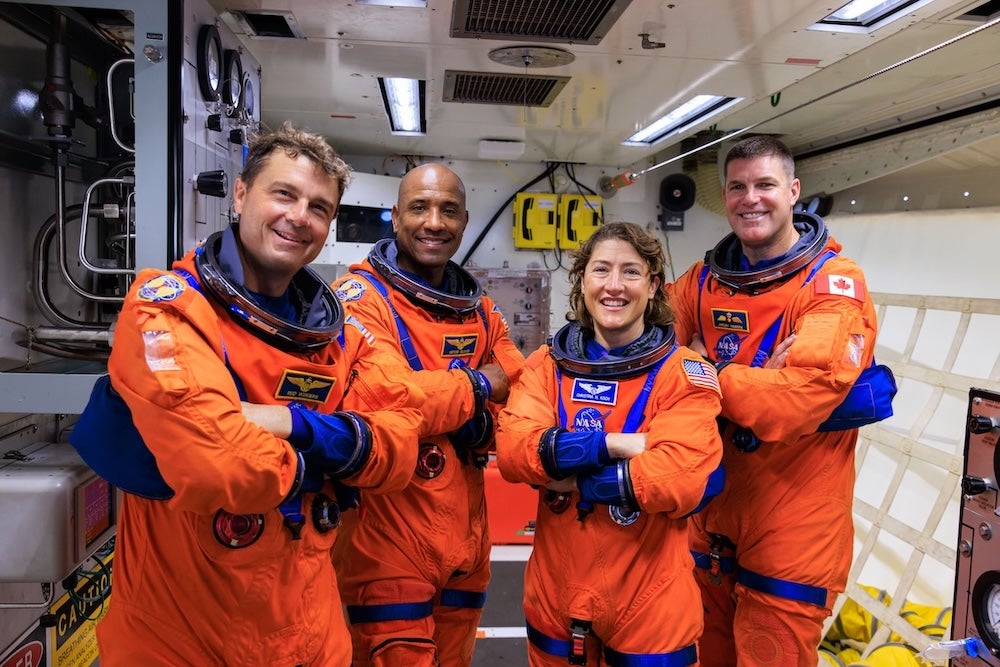
As NASA’s Artemis II astronauts return to Earth after a historic 10-day journey around the moon, attention is turning to what comes next. Experts from Rice University are available to provide insights into the scientific, human, technological and policy implications of this milestone achievement.
Space weather, solar risks and mission safety
Patricia Reiff, professor of physics and astronomy and associate director of outreach programs at the Rice Space Institute
Reiff brings decades of experience from various NASA missions, including Apollo, IMAGE, Cluster and MMS, and her expertise is crucial as Artemis missions venture deeper into space during periods of solar maximum. She addresses:
- The risks posed by solar flares, radiation storms and cosmic rays during deep space missions.
- Insights on predicting space weather to protect astronauts and spacecraft.
- How real-time solar wind monitoring can enhance mission safety.
- The potential impact of increased solar activity on upcoming Artemis missions and lunar operations.
Human biology, psychology and living beyond Earth
Scott Solomon, evolutionary biologist, teaching professor of biosciences and author of “Becoming Martian: How Living in Space Will Change Our Bodies and Minds”
Solomon highlights that while Artemis II advances spacecraft testing, many unknowns remain regarding human biology beyond low Earth orbit, including on the moon and Mars, such as:
- The differences between low Earth orbit and deep space environments (radiation, gravity).
- The challenges of living on the moon (with one-sixth of Earth’s gravity) and Mars (with one-third of Earth’s gravity).
- Issues related to food production, radiation exposure and psychological strain.
- Long-term implications, including human reproduction in space and potential evolutionary changes.
Solar science, space exploration and Houston’s role
David Alexander, professor of physics and astronomy, director of the Rice Space Institute and executive committee member of the Texas Aerospace Research and Space Economy Consortium
– Note: David Alexander has limited availability the week of April 13 –
Alexander connects Artemis II to broader scientific and regional developments, including:
- How solar activity influences mission planning and astronaut safety.
- Future developments in space exploration infrastructure, highlighting Houston’s growing role.
- Insights into how Artemis contributes to long-term exploration goals.
Astronaut health, performance and recovery
John DeWitt, director of applied sports science
A former NASA scientist conducting ongoing research aboard the International Space Station, DeWitt specializes in how the human body performs before, during and after missions. His focus includes:
- Muscle and bone loss in reduced gravity environments.
- Astronaut training for long-duration missions, particularly those aimed at Mars.
- Strategies for maintaining astronaut health during extended lunar and deep space missions.
- Astronaut reconditioning when they arrive back to Earth or in a gravity environment such as the moon or Mars.
- Risks and countermeasures to reduce physiological losses during spaceflight.
Moon-to-Mars science and exploration strategy
Kirsten Siebach, assistant professor of Earth, environmental and planetary sciences
Siebach emphasizes the unique value of human exploration in conjunction with robotic missions. Key points include:
- How astronaut observations enhance robotic spacecraft data.
- The role of robotic exploration on Mars in informing future human mission planning.
- The scientific benefits of having humans present, including real-time observation and decision-making.
- Science objectives for human observations on Mars.
Space policy, strategy and global leadership
Kenny Evans, fellow in science, technology and innovation policy at Rice’s Baker Institute for Public Policy
Evans discusses the broader geopolitical and policy frameworks surrounding Artemis II, including:
- How Artemis shapes U.S. leadership in space exploration.
- The role of science policy in long-term planning for the moon and Mars.
- Issues relating to research security and international collaboration in space programs.
Artificial intelligence and future space operations
Sanjoy Paul, executive director of Rice Nexus, co-chair of the Rice AI Venture Accelerator (RAVA) and co-founder of the nonprofit Houston AI
Paul highlights the importance of AI in the next phase of exploration. Key points include:
- AI applications in spacecraft operations and astronaut health monitoring.
- Cybersecurity challenges related to in-space computing systems.
- The role of AI-driven innovation and space startups in future missions.
To schedule an interview with any of Rice’s experts, contact media relations specialists Marcy de Luna at marcy.deluna@rice.edu and Rachel Leeson at rachel.leeson@rice.edu.