
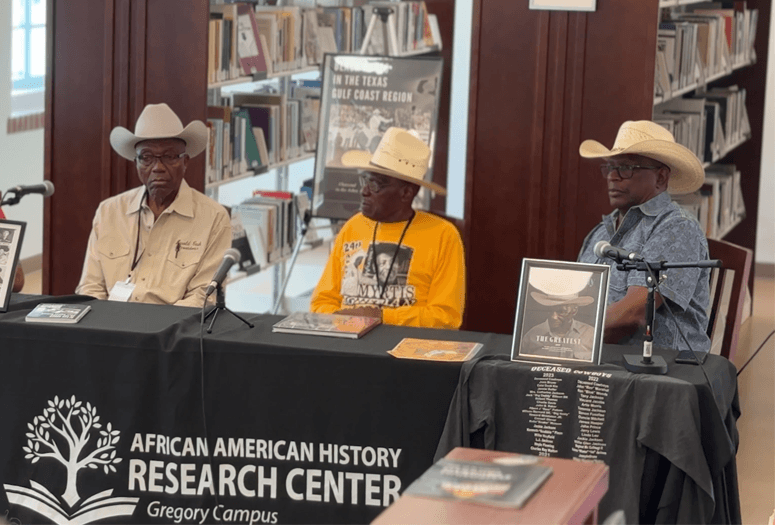
The stories didn’t begin in a lecture hall. They began in rodeo arenas, in small towns and massive stadiums, in front of crowds that could turn in an instant. At the Black Houston(s) Symposium, those stories returned to the room carried by the people who lived them.
Four Black rodeo cowboys — Myrtis Dightman, Harold Cash, Freddie “Skeet” Gordon and James Boone — sat together and spoke plainly about what it meant to compete. Not just the spectacle but the stakes. Not just the wins but the conditions that shaped them.
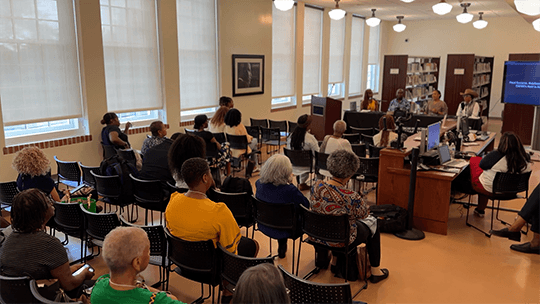
“They were talking about the experiences of going to these little tiny towns and performing for sometimes segregated audiences, sometimes audiences that were hostile to them,” said university historian Portia Hopkins, who brainstormed what became Black Houston(s) during her time as a postdoctoral researcher at Rice.
Dightman, often described as the “Jackie Robinson of rodeo,” reflected on breaking barriers in the 1960s as the first Black cowboy to qualify for the National Finals Rodeo. Others described careers that moved through Texas and beyond, across circuits that could shift from welcoming to openly hostile without warning.
“It was really like man against beast,” Hopkins said. “And so people were really there to just see, ‘Can this guy even do it?’”
What emerged was not a clean narrative of progress or adversity but something harder to resolve. The cowboys spoke about danger and dignity in the same breath. About navigating segregation while also forming genuine bonds.
“There’s this misconception that all of the experiences were negative,” Hopkins said. “But they shared that actually some of the best experiences they had were with their roping partner, with the [white] cowboys that they trained with.”
By the end of the panel, the conversation had shifted. Sports were no longer just performance or competition. They became a way of understanding contradiction, where risk and belonging can exist at the same time.
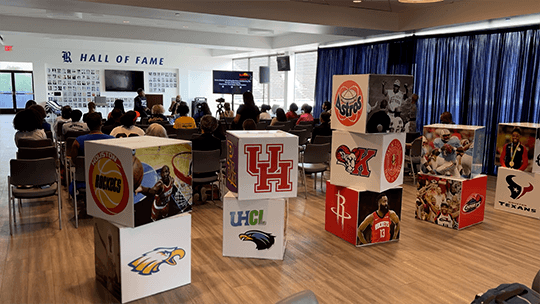
That layered perspective carried through the symposium itself, which unfolded across two days and two distinct spaces. The opening sessions took place at the African American History Research Center at the Gregory School, grounding the event in Houston’s Fourth Ward. The following day moved to Rice Stadium’s R Room, where the football field stretched out below the discussions.
“One of the reasons that we have this symposium in the community is because we want the community to feel like they’re also part of Rice,” Hopkins said.
The structure creates movement not just across locations but across perspectives. Conversations that begin in lived experience carry into institutional spaces, where they are expanded rather than abstracted.
“Working on the executive committee for Black Houston(s) has been the most fulfilling part of my time at Rice,” said Rose Oyoo, a senior majoring in psychology. “Being able to see the real life connections that happen each year and facilitating the bridge between academia and community is the highlight of my time as an organizer.”
“Black Houston(s) is one of the primary occasions where we are in direct conversation with people across the city who have boots on the ground doing the work we study,” said Hassan Henderson-Lott, a doctoral student in religion and a member of the symposium’s executive committee. “They are scholars and artists, scholars and athletes, scholars and community leaders, scholars and activists.”
Across the program, those conversations moved without rigid boundaries. Panels explored how food systems influenced athletic performance, how coaching could reshape classroom teaching and how mentorship travels across disciplines.
“As a fan and as someone who both played and worked in sports, this year’s theme, A League of Our Own: Sports and Embodiment, was super special to me,” said Erika Thompson, associate director of the Center for African and African American Studies (CAAAS), who also worked with Black Houston(s) in her previous role at the African American History Research Center. “I was so eager to see what the call for papers would yield, and the submissions did not disappoint. But what I love most about Black Houston(s) is seeing the array of community members, students, faculty and staff come together to share and learn from one another. It’s a magical time, one I look forward to every year.”
Educators examined how coaching philosophies might translate into academic environments, reframing authority as guidance and instruction as relationship building. Keynote speaker Damion Thomas of the Smithsonian Institution’s National Museum of African American History and Culture tackled how sports can level the playing field.
“What that requires is not only expanding people’s capacity to think but also their capacity to feel,” Henderson-Lott said. “They’re dancing, they’re moving, they’re singing, they’re praying.”
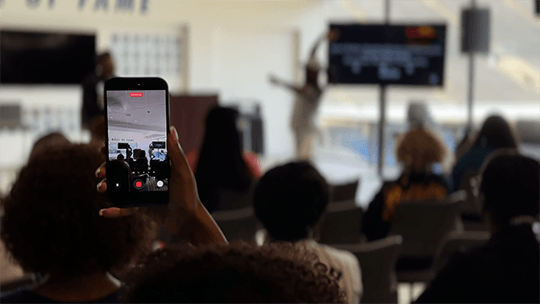
That emphasis on feeling took physical form throughout the symposium. A dance performance reimagined athletic movement as storytelling, using the full space of the room to draw the audience in.
“The dancers, the way that they were able to perform in this space, the manner in which they were able to think about ‘How do I use this entire space to really bring people in?’” Hopkins said. “Those are the types of things that we love to hear about.”
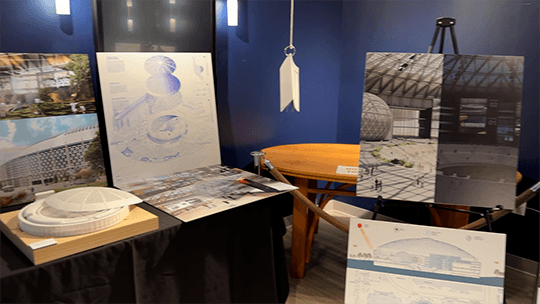
In the exhibit hall, students presented architectural models and archival materials exploring the Houston Astrodome, connecting past and present for audiences who may never have experienced it firsthand.
The symposium has grown steadily since its start in 2023, expanding its reach while deepening its institutional and community ties. Hopkins’ earlier work with the Gregory School, Fondren Library and the Center for Engaged Research and Collaborative Learning (CERCL) helped lay the groundwork for those partnerships, which continue to inform the symposium’s structure and direction along with CAAAS.
“It was only natural for CERCL to become a founding partner of the Black Houston(s) Symposium,” said Maya Reine, CERCL’s associate director. “We’ve long shared a mission to bring Rice outside the hedges and make Rice an inviting place for the community with the Black Houston(s) partner organizations. Working with the Black Houston(s) executive committee on behalf of CERCL has been a high point in my almost 20 years at Rice.”
The Center for Environmental Studies and Rice Athletics joined as Black Houston(s) co-sponsors in 2026.
“This conference could never be put together without the help of all of the community members and all of the community partners,” Hopkins said. “We were just so excited to be able to integrate athletics into this conversation, to think about wellness.”
By the time the final conversations wrapped, what lingered was not a single takeaway but a sense of return. The stories that began in arenas and on fields had come back into focus, reframed but not removed from their origins.