
Special to Rice News
By Lauren Kapcha
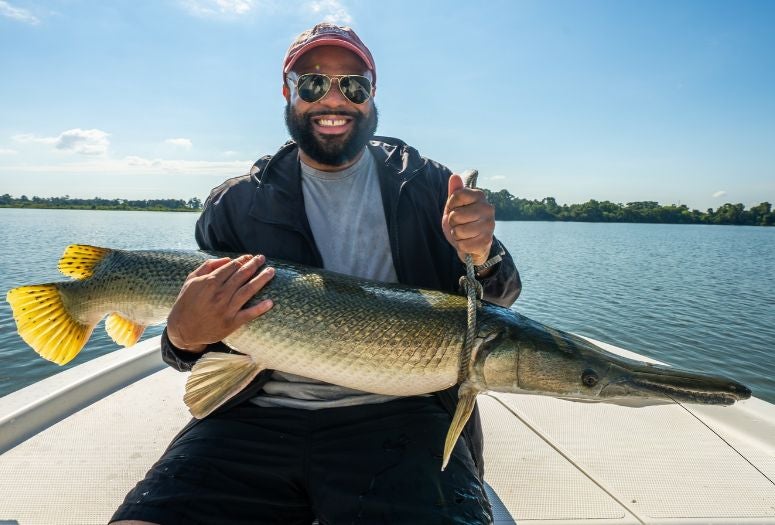
A few dozen miles from the Gulf of Mexico, in a river winding through the Houston area, a fish with a lineage stretching back tens of millions of years was waiting beneath the surface. When it took the bait, Rice University researchers got the chance to bring the specimen back to the lab.
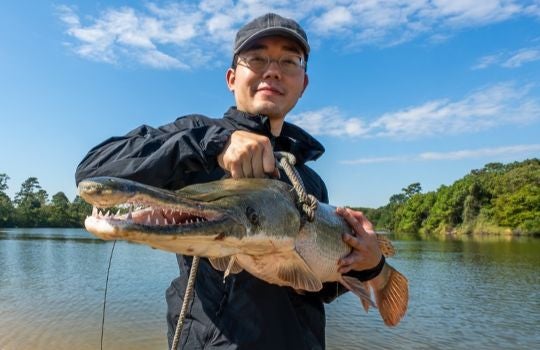
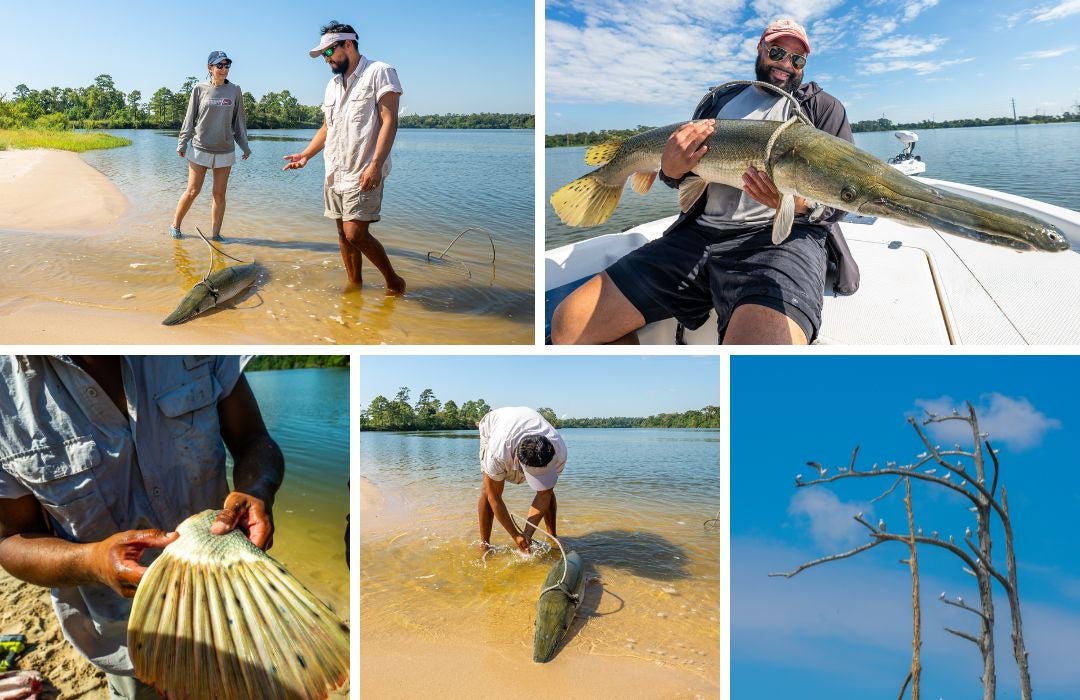
The setting was the San Jacinto River, a short drive from Rice’s campus. On a sunny October morning, Assistant Professor of Biosciences Kory Evans and members of his research group joined fishing guide Alex Sosa of Buffalo Bayou Fishing Champs to pursue one of Texas’s most distinctive freshwater fish: the alligator gar.
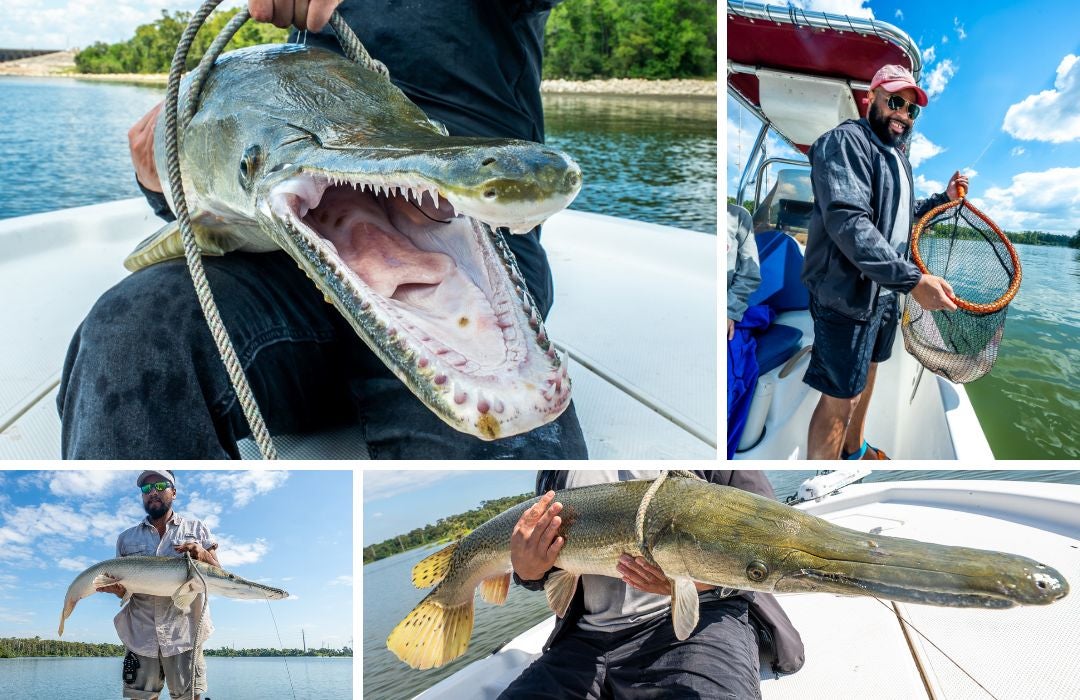
With its long snout, sharp teeth and armor-like scales, the alligator gar looks like something out of another era. Its ancient lineage also makes it a compelling subject for Evans, whose research explores how fish skulls have evolved over time and how those shapes dictate how fish feed.
“We caught two really big, amazing alligator gar and a smaller beautiful spotted gar,” Evans said after the trip. “This trip couldn’t have gone any better.”
A fish with a long history
Gar spend much of their time waiting for prey, hovering in place until something comes within striking distance.
“At the end of the day, they’re ambush predators,” Evans said. “So most of the time they spend it just parked and chilling until it’s time to hunt.”
Their long snouts and tooth-lined jaws are well suited to that strategy, and they offer researchers clues about the evolution of how fish eat.
To put that history into perspective, Evans pointed to an alligator gar fossil at the Houston Museum of Natural Science, estimated to be about 40 million years old. Its skeletal structure looks remarkably similar to the fish pulled from the San Jacinto River.
“Gar have been on this planet for over 100 million years,” Evans said. “That means that gar were swimming in the same waters, oceans, seas and riverbeds as dinosaurs.”
While gar are often labeled “living fossils,” they haven’t stopped evolving. Rather, living gar retain features that also appear in their fossil relatives, offering researchers a valuable way to investigate how fish anatomy has changed over time.
What a skull can tell us
Gar feed differently from many modern fish. They snap their elongated jaws shut on prey, while fish such as largemouth bass use suction to draw food into their mouths. Evans wants to understand how these different feeding mechanisms evolved.
“One of the major ideas that we’re trying to understand is how feeding underwater evolved in fishes in general,” he said.
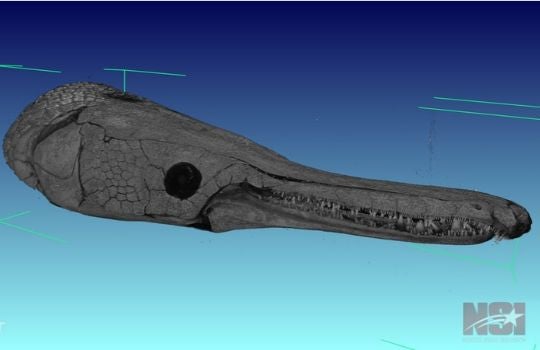
Gar belong to an early-branching lineage of living fishes, making them a useful point of comparison with other groups. By studying their skulls alongside those of more modern fish, researchers can investigate how anatomical structures and feeding strategies have changed over evolutionary time.
“The way we study that is to collect high-resolution three-dimensional data about the gar skeleton using a micro-CT scanner,” Evans said. “We’ll scan the gar and take a look at all the bones.”
The scans let researchers examine individual bones and investigate how they fit together and move during feeding. They can then model how skull structures change during feeding and compare them across species to study evolutionary changes spanning millions of years.
The group also analyzes the chemical composition of fish scales to investigate diet, comparing information from living fish with evidence preserved in the fossil record. Together, these approaches help researchers explore how fish anatomy and ecology have changed through time.
From the river to the lab
Collecting a specimen starts with getting a fish to take the bait and then bringing it aboard. Once an alligator gar was hooked, landing it was a challenge. Its tough mouth can make securing a hook difficult, and a large fish can put up a substantial fight.
Sosa helped the researchers bring the gar alongside the boat and secure it. One large alligator gar was collected for research, while other fish were released.
For Sosa, the appeal of gar fishing lies in the animals themselves.
“Every single one is very unique, from their head shapes and their teeth to their markings and their spots,” he said. “And they’re giant. When you finally land one that’s really, really big — that’s bigger than you — it’s very rewarding.”
For the researchers, the catch was the beginning of a longer process. By comparing this new specimen with existing natural history collections across Texas, the team can map broader patterns in fish skull evolution. It’s a reminder that answering fundamental questions about life’s ancient history can begin with an alligator gar pulled right out of Rice’s backyard.