
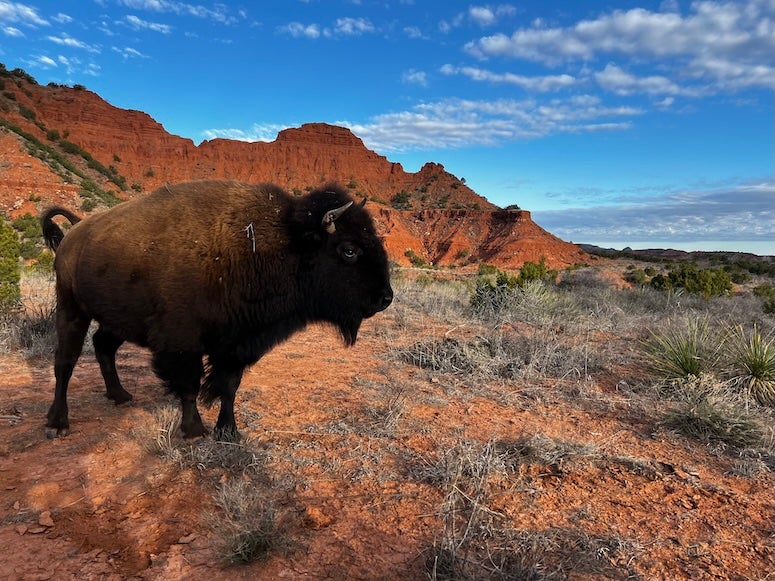
For decades, archaeologists questioned whether Native American communities in the Southern Plains hunted bison by driving herds over cliffs, a sophisticated technique widely documented farther north.
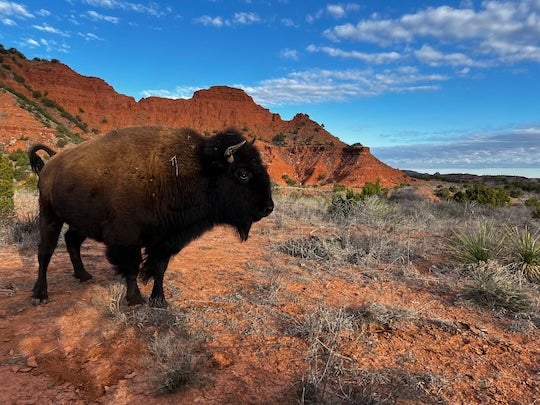
Now, new research led by Rice University is challenging that assumption.
At a site in the Texas Panhandle, researchers have uncovered evidence that Indigenous hunters repeatedly used a cliff to harvest bison over a period spanning 3,000 years. The discovery marks only the second scientifically verified bison jump in Texas and offers new insight into the ingenuity, cooperation and hunting traditions of ancient communities.
The findings, published in the journal American Antiquity, were led by August “Gus” Costa, adjunct lecturer of anthropology at Rice.
Located in Caprock Canyons State Park, the Nighthawk site provides evidence that ancient communities in the region practiced a hunting technique once thought to be largely confined to the northern Great Plains.
Bison jumping involved maneuvering herds toward cliffs, where the animals would fall to their deaths or become incapacitated. Unlike smaller hunting expeditions, these large-scale operations required extensive planning and cooperation among multiple groups of people.
“Bison jumping is exciting because it’s a community activity,” Costa said. “Large scale bison harvests (like jumps) are exciting because they require a large group of people working together to be successful.”
Hunters likely worked in specialized teams. Some located herds and guided them toward grazing areas near the cliffs, while others emerged from hiding to direct the animals toward the drop. Additional groups dispatched injured bison and processed the meat, hides and other materials.
Costa said these hunts likely served a larger social purpose, bringing communities together for ceremonies, trade, celebrations and strengthening relationships.
A hunting ground used for thousands of years
Researchers initially believed the Nighthawk site contained evidence of at least two hunting events based on the stone spear and arrow points discovered there. But further investigation revealed a much longer and more complex history.
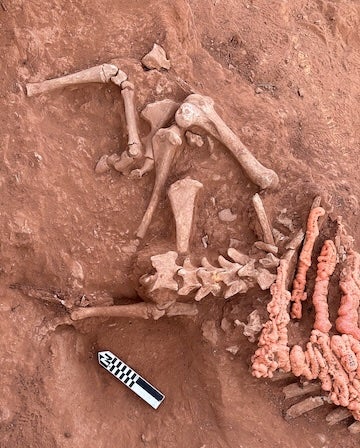
Using radiocarbon dating of bison bones, researchers identified evidence of at least seven separate hunting events spanning approximately 3,000 years. The findings suggest generations of hunters returned to the same location despite significant cultural and environmental changes.
Those changes included the transition from stone-tipped spears to bows and arrows, the introduction of pottery and shifts in the surrounding landscape.
Erosion dramatically altered the site over time, moving the cliff’s jump-off point approximately the length of a football field. Yet hunters continued returning.
“Returning to the same place over and over again over 3,000 years shows that people had a significant connection to the Nighthawk hunting facility,” Costa said.
The discovery also raises questions about how hunters adapted their techniques. Unlike many northern Plains bison jumps where the terrain may have concealed the cliff edge, Nighthawk sits on a projecting cliff where the animals likely could see the danger ahead.
“We don’t know exactly how they managed herding the bison, but the setting is different from the typical northern Plains jump,” Costa said.
Rethinking ancient life in Texas
For decades, the scarcity of documented bison jumps in the Southern Plains led some archaeologists to question whether the region’s inhabitants used cliffs for large-scale hunting.
Before the Nighthawk discovery, Bonfire Shelter, identified more than 60 years ago, was the only scientifically verified bison jump in Texas.
Costa and his colleagues have identified eight additional potential bison jump sites in and around Caprock Canyons, suggesting the practice may have been more widespread than previously recognized.
Some sites may have gone unnoticed because they are located on steep slopes beneath cliffs, places archaeologists don’t typically investigate because they would not have been suitable for camping. Instead, researchers have traditionally focused on areas where people lived and left behind tools and other evidence of daily life. Erosion and limited access to private property have also complicated efforts to identify additional locations.
“The jump was hidden in plain sight,” Costa said.
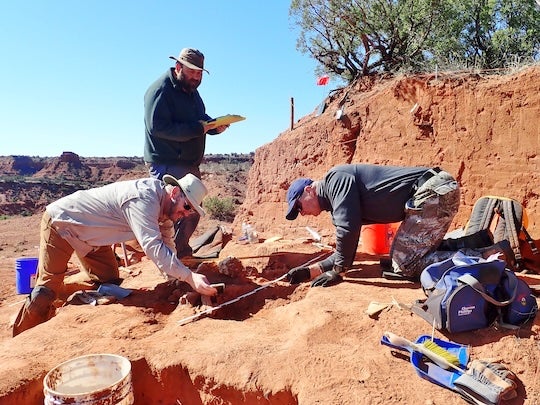
With fieldwork at Nighthawk complete, Costa and his colleagues are turning their attention to identifying additional bison jump sites across the Southern Plains. They’re also analyzing ancient bison DNA and the chemistry of bones and teeth to better understand how herds migrated, what their environment was like and how they may be connected to bison living in Caprock Canyons State Park today.
But for Costa, the discovery is about more than documenting an ancient hunting technique. It’s also about challenging assumptions about the knowledge and capabilities of Indigenous communities in the Southern Plains.
“For a long time when it comes to Indigenous bison hunting culture, the Southern Plains hasn’t received much respect, at least when compared to the north,” Costa said.
He explained that the archaeological record doesn’t always fully reflect what ancient societies were capable of accomplishing. The absence of surviving evidence can sometimes lead to assumptions about what people did or did not know how to do.
“It’s about respect,” Costa said. “Bison jumping is a complicated community effort, and getting that incorporated into the story of Southern Plains people is important.”
The research was supported by funding from the Summerlee Foundation and Texas Parks and Wildlife.