
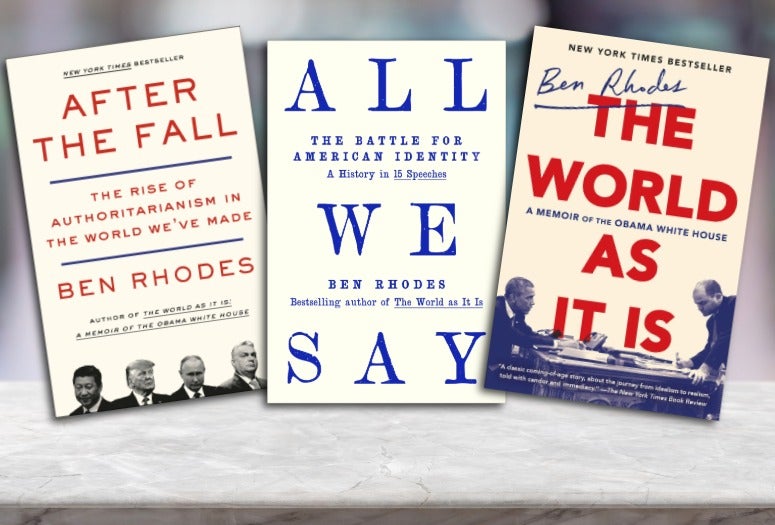
Before you could answer anyone in a Seneca council, you first had to repeat everything they had just said. The rule governed the councils of Red Jacket’s day, says Rice University alumnus Ben Rhodes ’00. Red Jacket’s 1805 reply to a Christian missionary at Buffalo Creek, New York, is the second speech in Rhodes’ new book “All We Say: The Battle for American Identity: A History in 15 Speeches.”
“Having to repeat the other side forced you to take seriously the arguments of the people who disagreed with you, which fostered pluralism,” Rhodes said. “It also made you more persuasive because if you truly inhabit the argument of the people you’re trying to persuade, you’re better able to persuade them. The echoes today are obvious. We don’t listen and we don’t persuade. We just reinforce our own beliefs or attack the people we disagree with.”
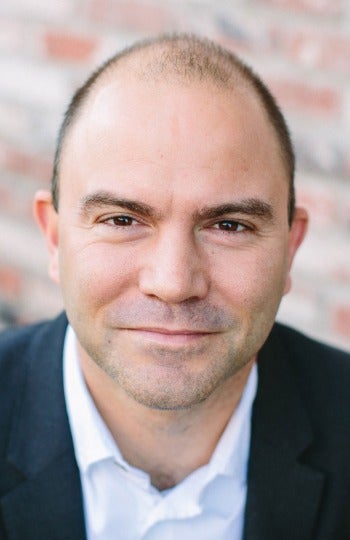
Rhodes spent eight years as a speechwriter and deputy national security adviser to former President Barack Obama. He will return to Rice Nov. 17-18 to deliver the fall Campbell Lectures, the annual series hosted by the School of Humanities and Arts. The first night looks back at the speeches that have shaped the argument over American identity. The second looks ahead to a world being reshaped by artificial intelligence and authoritarianism. Both draw on habits of mind Rhodes began building as a student.
Rhodes double-majored in English and political science at Rice, a pairing he said taught him both storytelling and how systems work. Over the years, he has taken grief for bringing a fiction writer’s background into political speechwriting. His answer traces back to two of his English professors: Max Apple, whose creative writing class Rhodes took four times, and Terrence Doody, now professor emeritus of English.
“Both of them pushed me past the cleanest, most polished version of an idea,” Rhodes said. “They wanted to know what I actually thought, why I thought it and how I could communicate it authentically. That has been the most important and lasting lesson I learned. Plenty of people can write something articulate. Writing is far more powerful when it sounds like it could only have come from you.”
Rhodes applied that test to himself when he turned to American history, choosing speeches as the lens a speechwriter could credibly bring. “All We Say,” published in May by Random House, runs from Benjamin Franklin to Donald Trump. One chapter finds Frederick Douglass in Boston in 1869 at the height of his influence. Congress had just passed constitutional amendments extending rights to Black Americans, and Douglass used his platform to defend Chinese immigrants facing fierce prejudice. Rhodes calls the speech the most powerful vision of genuine multiracial democracy he has ever seen.
“You could argue Douglass lost the argument because not long afterward, the United States banned Chinese immigration for decades,” Rhodes said. “But look around. America today looks a lot more like Douglass’ speech. We tend to fixate on elections and immediate political outcomes, but one of the roles of a speech is to build movements and seed ideas, even when that takes a long time.”
Rhodes’ Nov. 18 lecture grows out of his earlier book “After the Fall,” for which he traveled to dozens of countries to understand the rise of authoritarianism around the world. One of the most acute forces he found at work, he said, was social media.
“Social media platforms that people originally saw as connectors and vehicles for expression became the perfect tools for surveillance on one hand and disinformation and propaganda on the other,” Rhodes said. “I don’t think the tech companies set out to build the perfect tools for autocrats, but they did. Something on an even more alarming scale could happen with AI. If you vacuum up all the data in the world, no human being could review it. AI can.”
The stakes reach past politics, Rhodes said. AI calls into question a basic bargain: Get an education, find a vocation and do meaningful work that supports you and your family. He already senses unease among college graduates. Around the world, he hears a broader version of the worry, a feeling that huge forces are shaping people’s lives while they have no voice in them.
“I hope people leave [the Campbell Lectures] understanding that they have more agency than they think,” Rhodes said. “There’s no reason we can’t decide how AI should work for us. We can learn from the past and have a say in the future instead of treating all of it as something that simply happens to us, like the weather.”
Rhodes will deliver “How Speeches Have Shaped the Battle for American Identity” Nov. 17 and “Being Human in an Age of AI and Authoritarianism” Nov. 18. Both lectures begin at 6 p.m. in the Pitman Cinema Theatre in Susan and Fayez Sarofim Hall. Registration is available for in-person and virtual attendance. The Campbell Lecture Series is organized by the School of Humanities and Arts dean’s office with support from the Campbell Foundation.