
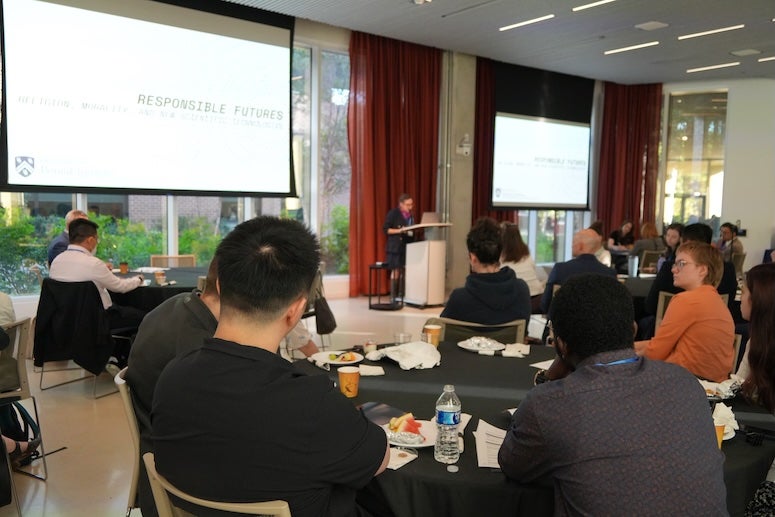
Artificial intelligence can write an obituary, offer advice and even deliver a religious sermon. But as technology takes on increasingly human tasks, researchers at Rice University are asking a bigger question: Just because we can use AI to do something, should we?
That question is helping drive Responsible Futures: Religion, Morality and New Scientific Technologies, an international research initiative led by Rice’s Boniuk Institute for the Study and Advancement of Religious Tolerance in partnership with the University of California, San Diego.
Funded by the Templeton Religion Trust, the initiative brings together researchers from around the world to examine how religious beliefs, moral values and cultural traditions shape the development and use of emerging technologies.
“We want to get outside the hedges of the academy and make sure we’re giving back to society through our research,” said Elaine Howard Ecklund, director of the Boniuk Institute, the Herbert S. Autrey Chair in Social Sciences, professor of sociology and co-leader of Responsible Futures. “And never before has this kind of scholarly work been so needed as it is right now.”
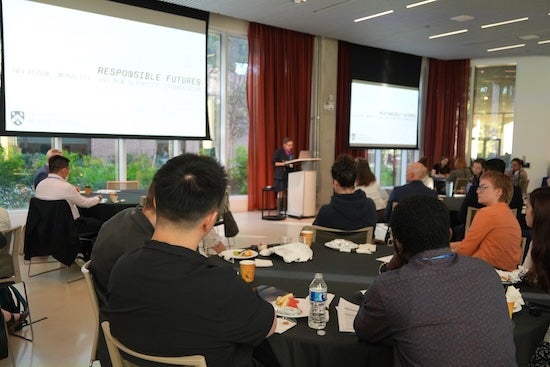
The initiative officially launched with a two-day conference Oct. 23-24 at Rice, bringing together international scholars from sociology, psychology, anthropology, philosophy, theology and other disciplines. The gathering, which coincided with the conclusion of Rice’s AI Week, included presentations and working sessions focused on developing research across three areas: AI, human biotechnologies and technologies affecting the natural world.
Ecklund leads the initiative alongside John H. Evans, distinguished professor of sociology at UC San Diego and co-director of its Institute for Practical Ethics.
When technology becomes personal
During the conference, Ecklund shared a personal experience that prompted her to reconsider the role of AI in everyday life.
After losing a loved one, Ecklund turned to ChatGPT for help writing an obituary. But after spending nearly an hour working with the technology, she realized she was becoming more focused on crafting the perfect obituary than reflecting on the person she had lost.
The experience made her question whether some tasks are meant to be difficult, particularly those connected to grief, love and human relationships.
“Grieving is one of the tasks we want to be filled with friction,” Ecklund said, explaining that using AI to make the process easier seemed to interfere with something she needed to experience herself.
“AI promises, to some extent, this kind of frictionless efficiency, but human relationships and genuine community are inherently embodied, relational and often beautifully inefficient,” she said.
Her concern extends beyond writing an obituary. As AI becomes more integrated into everyday life, Ecklund worries that relying on technology to navigate deeply personal experiences could gradually diminish our capacity for genuine empathy, moral accountability and the qualities that make us uniquely human.
Those questions are central to Responsible Futures, which includes 17 research projects examining how emerging technologies intersect with religious, spiritual and secular values.
Studying AI’s influence on human beliefs
Among the participating researchers is Joshua Conrad Jackson, an assistant professor of psychology at Harvard University, whose work explores how AI may influence religious beliefs and practices.
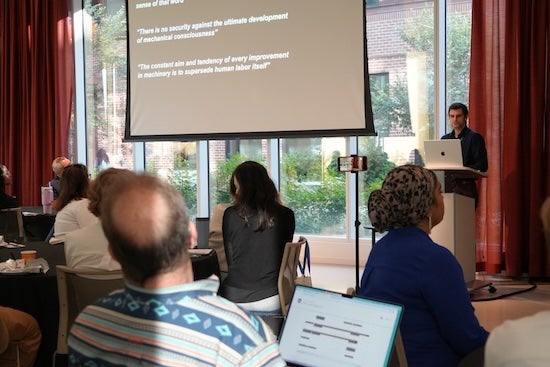
Jackson presented findings from earlier research examining how people responded to religious sermons delivered by a robot compared with those delivered by a human religious leader.
Researchers found that while people generally considered the human speaker more credible, they did not entirely dismiss the robot as a messenger of religious teachings. Those who heard the robot were also more likely to give nothing when offered an opportunity to donate to the temple.
“There’s a difference between capability and credibility,” Jackson said.
His research illustrates a central question for the initiative: Even when machines can perform tasks traditionally carried out by humans, will people trust them in the same way?
Other projects will examine how people across China, Indonesia, India and the United States trust AI to communicate religious and moral knowledge. Researchers will also study how Christians in Singapore incorporate AI into their spiritual practices and how people in China and the U.S. use religious and secular beliefs to interpret AI’s effects on work, education and identity.
Ecklund’s own research will examine the moral perspectives of AI scientists and engineers, including how their views compare with those of the general public.
Beyond AI, participating scholars will investigate public attitudes toward genetic and reproductive technologies as well as how religious and cultural values influence responses to environmental challenges.
At Rice, religion scholar Judith Brunton is examining how cultural narratives, religious values and moral frameworks influence communities navigating transitions away from fossil fuel dependence, including in Houston and Calgary.
Bringing human values into innovation
Rice Provost Amy Dittmar emphasized the importance of keeping people at the center of technological innovation.
“The research you are conducting will help society grapple with this new and ever changing landscape that makes us rethink not only how we use technology but who we are as human beings,” Dittmar told participants.
For Ecklund, the goal is not to position science and religion as opposing forces but to bring different perspectives together to better understand the moral implications of scientific advancement.
“The general public cares about the morality of these technologies,” she said. “So we need our religion scholars at the table. We need our philosophers and theologians as well as our social scientists.”
Funding acknowledgment: Responsible Futures: Religion, Morality and New Scientific Technologies is funded by the Templeton Religion Trust (grant No. TRT-2024-33523).