
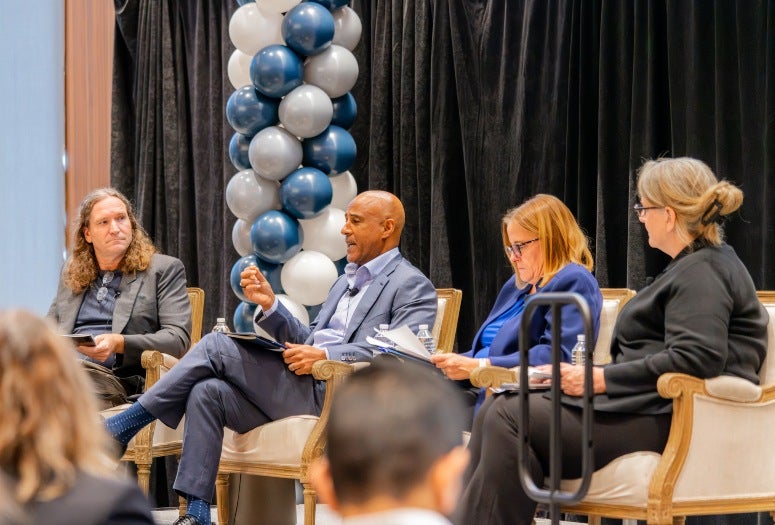
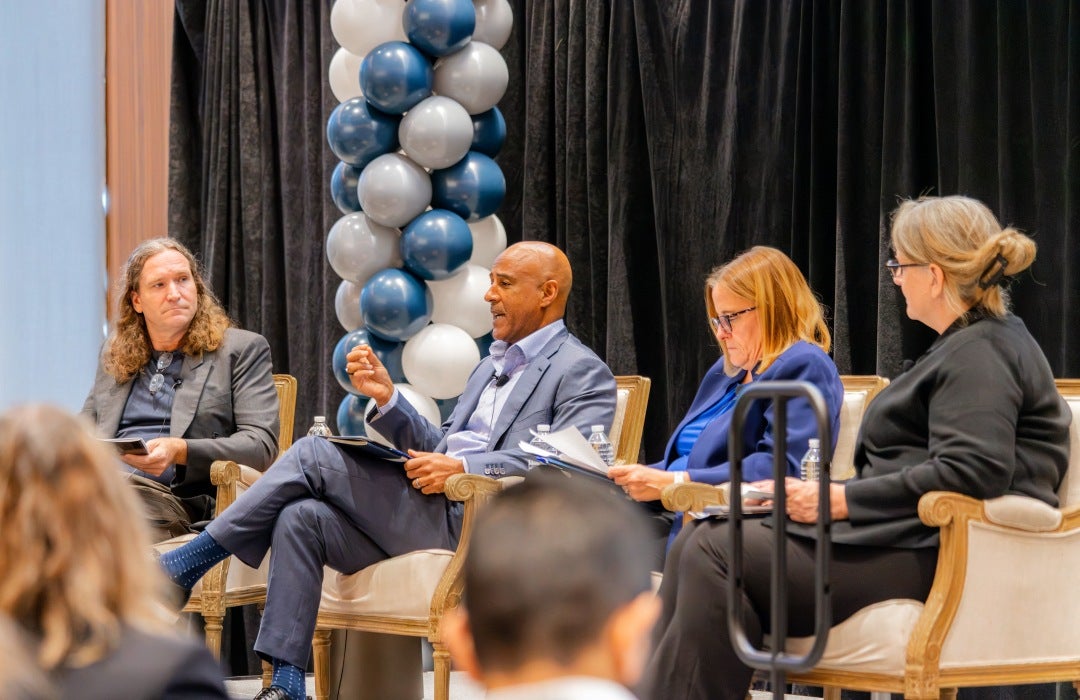
Rice University launched AI Week 2026 with a fireside chat focused on how artificial intelligence will shape the university’s future in research, teaching and operations. Moderated by Christopher Jermaine, chair and the Victor E. Cameron Professor of Computer Science, the discussion brought together President Reginald DesRoches, Amy Dittmar, the Howard R. Hughes Provost and executive vice president for academic affairs, and Kelly Fox, executive vice president for operations, finance and support, to explore the opportunities, challenges and institutional responsibilities associated with AI adoption.
The central message was clear: Rice should embrace AI as a transformative tool while preserving the human relationships, academic rigor and personalized educational experience that define the university. Rather than pursuing AI adoption for its own sake, Rice aims to use the technology thoughtfully, responsibly and in ways that advance its academic mission.
Programming for AI Week includes more than 30 panels that center on the use of AI technology in academia. The week is a cornerstone of Rice’s WISEOwl campaign, a yearlong internal initiative supporting the responsible and effective integration of AI across campus. It bolsters Momentous, the university’s strategic plan that is shaped in part by a call for responsible AI.
Several key themes and discussion points filled the hourlong gathering.
Responsible AI adoption must remain human-centered
DesRoches emphasized that AI offers significant opportunities to transform research, teaching and university operations. Applications in areas such as health and medicine, energy, climate and finance could enable new discoveries, while AI-supported instruction could create more personalized learning experiences and administrative applications could improve efficiency.
These opportunities, however, come with a responsibility to ensure that AI remains technically sound, ethically grounded and human centered. Privacy, security, bias and accountability must remain central considerations as the university adopts new tools.
DesRoches stressed that Rice’s distinctive culture depends on meaningful relationships among Owls. Those relationships must be strengthened rather than displaced by technology.
AI fluency and professional development are institutional priorities
Fox encouraged staff to approach AI with curiosity rather than fear, particularly amid concerns about job security and changing professional responsibilities. She argued that Rice’s growth ambitions create opportunities for AI to help employees work more effectively and expand what the university can accomplish.
She highlighted the importance of questioning established processes, experimenting with new approaches and collaborating with colleagues to identify practical applications. Routine, repetitive tasks are particularly promising candidates for automation, potentially freeing employees to focus on more meaningful work and interpersonal engagement.
The discussion also connected to Rice’s broader AI fluency initiative, including professional development, training, communities of practice and opportunities for faculty, staff and students to develop their skills. The university’s emerging responsible AI values are intended to guide this work with community feedback helping shape the institution’s approach.
Teaching must adapt to AI without compromising learning
Dittmar addressed the divide over AI use in the classroom. Some view AI as essential preparation for a changing workforce, while others worry that it may undermine critical thinking, academic integrity and foundational learning.
Her position was that one size does not fit all. Appropriate AI use will vary by discipline, course objectives and teaching methods. Faculty should determine how AI supports learning in their classrooms while ensuring students develop the skills they need to succeed in a rapidly changing world.
The panel also emphasized that students need more than technical AI proficiency. Critical thinking, communication, leadership, adaptability and interpersonal skills remain essential and may become even more valuable as AI capabilities advance.
DesRoches encouraged faculty to remain flexible and curious, drawing on campus resources to experiment with new approaches to teaching and learning.
Doctoral education must continue to emphasize discovery and understanding
Addressing concerns that AI could eventually outperform humans at aspects of research, Dittmar argued that doctoral education remains fundamentally about understanding the “why,” not simply producing answers or completing tasks.
As AI makes data analysis, problem-solving and certain research activities more accessible, the challenge for doctoral students will be to ask deeper questions, develop new methods, interpret findings and push the boundaries of knowledge.
AI can support this process, but it does not eliminate the need for rigorous intellectual development. Graduate education must also continue to cultivate collaboration, communication and the ability to work effectively with others.
AI should reduce administrative burdens and enable greater impact
Fox described Rice’s efforts to identify operational applications that could improve efficiency without diminishing the human aspects of university work.
Priority areas include enhancements to existing enterprise systems, research administration and development operations. The university aims to introduce approximately 40% of the appropriate AI capabilities already available through its enterprise resource planning systems during the fiscal year.
The broader objective is to reduce repetitive administrative work and allow employees to devote more time to activities that require judgment, expertise and personal interaction.
The panel also discussed investments in research infrastructure, including forthcoming new space and potential seed funding for research capabilities.
Academic integrity and assessment require new approaches
A community question raised a significant challenge: When students can use AI to complete work outside the classroom, traditional assignments may no longer reliably demonstrate individual understanding. More in-person assessments, oral examinations and additional teaching assistant support may be needed.
Dittmar acknowledged that these changes create substantial demands on faculty time and workload. Rice is exploring ways to support faculty through institutional resources, collaboration with peer universities and expanded teaching assistant models.
She stressed that new assessment practices must not come at the expense of meaningful classroom instruction. The university will need to consider both the financial costs of these changes and their effects on educational quality.
Governance should balance universitywide support with local flexibility
DesRoches described a governance approach that combines centralized resources with decentralized decision-making.
Shared capabilities, including computing infrastructure, privacy protections and security, require universitywide coordination. Decisions about classroom practices and many operational applications, however, should remain with the faculty, schools and units closest to the work.
The panel also cautioned against making sweeping institutional changes before understanding their consequences. Rather than simply moving faster or slower than peer institutions, Rice’s leadership said the university should be thoughtful, adaptable and willing to experiment before implementing changes at scale.
Academic integrity requires careful consideration because it is central to the Rice student experience and institutional culture.
Financial sustainability, equitable access and environmental impact matter
The panel acknowledged that AI adoption involves substantial financial and environmental considerations.
Fox emphasized the importance of providing broad access to enterprise AI tools while recognizing that specialized research applications may require shared funding between central administration and individual units. Monitoring usage and evaluating costs will be important in managing licenses, subscriptions, computing resources and future
capital investments.
Dittmar added that investment decisions should be evaluated not only through traditional financial returns but also through their contributions to Rice’s educational and research mission.
On environmental sustainability, Fox confirmed that Rice must account for AI’s energy and resource demands while continuing to pursue its carbon-neutrality goal. The university’s living-lab framework could help researchers measure environmental impacts, test solutions and inform future decisions.
Closing messages
In their closing remarks, each panelist offered a guiding principle for Rice’s AI journey:
- Dare to question: Bring curiosity to existing practices, rethink how students learn and prepare them to think critically, adapt and thrive in careers that may not yet exist. AI adoption must reflect the distinct needs of different disciplines.
- Preserve human relationships: No matter how pervasive AI becomes, Rice must protect the personal connections among students, faculty and staff that distinguish its educational experience and institutional culture.
- Experiment thoughtfully: Focus on practical improvements, professional development and incremental pilots that demonstrate value before introducing large-scale changes.
The fireside chat established a shared direction for Rice: AI should be embraced as an enabler of discovery, learning and operational effectiveness, but its adoption must remain aligned with the university’s mission and values.
Success will require more than access to advanced tools. It will depend on developing AI fluency across the campus, supporting faculty and staff through change, preserving academic integrity, investing in sustainable infrastructure and creating governance structures that balance shared responsibility with local expertise.
Ultimately, Rice’s opportunity is to use AI to expand what its community can accomplish without losing what makes the university distinctive. As the institution advances its personalized-scale vision for global impact, the goal is not to replace the human elements of university life but to use AI to make more room for them.