
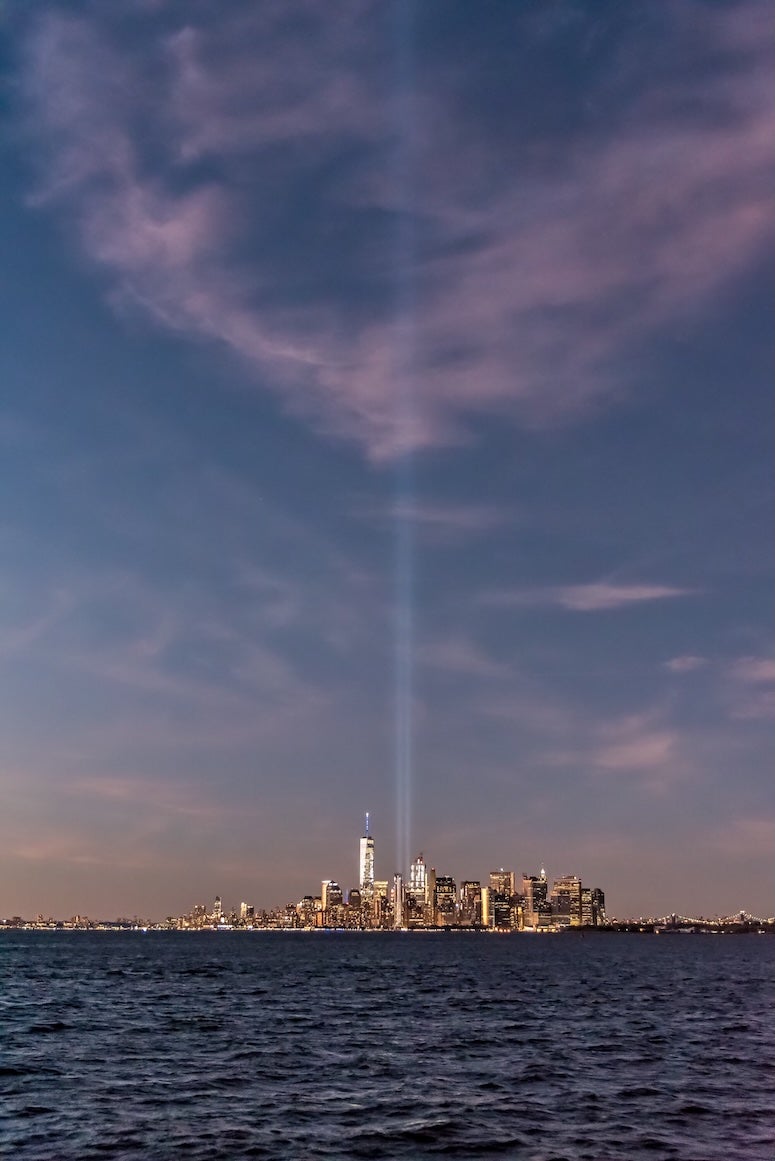
A quarter-century after the Sept. 11, 2001, terrorist attacks, religious bias in America has not disappeared, but the forces shaping it have changed.
Rice University researchers who have examined attitudes toward Muslims and religious discrimination across more than two decades have found a complicated shift. Overall support for restrictive policies targeting Muslims declined between 2002 and 2019, even as attitudes became increasingly divided along political, religious and demographic lines.
More recent research from Rice’s Boniuk Institute for the Study and Advancement of Religious Tolerance points to another important lesson: Conflicts happening thousands of miles away can intensify religious tensions at home, particularly when they intersect with divisions already present in American society.
Kerby Goff, associate director of research at the Boniuk Institute and research assistant professor in the Department of Sociology, said one explanation for the shift lies in how people respond to a perceived external threat.
“Social science generally shows that when a group perceives a threat from outside, that perception produces a cohesive defensive response,” Goff said. “Over time, that cohesiveness dissipates. In the decades following 9/11, attitudes toward Muslims came to be shaped more by internal religious, political and demographic divisions in the U.S.”
A changing landscape
Boniuk Institute director and the Herbert S. Autrey Chair in Social Sciences Elaine Howard Ecklund and colleagues compared nationally representative surveys conducted in 2002 and 2019 to examine how Americans’ attitudes toward policies targeting Muslims changed over time.
In 2002, 38% of Americans surveyed favored making it harder for Muslims to settle in the U.S. By 2019, that figure had fallen to 17%.
But researchers found another shift taking place at the same time. Differences in attitudes by political affiliation, religion and age became more pronounced. Political affiliation, in particular, emerged as a significant dividing line by 2019.
By the numbers
- 17% of Americans surveyed in 2019 favored making it harder for Muslims to settle in the U.S., down from 38% in 2002.
- 23% of Jewish respondents and 16% of Muslim respondents reported an increase in religious bias or hostility following Oct. 7, 2023.
- 75% of Jewish respondents and 56% of Muslim respondents said in 2024 they were concerned about experiencing religious bias or hostility in the future.
When conflicts abroad are felt at home
The institute’s more recent research shows why these questions remain relevant 25 years after 9/11.
A 2024 Boniuk Institute survey examined religious bias and hostility following the Oct. 7, 2023, Hamas-led attack on Israel and the war in Gaza. Nearly a quarter of Jewish respondents (23%) and 16% of Muslim respondents reported experiencing an increase in religious bias or hostility since Oct. 7, 2023. Researchers also found significant concern among both groups about experiencing religious bias or hostility in the future.
For Goff, the findings illustrate how international conflicts can reverberate through religious communities in the U.S., especially when they overlap with existing divisions at home.
“Conflicts and targeting of specific religious groups do have consequences here in the U.S., but this is contingent on those conflicts overlapping with our own internal conflicts,” Goff said.
He said the Israel-Palestine conflict is particularly significant because it intersects with Christian, Jewish and Muslim identities in the U.S. as well as political divisions surrounding international alliances.
“Because both Muslims and Jews are large religious minority populations in the U.S. and their full inclusion as Americans is often contested, global conflicts bring these internal conflicts and perceptions of threat to the forefront, leading to bias and hostility and fear of future discrimination,” Goff said.
Ecklund said the research raises a larger question about religious difference and belonging in America.
“Inclusion and religious pluralism need not be at odds with national identity, but when they are, this leads to religious discrimination, or at least provides a justification for it to some,” Ecklund said.
What helps bring people together?
Understanding what contributes to religious discrimination and conflict is only part of the Boniuk Institute’s work. Researchers are also examining the other side of the equation: What allows people with different religious identities to build trust and work together toward a healthy religious pluralism?
Through the Houston Religious Leadership Project, researchers have interviewed and conducted focus groups with religious and community leaders across the greater Houston area to better understand the opportunities and barriers to interfaith collaboration.
One lesson, Goff said, is the power of a shared problem.
“We’ve seen that when religiously diverse communities understand that they must work together to solve shared problems, like poverty or health or even political polarization, then they are able to build bridges across deep difference for the benefit of all,” he said.
The same sense of solidarity that can exclude people during periods of perceived threat can also work in the opposite direction.
“We find that when a threat is understood as something we all face, regardless of religious or other differences, then solidarity across difference is possible,” Goff said.
Ecklund points to Houston where differences are often bridged during crises.
“When there have been natural disasters in Houston, for example, people come together across religious traditions to help one another,” she said.
Twenty-five years after Sept. 11, the research offers a broader lesson: Religious difference itself does not have to lead to division. How people understand those differences, who they consider part of their community and whether they see challenges as shared can help shape whether moments of uncertainty deepen divisions or create opportunities for cooperation.
To schedule an interview with a Boniuk Institute expert, contact media relations specialist Kat Cosley Trigg at kat.cosley.trigg@rice.edu
The Houston Interfaith Leadership Project study is part of “Revitalizing Interfaith Leadership in Houston and Beyond,” Ecklund, Elaine Howard, PI, Kerby Goff, Co-PI, Rachel Schneider, Co-PI. Funded by the Arthur Vining Davis Foundations (R_2308_24271).
The religious discrimination study is part of “Religion-Related Bias Victimization: Addressing a Blind-Spot,” National Science Foundation, Grant #1753972, Elaine Howard Ecklund, PI, Christopher P. Scheitle, Co-PI.
The 2024 Boniuk Institute Religion and Social Issues Survey was funded by the Boniuk Institute for the Study and Advancement of Religious Tolerance at Rice University.