
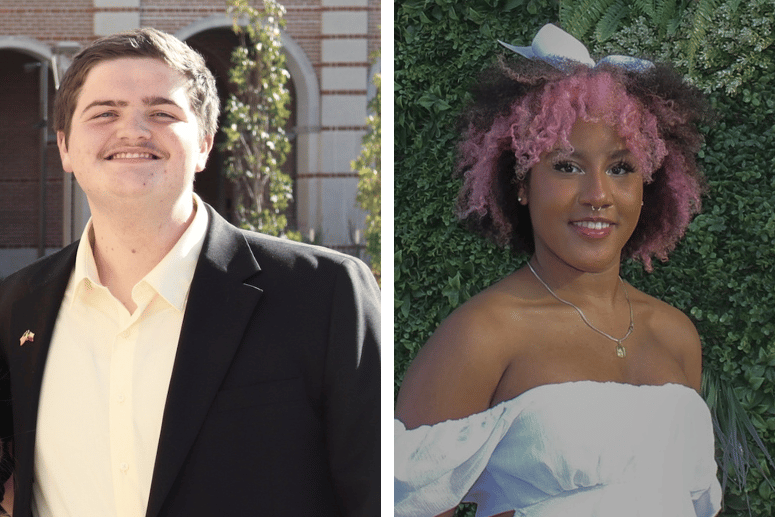
Sarai Abram knows the power of being heard.
Long before she began studying Black maternal health at Rice University, she knew the story of her grandmother, a Black woman who was told by a doctor that she wasn’t pregnant and that the baby she was carrying was a tumor. Her grandmother trusted herself and sought a second opinion.
Eli Risinger has spent much of his life thinking about a different question: How do you build systems that give people a voice? It drew him first to elections, then to political science and, at Rice, into broader questions about civil rights, justice and the law.
Risinger and Abram selected for the 2026-28 Obama-Chesky Voyager Scholarship for Public Service
Now, those interests have earned both Rice juniors an opportunity to explore what it could mean to build their lives around serving others.
Abram and Risinger are among 100 college juniors nationwide selected for the 2026-28 Obama-Chesky Voyager Scholarship for Public Service, a two-year leadership development and scholarship program administered by the Obama Foundation and supported by a $100 million contribution from Airbnb co-founder and CEO Brian Chesky.
The program provides up to $50,000 in last-dollar financial aid during students’ junior and senior years, along with leadership development, access to mentors and a Summer Voyage that allows scholars to design a work-travel experience around their public service interests.
For Abram and Risinger, the opportunity gives them room to explore how the experiences and ideas that have shaped them might inform their future work.
For Abram, a history and English major with a concentration in creative writing, the answer is taking shape at the intersection of policy and storytelling.
“Without my grandmother’s unwavering persistence and a doctor who did not dismiss her concerns, my mom and I would not be here today,” Abram said.
That family story sits at the heart of her interest in Black maternal health.
“I want to be able to not only help solve this issue through policy but amplify the voices of women like my grandmother through writing,” she said.
Abram’s interest in using stories to understand injustice began early. An avid reader as a child, she was particularly drawn to historical fiction and American Girl books featuring girls of color. Their stories introduced her to injustices she wanted to better understand and address.
At Rice, she began to see how storytelling could become part of that work.
Research could help uncover experiences that have been overlooked. Policy could address inequities. Writing could help people understand the lives behind both.
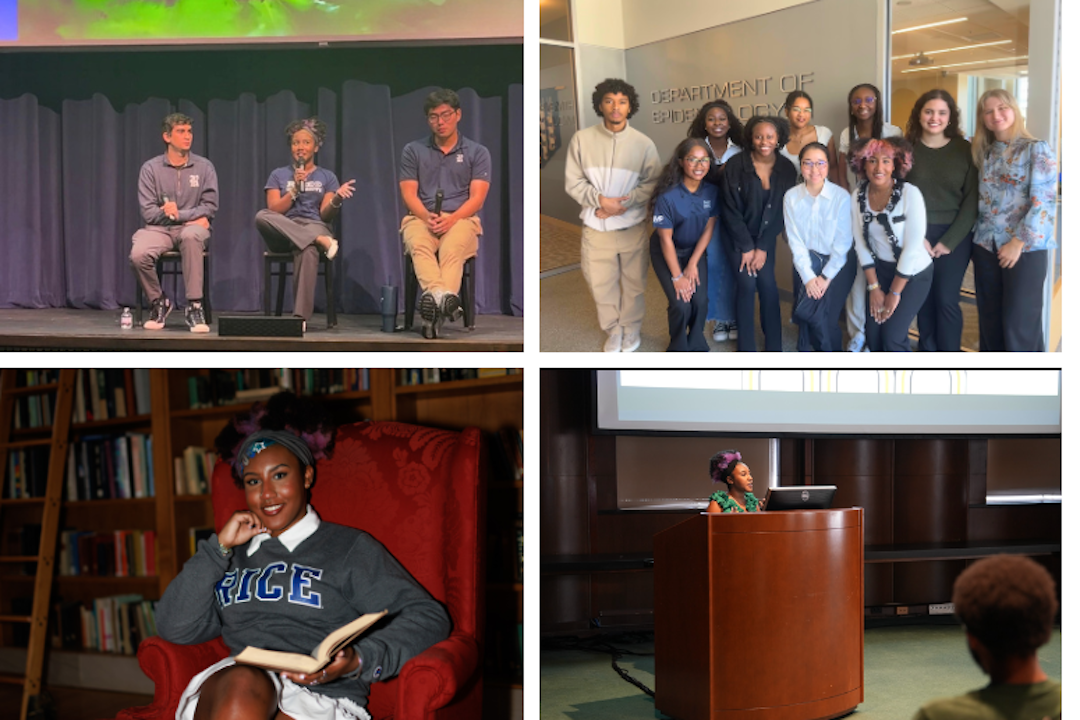
An Alternative Spring Break trip during Abram’s freshman year helped bring those ideas together. She traveled to Atlanta with a group focused on learning about the policies and experiences shaping Black maternal health. She came away with a broader understanding not only of the issue but of what it means to serve.
“Public service encompasses more than being a hands-on volunteer,” Abram said. “Public service can come in the form of teaching others of the history that affects something, whether that be through giving presentations, research or literature.”
Now, the Voyager Scholarship gives her a chance to take that work beyond the classroom.
For her Summer Voyage, Abram said she hopes to work with reproductive justice organizations in Washington, D.C., and New York before spending time in England, where she wants to explore Black maternal health in a country with a different health care system and government structure. Her goal is to better understand how research, policy and storytelling can work together to address the issue.
Risinger’s path has been less about finding his interest than discovering how many directions it could take him.
As a child, while his brother staged pretend wars on one side of their room, Risinger built civilizations on the other. He thought about where buildings should go, how people would move through communities and how changing one piece of a system could affect everything around it.
By fifth grade, he had discovered elections.
For years, the destination seemed obvious.
Risinger, who is majoring in political science and social policy analysis with minors in African and African American studies and politics, law and social thought, arrived at Rice determined to become an election attorney and work on equal protection in the electoral process.
Then Rice complicated the plan.
His studies in African and African American studies introduced broader questions about systems, justice and civil rights. A Knowing Blackness course taught by Linsey Sainte-Claire, assistant professor in the Department of Modern and Classical Languages, Literatures and Cultures, was particularly influential.
“Her class really kind of put my trajectory on where it is,” Risinger said.
Rather than pulling him away from elections, those experiences widened his understanding of what a career in law could look like.
“Rice has kind of taken my one-lane road and made it into a dusty cloud,” Risinger said. “Even as a type A person, I really enjoy living in it and exploring all these different things.”
Today, Risinger sees civil rights as a thread connecting many of those interests. He is considering a future as a civil rights attorney, potentially specializing in elections or tax laws, and ultimately hopes to become a federal judge.
His Summer Voyage is still taking shape.
His original idea grew out of research he conducted on voting behavior in Texas. What began as an effort to understand seemingly conflicting political beliefs evolved into conversations about communities and what people wanted their representatives to understand about them.
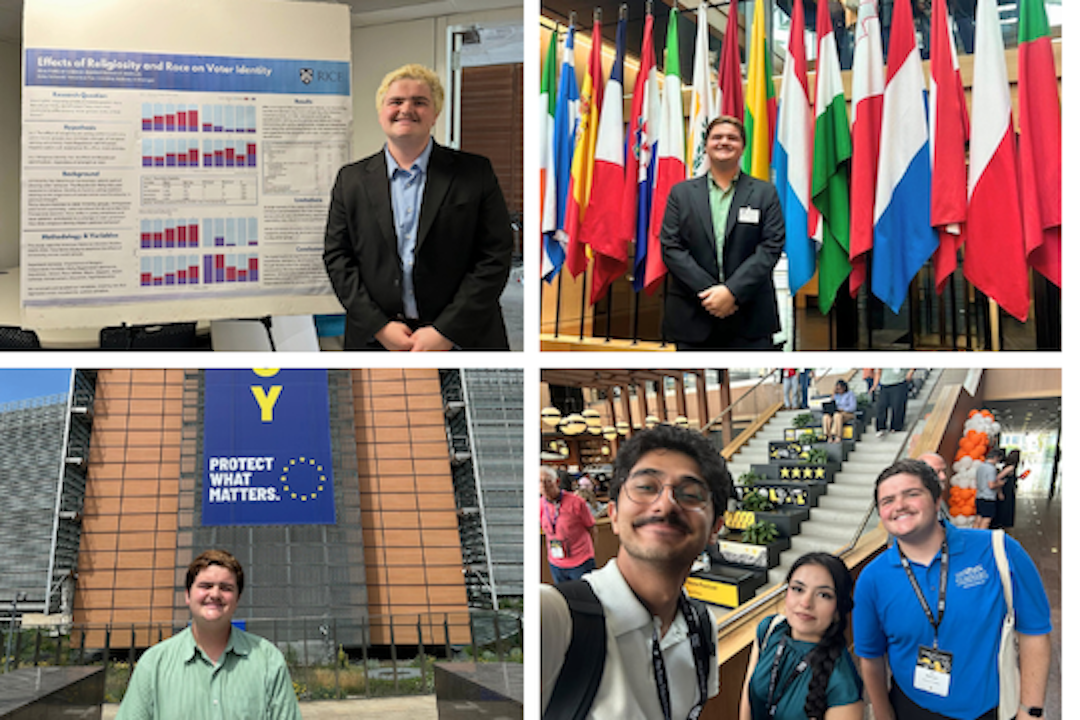
Risinger initially imagined taking that work to communities in swing states. Now, he is also considering opportunities involving civil rights or the federal judiciary, potentially in the Northeast.
The freedom to explore carries particular meaning for Risinger.
He grew up in what he describes as an under-resourced community and from a low-income background. When he applied to Rice, he said admission felt more like a dream than something he expected could become reality.
And since arriving, experiences that once seemed beyond his reach have continued to become possible.
“Even though I come from this under-resourced community and a low-income background, I can still get to this next part of my life and get into places I never thought I would be able to,” Risinger said.
The Voyager Scholarship gives him another opportunity to explore those interests and determine where they might lead.
And this time, he will have a familiar face along for the experience.
Risinger and Abram were friends before either knew the other had applied for the scholarship. Both are Rice campus tour guides.
Before the new class of Voyager Scholars was publicly announced, Risinger was looking through photographs of the recipients when he spotted someone he recognized.
“I zoomed in and was like, ‘Is that Sarai?’” he recalled.
He messaged her.
She had won, too.
Abram wants to use policy and storytelling to address Black maternal health. Risinger is exploring how law and public service can address issues of representation and civil rights. Neither knows exactly where that work will ultimately take them.
The Voyager Scholarship gives them room to find out and the chance to do some of that discovering together.
“I’m really grateful that I get to spend time with Sarai,” Risinger said. “Everywhere that I’ve gone with these things, I get to have somebody as my little Rice buddy, my support system through it.”