
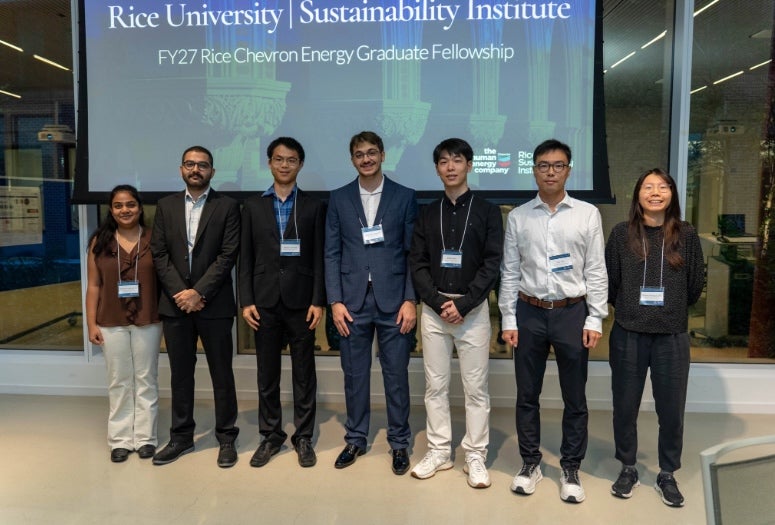
Rice University’s Sustainability Institute recently hosted its third annual Chevron Energy Graduate Fellowship Reception in recognition of the 10 recipients of the 2026-27 Chevron Energy Graduate Fellowships.
“This exciting partnership between the Sustainability Institute and Chevron represents our shared commitment to advancing scalable innovations in energy that lead to emissions reductions across energy value chains,” Rice President Reginald DesRoches said. “This year’s fellows are tackling critical energy challenges, focusing on creating real-world solutions that can transform how we live, how we work and how we interact with our environment.”
The 2026-2027 fellows are:
- Abdullah Alqallaf, chemical and biomolecular engineering
- Bohan Zhang, history
- Emilia Mann, mechanical engineering
- Fiona Chen, chemical and biomolecular engineering
- Fu Yin, Earth, environmental and planetary sciences
- Hossein Gazmeh, civil and environmental engineering
- Monisha Vijay Kumar, applied physics
- Rosie Zhu, Earth, environmental and planetary sciences
- Yingxin Tang, civil and environmental engineering
- Zikai Qian, chemical and biomolecular engineering
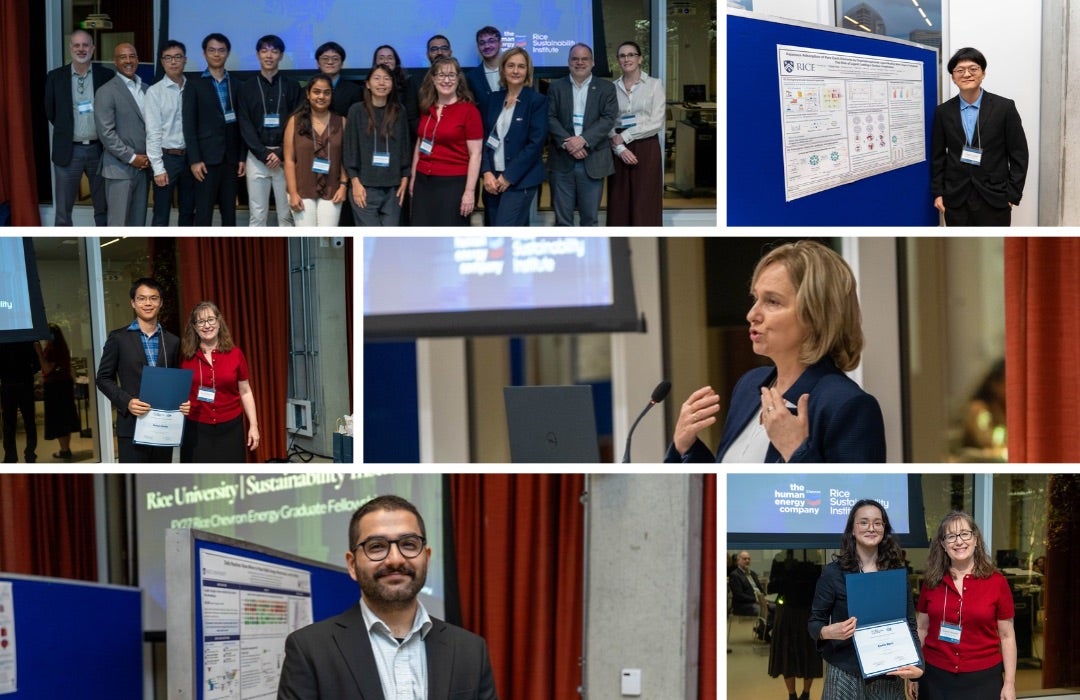
“Where energy comes from in the United States has been completely transformed, even in the last 20 years, by new technologies,” said David Sholl, executive vice president for research. “Each of the students here will have a chance to be a leader that drives these changes and technologies in the future.”
This year, recipients will also have access to subject matter experts from Chevron with relationship building between academia and industry as a goal of the fellowship.
“When academic and industry perspectives meet early on, the path from the lab to real-world applications becomes much easier,” said Vesna Mirkovic, the strategic relationships manager at Innovation Chevron Technology Ventures. “We see this fellowship as more than an award. It is a chance to learn from each other and ask difficult questions.”
The awarded projects come from a range of fields, from engineering and chemistry to history, representing the breadth and depth of the work necessary to address today’s pressing sustainability challenges as the world faces critical issues.
“These projects demonstrate just how multidisciplinary sustainability research has become,” said Carrie Massiello, director of the Sustainability Institute. “This year’s fellows are exploring questions that span fundamental science, new technologies, infrastructure and energy systems.”
“The fellowship gives us the important opportunity to have connections with industry,” said Yingxin Tang, a graduate student in civil and environmental engineering who is developing more environmentally friendly methods of rare element extraction. “This can guide us to transfer our work to large scale or industry applications.”
Hossein Gazmeh, a Chevron fellow, is studying the placement of electric vehicle charging stations. His results show that effective charger placement isn’t just about proximity or access: people’s daily travel patterns and the communities they visit also matter, even when chargers aren’t the closest to their homes or workplaces.
“I was especially excited about this fellowship because I see my work being applied to other forms of energy infrastructure,” said Gazmeh, a graduate student in civil and environmental engineering. “It’s about more than simply where people live or how close they are to infrastructure. Each new infrastructure investment can reshape mobility patterns, affect local businesses and influence neighborhood development. Effective placement strategies should account for these broader effects.”
Other fellows, like Monisha Vijay Kumar, who is developing carbon nanotube fiber devices for electrified gas heating applications, are excited to see their projects being recognized and supported by both Rice and Chevron.
“Carbon nanotubes are widely studied at Rice both for their fundamental properties and applications,” said Vijay Kumar, a graduate student in applied physics. “With their potential for lower embodied energy compared to conventional metals, they offer exciting potential for sustainable technologies. I’m grateful to Chevron for supporting my research and helping advance this.”
Recipients highlighted the unique opportunities created by the academic and industry partnership of the fellowship.
“Lithium is a critical element for modern batteries,” said Zikai Qian, a graduate student in chemical and biomolecular engineering who has developed a method to substantially extend the lifespan of membranes used to extract lithium from brine. “Bringing together Chevron’s industrial expertise and Rice’s research could open up wider applications for this work.”