
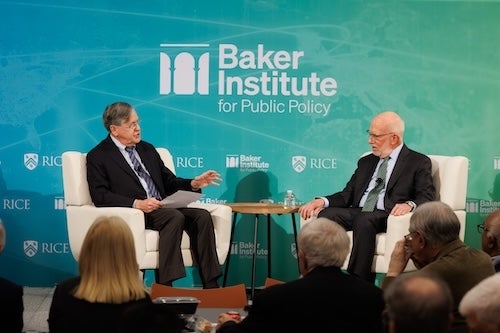
Rice University’s Baker Institute for Public Policy and the Carter Center hosted their fifth annual elections conference Dec. 8 that focused on the 25th anniversary of the presidential race of George W. Bush v. Al Gore. A landmark 2000 Supreme Court case effectively decided that presidential election, and panelists reflected on its legacy and contested elections today.
“Elections are quite literally the heart of our democracy,” David Satterfield, director of the Baker Institute, said in his welcome remarks. “They’re the way we select our elected officials who lead our nation, and they provide for a peaceful transition of power. That’s quite a unique, special and privileged thing in today’s world, as it will be in tomorrow’s. As President Jimmy Carter and Secretary James A. Baker III said, ‘If elections are defective, the entire democratic system is at risk.’ I would add to that, if elections are perceived as defective, the risk is real.”
This is also the 20th anniversary of a report issued by the Commission on Federal Election Reform, a commission co-chaired by Carter and Baker in 2005 created in the aftermath of the 2000 election that examined bipartisan ways to improve how we vote in the United States. Since then, the Carter Center and Baker Institute have continued Carter and Baker’s commitment to improving the confidence voters have in election outcomes.
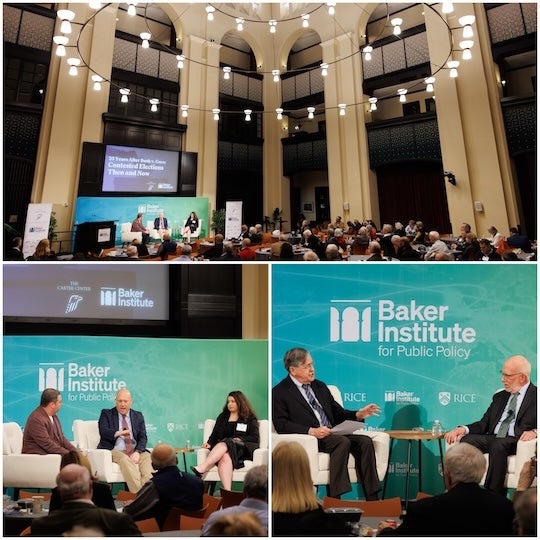
“A lot has happened in these past 25 years,” Satterfield said. “As our nation has become, in many ways, more fractured, more polarized than at any point since the ending of the Civil War and the continued political fighting over the legitimacy of elections, as I noted earlier, plays a role in this polarization today.”
Panels discussed the obstacles and opportunities for U.S. elections and how redistricting will impact future elections. The presenters emphasized the importance of bipartisan efforts, local election administrator support and addressing cybersecurity threats — emphasizing that election professionals prioritize the process over party affiliation.
“This isn’t about making policy that helps or hurts someone in political terms,” said Kim Wyman, senior fellow at the Bipartisan Policy Center. “It’s about making policies that are going to advance elections that people have confidence in — and how can we get that discussion out of that political fray where it’s about voter suppression or it’s about voter fraud and take it a level up.”
In 2024, the Baker Institute and the Carter Center published “Guiding Principles for Election Administration,” a proposal intended to assist the election community, including elected officials, election officials, policymakers, advocates and the media. Individual policies and procedures vary from community to community, but the team identified principles that are crucial to a healthy election system to provide a framework for effective bipartisan policies required for Americans to have faith in elections.
Watch the entire conference here, and learn more about the Baker Institute’s elections work here.