
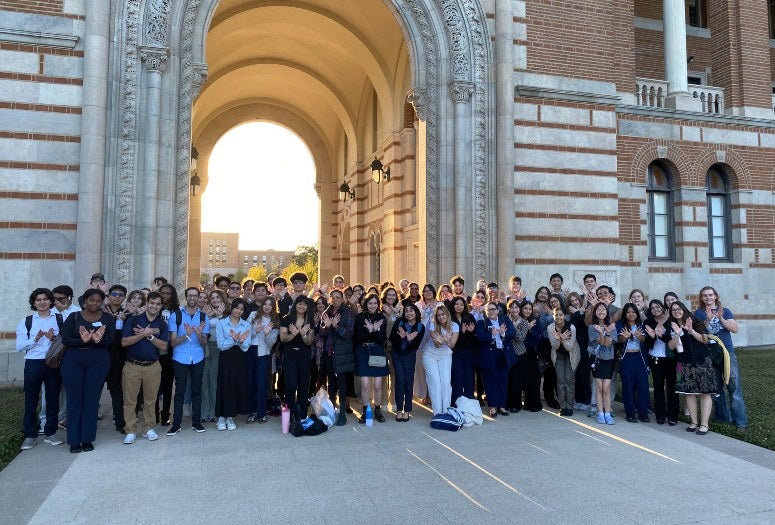
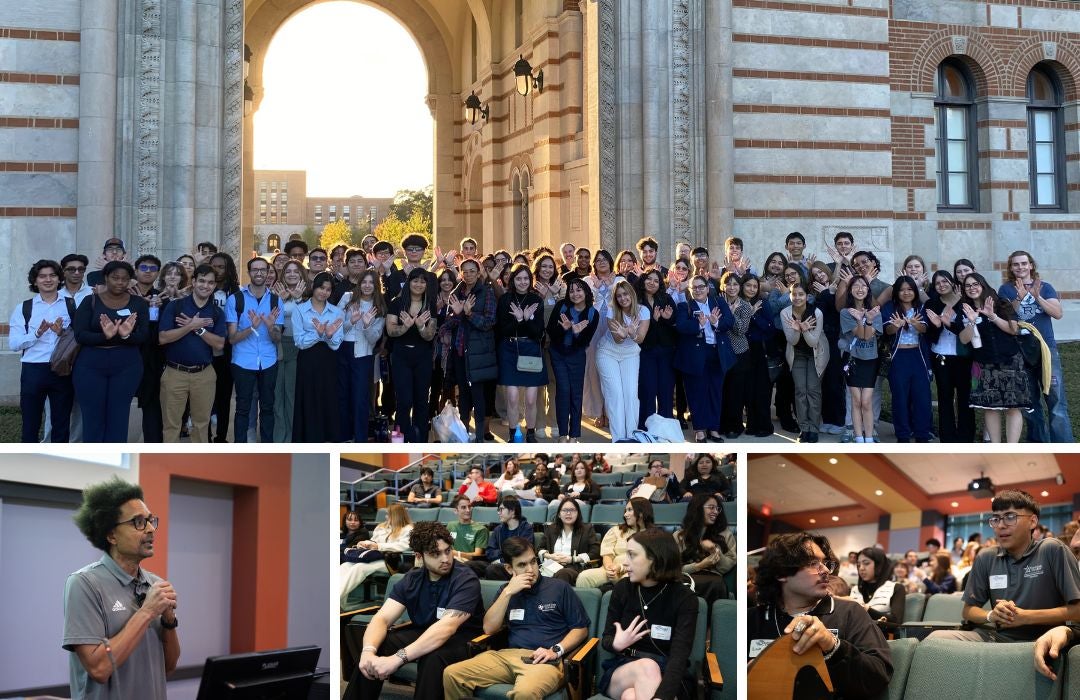
Rice University and the Take Flight Scholars program welcomed community college honors students to two immersive Take Flight On Campus at Rice days offering an in-depth look at the pathways between two-year colleges and four-year universities. Previously focused on STEM honors students at San Jacinto College and Lone Star College, this year Take Flight has expanded to include students in the humanities, business and social sciences and has rebranded from the Take Flight STEM Pathway to the Take Flight Scholars Program.
“It’s exciting to see Take Flight continue to build on our successes over the last four years and expand to include more disciplines and students,” said Andy Osborn, program manager of educational initiatives. “These events provide an excellent opportunity for Take Flight Scholars to envision themselves at Rice or another four-year institution and encourage them to continue exploring what they want to gain from their college experience.”
The events held Oct. 31 and Nov. 14 brought students face to face with faculty leaders, academic advisers and current Rice students as they explored what a future at a top-tier research university could look like. Activities included visits to classes, student panels with Take Flight alumni and Rice Peer Academic Advisors, a campus tour, faculty presentations and either a student organization fair or a goal-setting workshop. Altogether, students were asked to connect their lived experience to their personal aspirations, documenting what kind of education and what kind of freedom they hoped to seek next.
One message echoed consistently: They have earned a place within a four-year institution, and their education should help them to elevate their lifelong potential.
DAY 1: A journey from community college to Mars
The first Take Flight session opened with tradition and excitement. President Reginald DesRoches, a longtime champion of building connections from community colleges into research universities, shared his own community college story. He recalled how financial strain pushed him to a two-year campus as a graduate student and the experience strengthened his belief in the grit and resilience that community college students bring to higher education.
“You’ve earned this opportunity,” DesRoches said. “If you keep pushing, keep showing up and keep believing in yourself, doors will open.”
DesRoches encouraged students to picture themselves at Rice not as guests but as future researchers, innovators and leaders.
Students then shifted to interplanetary discovery with a dynamic lecture from Kirsten Siebach, assistant professor of Earth, environmental and planetary sciences and a scientist on NASA’s Curiosity and Perseverance rover teams.
Siebach walked students through the dramatic history of Mars, including its towering volcanoes, ancient rivers and preserved rock record that captured a time when the planet was warmer and wetter.
Her talk culminated with a recent breakthrough: a Perseverance-collected mudstone sample containing organic material and mineral signatures that, on Earth, often form only through biological processes.
“It’s a potential biosignature,” Siebach said to a rapt audience. “We don’t know what it means yet, but we’re asking the scientific world to help us figure it out. Someday, one of you could be part of that.”
DAY 2: Liberal arts, freedom of mind and charting an educational path
Two weeks later, business, social science and humanities students gathered and learned about a liberal arts education and interdisciplinary exploration.
The morning opened with Alex Byrd, vice provost for the Office of Access and Institutional Excellence and associate professor of history, who challenged students to think differently about what college can be.
Byrd introduced the story of Izzy Samperio ’21, a visual and dramatic arts student whose journey reflected the power of academic freedom. Initially unsure whether she could pursue art at a STEM-oriented university, Samperio ultimately discovered the humanities as central to Rice’s identity.
“Liberal comes from the Latin word for ‘free,’” Byrd said. “A liberal arts education is about expanding your mind and understanding the world and society around you.”
He encouraged students not to let their majors or faculty checklists define the entirety of their education. Instead, he urged them to study the course catalog boldly and intentionally and maybe step outside the predetermined lines.
Byrd illustrated his point with examples of Rice students who designed personal intellectual paths beyond the boundaries of standard majors and coursework.
Across both days, Take Flight offered students not only a glimpse of life at Rice but also a vision of what their futures could hold. They heard from leaders who charted their own unconventional paths, built careers in the arts and pursued socially grounded research.
They observed real classes, explored academic buildings, learned the rhythms of campus life and reflected on who they want to be and what they need from a university to get there.