
By Rosie Nguyen
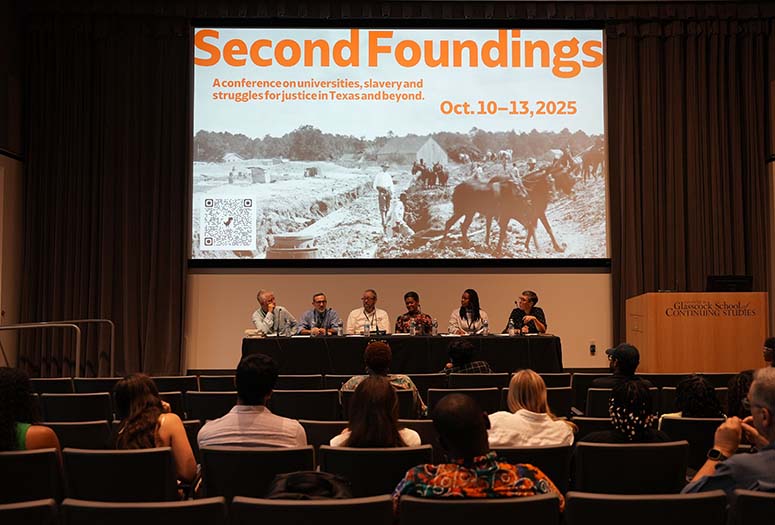
Hundreds of scholars, students and community members from across the country gathered at Rice University in mid-October for the fall research conference of the Universities Studying Slavery (USS) Consortium.
It was the first time since the consortium’s founding in 2016 that its conference was held in Texas — and the farthest west it has convened. This year’s theme was “Second Foundings: Universities, Slavery and Struggles for Justice in Texas and Beyond.”
According to University of Virginia history professor Kirt von Daacke, who coordinates the consortium, USS includes more than 100 educational institutions in six countries that share best practices and guiding principles for truth-telling projects about human bondage and the enduring legacies of racism.
“We’re honoring the people who were enslaved and quite literally built this country, while their stories are being scrubbed off the internet and out of museums,” said Pearl Eni, a researcher at the University of Maryland. “To be in a community of people who are saying their names, putting their names on memorials — I can feel in my heart how deeply important it is.”
Conference organizers said the gathering explored questions such as how the legacies of slavery and segregation shaped schools founded after abolition, how those histories are reflected on campuses today, and what actions can be taken to facilitate repair and reconciliation.
“Right now, schools are facing some significant challenges,” said Eric LaForest, chair of the history, philosophy and religious studies department at Loomis Chaffee School in Windsor, Connecticut. “Getting together and talking about our work is restorative and empowering for a lot of people.”
“I found that this conference has not only been a place for us to collectively mourn the racism that we’ve experienced, but also empower each other,” said Lyric Bailey, an Africana studies major at Davidson College in Davidson, North Carolina.
The four-day program featured panels, workshops, documentary screenings, student poster presentations and a half-day excursion to Texas Southern University (TSU).
“I suggested that we include a day at TSU because I knew there would be attendees from other parts of the country who might not know there’s an HBCU in Houston,” said Karen Kossie-Chernyshev, professor of history at TSU and co-organizer of the conference. “As a Rice graduate who’s worked at TSU for 31 years, I know the gems we have here — including the museum and the John Biggers murals.”
Keynote speakers included Ruth J. Simmons, president emerita of Brown University and President’s Distinguished Fellow at Rice, and Crystal R. Sanders, associate professor at Emory University.
“I received profound inspiration from Simmons’ lecture,” said Molly Morgan, assistant teaching professor of anthropology at Rice. “She called us to maintain the university as a beacon of truth, no matter what challenges we face.”
Caleb McDaniel, Mary Gibbs Jones Professor of Humanities at Rice and co-organizer of this year’s conference, said more than 335 attendees came to the event, representing 21 states and numerous institutions, local communities and organizations.
“We were overwhelmed by the response and interest in the conference,” McDaniel said. “I hope these collaborations will lay the groundwork for future partnerships through the USS Consortium and beyond.”