
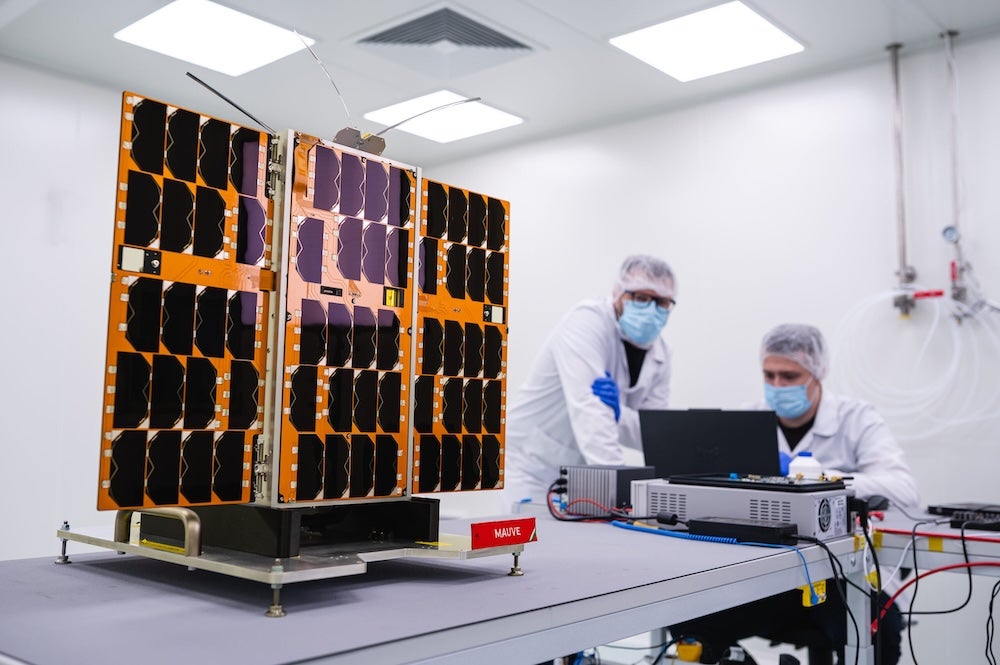
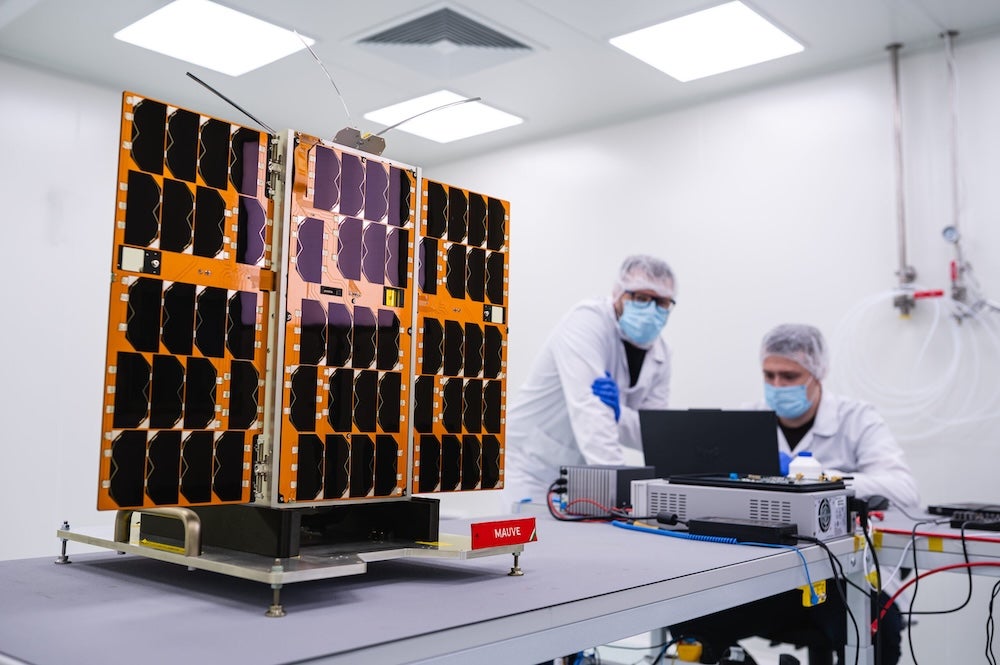
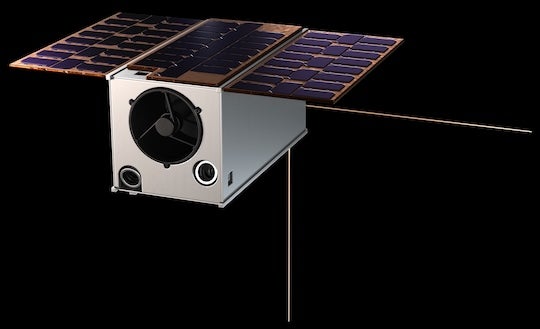
Blue Skies Space, a United Kingdom space science data company, has successfully launched its first satellite, Mauve, marking the start of a three-year mission to study the stars and how their activity influences the habitability of distant exoplanets. The satellite was launched on SpaceX’s Falcon 9 rocket Nov. 26 as part of the Transporter-15 rideshare program.
Christopher Johns-Krull, interim vice president for research and a professor of physics and astronomy at Rice University, is a member of the Mauve science program at Blue Skies Space. His involvement reflects Rice’s strong role in space science and highlights the expertise he brings as a senior faculty member guiding research on stellar behavior and exoplanet environments.

“I’m excited to see Mauve begin its mission,” Johns-Krull said. “This satellite gives us a chance to study stellar activity in a way we simply couldn’t from the ground. The data will help us understand how stars shape the environments of the planets around them, which is central to figuring out where life might be possible.”
Mauve will enable the study of transient, energetic phenomena from stars, largely emitted through powerful explosions, known as flares, that will affect the planets around them, according to a recent release by Blue Skies Space.
This emission is largely seen at energetic ultraviolet wavelengths, which Mauve can observe over long periods of time thanks to its sensitivity to light in the 200-700 nanometer range, the company said. In addition to stellar flares, research priorities include young exoplanet hosts, hot stars and binary stars.
Research institutions worldwide have arranged access to data collected by Mauve, including Rice, Boston University, Columbia University, INAF’s Osservatorio Astrofisico di Arcetri, Konkoly Observatory, Kyoto University, National Astronomical Observatory of Japan, Maynooth University, Vanderbilt University, and Western University.
Mauve will open a new window on stellar activity that has previously been largely hidden from view, said Giovanna Tinetti, chief scientist and co-founder of Blue Skies Space.
“By observing stars in ultraviolet light, wavelengths that can’t be studied from Earth, we’ll gain a much deeper understanding of how stars behave and how their flares may impact the environment of orbiting exoplanets,” he said in the release. “Traditional ground-based telescopes just can’t capture this information, so a satellite like Mauve is crucial for furthering our knowledge.”
Marcell Tessenyi, CEO and co-founder of Blue Skies Space, shared this view and pointed to the broader goals behind the mission.
“Our vision is to make space science data as accessible as possible,” Tessenyi said. “Mauve will undergo commissioning before delivering datasets to scientists in early 2026 and serve as a springboard to launch a fleet of satellites addressing the global demand for space science data.”