
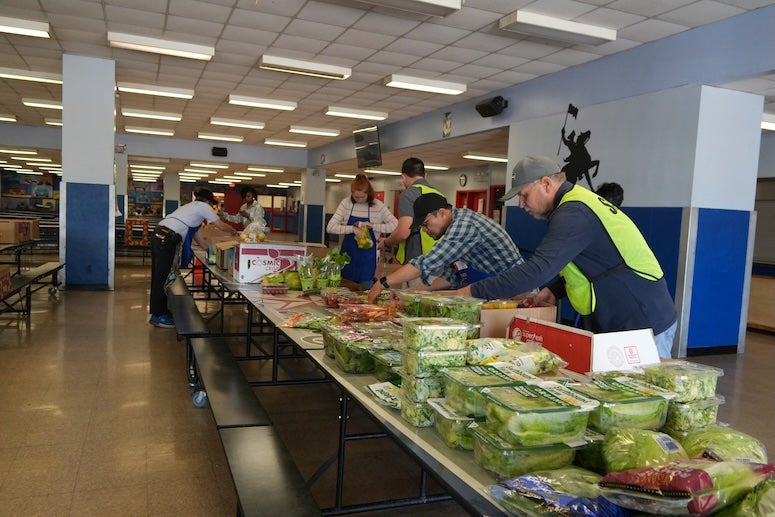
On a warm Sunday morning at Paul Revere Middle School, the hallways filled with conversation as members of Miracle City Church made their way from worship to the cafeteria, where a delivery truck from Second Servings of Houston had just arrived, fresh from a pickup from local grocery stores. Volunteers, including Rice University seniors Ian Wright and Anna Delesalle, moved quickly to unload crates of produce, baked goods, milk and eggs.
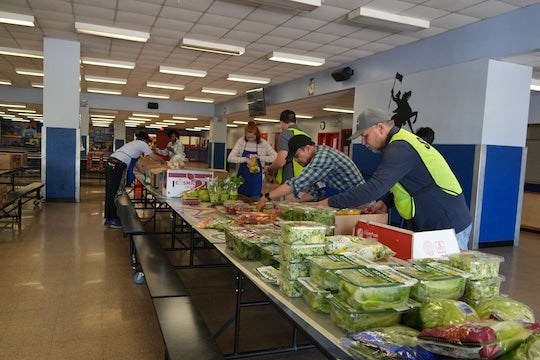
The students, there to both volunteer and observe how the process worked, are partnering with Second Servings through the capstone project for Rice’s social policy analysis (SOPA) major to study potential expansion into Galveston and Brazoria counties.
“It was incredible to see how efficient it all is,” Wright said. “Every volunteer had a role, and every bit of food found a home.”
Working alongside the Food and Faith Collaborative, the group turned the middle school’s cafeteria on the west side of Houston into a makeshift grocery store. Tables labeled by category — fruits and vegetables on one side, dairy and baked goods on the other — gave families the freedom and dignity to choose what they needed most.
“We take perfectly good food that would otherwise be thrown away and get it to the people who need it,” said Max Curry, director of logistics for Second Servings of Houston. “The research Rice students are doing helps us expand smartly, not just widely — making sure every truckload reaches the right communities.”
By the time the line began to form, more than 50 people waited with grocery bags and boxes in hand. For them, the pop-up shop meant access to fresh, healthy food that might otherwise have gone to waste. For Wright and Delesalle, it was their first time attending a Second Servings pop-up — an opportunity to witness the organization’s work up close before diving into the data analysis that will guide their research.
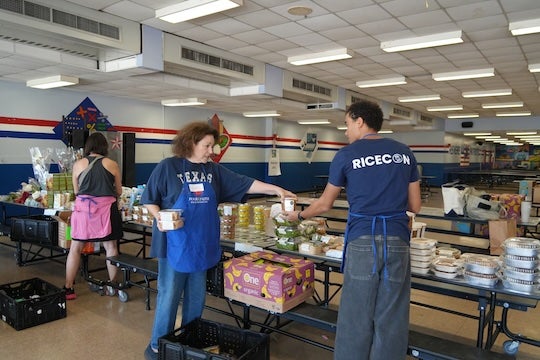
Second Servings is Houston’s only prepared-and-perishable food rescue organization. Since 2015, it has rescued more than 18 million pounds of food valued at over $130 million from more than 450 food donors and delivered it to more than 150 local nonprofits across the Houston area.
Partnering with the organization has allowed the Rice students to apply the analytical tools they’ve learned in the classroom to a real-world issue.
“Before this project, I didn’t realize how much perfectly good food goes to waste,” Wright said. “Having the chance to apply what we’ve learned in class to a real-world challenge — and see the impact up close — has been eye-opening.”
Delesalle agreed that seeing the process firsthand has changed the way she thinks about policy work. “It’s one thing to study hunger through data,” she said. “But it’s another to see families lining up for groceries that might have been thrown away. This experience makes the issue real and reminds us why policy work matters.”
After volunteering at the pop-up, Delesalle said the experience sparked new ideas for their research approach. “Talking with volunteers and seeing how a pop-up operates made us realize it’s about more than just numbers,” she said. “We decided to create a survey for pop-up leaders, so we can capture their perspectives and better understand what makes each site successful — information we’ll use to guide expansion into Galveston County.”
The partnership comes at a critical moment. In the aftermath of the government shutdown as federal nutrition assistance programs face renewed uncertainty, food rescue organizations like Second Servings are fielding more requests than ever.
“We’ve never seen demand like this,” Curry said. “People are calling daily to find out where they can get food. Being able to expand strategically — with Rice students helping us analyze where that need is growing — is invaluable.”
From classroom to community
The SOPA capstone is a yearlong course that pairs students with community organizations to design and carry out applied research projects. Each student team explores an ongoing social problem, collects data and develops policy recommendations that nonprofits and government offices can use to strengthen their programs. Past projects have focused on housing instability, environmental justice and access to health care across Houston.
“Capstone is a wonderful opportunity for our students to engage in real-world policy research,” said Steven Perry, assistant teaching professor in the Department of Political Science and major adviser for the SOPA program. “By working with a community partner on an ongoing issue — like housing, justice or food insecurity — they can use the empirical skills they’ve learned in the classroom to make recommendations and help develop policies with tangible social impact.”
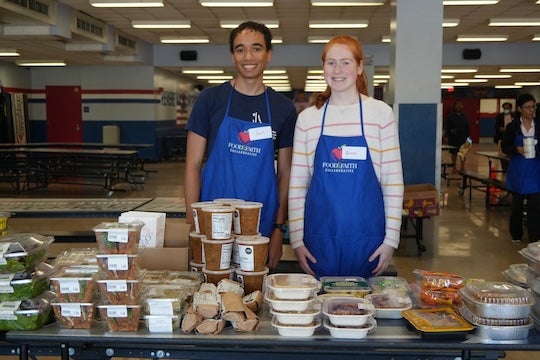
For Wright and Delesalle, the day offered more than just insight into food rescue logistics — it put their research into perspective.
“You read about hunger and food insecurity all the time, but being there — seeing the food come off the truck and go straight into people’s hands — made it real,” Wright said.
Their work will ultimately help Second Servings identify where to expand next in Galveston County — a move that could bring fresh, healthy food to even more families who need it.