
When Purvez Captain retired after three decades at Ernst & Young, he noticed something about the new generation of interns and recruits who came through: They were sharp, they understood economics, but many lacked the computational tools necessary to turn raw data into decisions.
“The students who came in with strong computational skills did very well,” Captain says, speaking today as a Rice University alumnus and longtime adviser to the Department of Economics. “Those who didn’t struggled. That’s what got us thinking — why not give Rice students that edge before they ever leave campus?”
That question helped spark the creation of Rice’s new Master of Computational Economics (MCEcon) — a graduate program that sits at the intersection of economics, data science and computation. Launching in fall 2026, the program positions Rice among the leading institutions offering this kind of quantitative economics and computation degree.
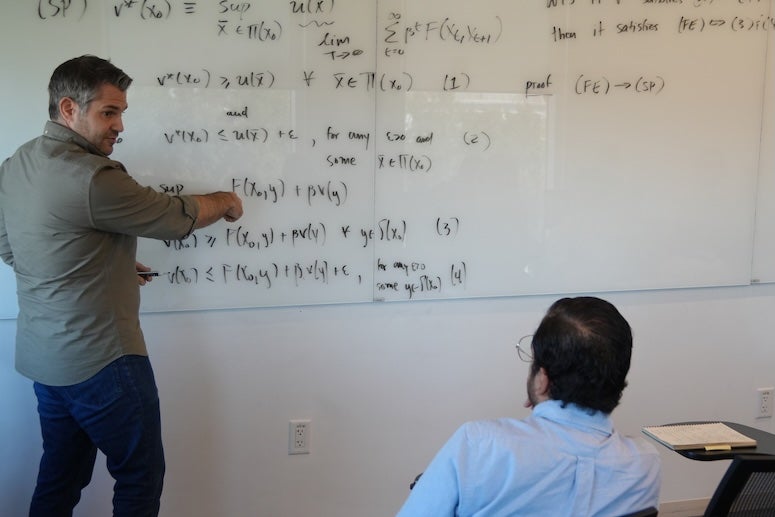
“The landscape of economics is changing,” said Zach Bethune, associate professor of economics and director of the Master of Computational Economics program. “It’s not enough to know the theory — you have to be able to code, analyze data and use computational tools to test and apply that theory.”

Bethune says the new degree offers students the same rigorous foundation in economic theory and empirical methods as more traditional programs but with a distinctive emphasis on computation. “The computational aspect of this program isn’t a side project,” he adds. “The computational training is central. It’s about preparing students for how economics is actually done today.”
The curriculum will cover programming and data analytics, dynamic modeling, machine learning and macroeconomics and simulation. The cohort size will be intentionally small, allowing students to learn directly from faculty whose research uses computational methods. That includes Chase Coleman, a lecturer who joined Rice two years ago specifically to help design and teach the program’s applied courses.
“We’re not turning students into software engineers — we’re turning them into scientists,” Coleman says. “In today’s world, scientists need to know how to program, analyze data and use those tools to generate insights.”
Coleman — who continues to work professionally in computational economics — says the program’s blend of coding, analytics and economic modeling will help graduates stand out in a rapidly evolving job market. “The space moves quickly,” he noted. “The techniques that mattered 10 years ago matter a lot less today. This program keeps students — and even us as faculty — at the forefront.”
Captain said what excites him most is Rice’s willingness to adapt based on alumni and employer feedback. “A good institution doesn’t just create a curriculum — it evolves it,” he said. “Data and analytics are changing everything about the job market. Rice is responding in a way that will prepare its students to lead.”
Rachel Kimbro, dean of the School of Social Sciences, said the Master of Computational Economics reflects Rice’s broader commitment to equipping students with the skills today’s employers demand.
“Our faculty are designing programs that meet the realities of a rapidly changing workforce,” Kimbro said. “This one blends the strengths of Rice economics — rigorous theory and empirical training — with the computational fluency students need to thrive in data-driven careers.”
The program will also deepen collaboration between graduate alumni and current students, creating new mentoring, internship and hiring pipelines.
For Bethune, that partnership between theory and practice is exactly the point: “Students with this combination of skills — economic reasoning, statistical rigor and computational fluency — are going to be incredibly valuable. This program is about equipping them to lead in that future.”
Applications for the inaugural cohort are now open with informational sessions planned throughout the spring semester. For updates or to register for an upcoming session, visit here.