
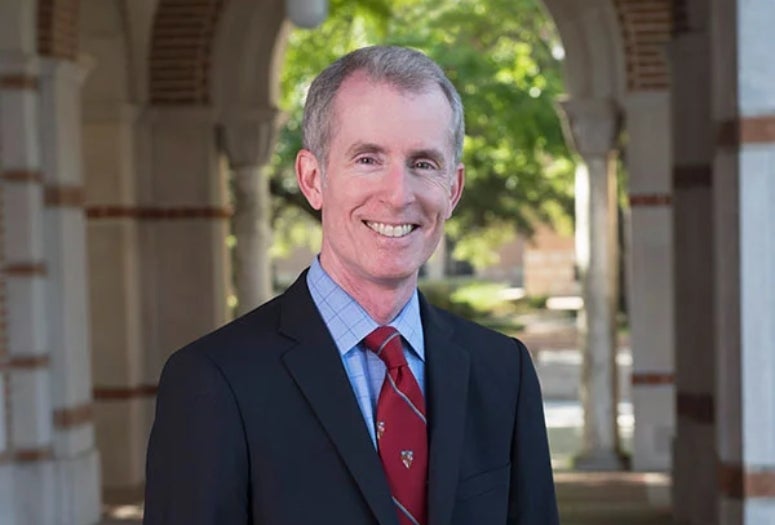
Rice University recognizes Matthew Taylor for his 31 years of service. As senior associate provost he oversees the Office of Strategic and Educational Initiatives within the Provost’s Office. His last day with the university will be Dec. 31.
Q: What is your favorite time of year at Rice and why?
A: Matriculation in the fall. Every new class of first-year students reminds me of Rice’s ability to change lives and renews my faith in education.
Q: Share your most memorable, standout moments during your time at the university.
A: There are too many to pick from! Taking a cue from Taylor Swift, I’ll offer one from each of the “eras” of my 30-plus years at Rice:
1. I started my career at Rice as a faculty member in the history department. The first class I taught was on the Vietnam War. I knew the subject very well but went into the course having essentially nothing prepared other than a syllabus. So every Monday, Wednesday and Friday morning was a mad scramble in the depths of the Fondren stacks to compose a lecture or discussion plan before my 11 a.m. class. In about the fifth week, I had writer’s block and just couldn’t generate a coherent lecture. As a 28-year-old, first-time university teacher, I was mortified at the prospect of showing up unprepared for class. I thought about canceling class that day, but at the last minute I came up with an idea: I would ask my 53 students one question and see where it would take us. The question: Is the Vietnam War best understood as a civil war, a proxy war, a revolutionary war or a colonial war? The question was the only item I brought to class — I had no notes, no preplanned follow-up questions or answers, no backup plan and no net. Surprisingly, the discussion was robust and thoughtful and serious, and I guided it with ease. It was the moment when I realized and trusted, in a completely new way, the depth of my knowledge, and it was the moment I knew I belonged at the front of a Rice classroom.
2. The opening of McMurtry College and Duncan College in the fall of 2009. I was a member of the steering committee responsible for the project since 2005. It was an enormous undertaking — a $175 million project that added 628 beds to campus housing. It was on that project that I built the relationships with amazing folks like Kevin Kirby, Mark Ditman, David Rodd and Barbara Bryson and the college magisters who helped me to be effective as associate dean of undergraduates. It was also on that project that I witnessed Rice student self-governance and the special compact between students and the university administration at their very best. What I think is mostly forgotten about the project is how students led, and the university empowered them to lead creation and implementation of the plan to house Baker College and Will Rice College in Duncan and McMurtry for the 2009-10 academic year, while major additions were made to Baker and Will Rice. This innovative plan not only made it feasible for those additions to be completed without totally disrupting the Baker and Will Rice communities; it also decisively shaped the formation of the McMurtry and Duncan communities, since the first class of freshmen at those colleges arrived and resided under the mentorship of Baker (Duncan) and Will Rice (McMurtry).
3. In December 2011, I was tapped to be the inaugural director of the new Program in Writing and Communication (PWC). I had eight months — from January 2012 to the beginning of the fall 2012 semester — to establish the FWIS program (which meant finding — and in some cases hiring — faculty to teach 70 sections of FWIS); recruit and hire staff for a new Center for Written, Oral and Visual Communication (later renamed CAPC — the Center for Academic and Professional Communication); guide renovation of a space in Fondren to house the PWC and CAPC; and, with David Tenney and his team, create the logistics infrastructure to support enrollment of every first-year student in a FWIS. It was one of the most complex and pressure-filled assignments of my Rice career. Thanks to hard work by many partners — Terry Doody, Helena Michie, David Tenney, Jennifer Wilson, in particular, and the support of Provost George McClendon and vice provost Paula Sanders — it all miraculously came together.
4. Every commencement since 2016 has been especially meaningful and memorable to me. The first cohort of RESP Scholars graduated in 2016. Most RESPies have overcome considerable barriers to attend and persist to succeed at Rice. Having known them since before they matriculated and knowing each of their stories and aspirations makes me feel like I’m crossing the stage with them.
Q: How have you seen Rice evolve over the years?
A: Rice has become bigger, more diverse, more complex, more ambitious and less green. The student body has doubled in size since I arrived. The campus feels more dynamic, more like a full-blown university campus as a result. Yet I also miss the days when the campus was a bit monastic. From the inside of the administration, the “business” of the university has become more complex and more difficult to steer or to change, but it continues to be a place that runs on relationships, a place with a remarkably “flat” org chart where office doors are open and collegiality and collaboration are the coin of the realm. The best change of all is the diversification of the student body. I’m proud to have been present for and to have had a small hand in the many changes that supported this necessary and wonderful evolution of the Rice community.
Q: How have you evolved because of your experience at the university?
A: Because I was tasked with leading or allowed to pursue projects over the years that spanned just about every corner of the university, I developed expertise in areas I never would have imagined would become integral to my career. For instance, I was trained as a historian and viewed myself as a humanist, a person of the liberal arts, but my work to develop and lead RESP necessitated that I become an expert in STEM education and transition and success for students from under-resourced communities. For the past dozen years, consequently, thinking about STEM education occupied a lot of my time and energy, and, to my surprise, I found myself helping to lead a variety of STEM-related, universitywide initiatives and being co-PI on over $7 million in grants from the likes of the National Science Foundation and Howard Hughes Medical Institute.
Q: What advice would you give to employees to make the most of their time at the university?
A: First, learn as much as you can about all the components of the academic enterprise and the drivers of an institution’s mission. The more you understand how the many components of a university are related to each other and support the mission of the institution, the more you will be able to contribute in your individual role, in service on committees and in collaborations with colleagues from other units. My value to Rice as an employee over the years derives in no small part from the fact that I have firsthand knowledge of and experience in the big four of the academic enterprise — teaching, research, fundraising and admission — as well as with athletics, residence life and the college system, student health and well-being, teaching, DEI, Title IX, alcohol policy, the Honor Code and student discipline, leadership development, civic engagement, student government, promotion and tenure, capital projects and others.
Second: Learn to be a good “university citizen.” Universities can’t thrive without selfless service from the members of the university community. Of course, service can take many forms. What I encourage folks to do is to find ways to serve by giving both in and outside of their jobs — give their time, energy, presence, expertise, passion and compassion to enrich and support our students’ learning and growth.