
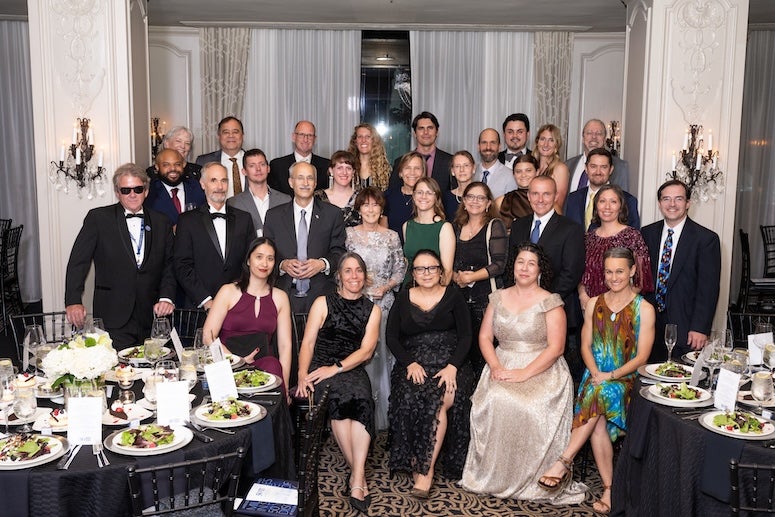
More than 300 guests gathered Nov. 6 at Hotel ZaZa in Houston’s Museum District for a dinner and alumni awards ceremony celebrating the 50th anniversary of the Wiess School of Natural Sciences as an independent school at Rice University. This milestone highlighted the school’s legacy of discovery and its ongoing contributions to the sciences.
The gathering brought alumni, faculty, students and university leaders together to recognize the Wiess School’s role in driving scientific discovery and to honor alumni whose work reflects that legacy. From advances in nanoscience and astronomy to breakthroughs in the life sciences, the school has built a record of research that reaches far beyond campus and continues to shape the fields it serves.
“For 50 years, the Wiess School of Natural Sciences has embodied the very essence of Rice University — a spirit of curiosity and a belief that the most profound questions lead to the most transformative discoveries,” Rice President Reginald DesRoches told the crowd. “This is where foundational science happens — where researchers ask why and how and in doing so lay the groundwork for solutions that change our world.”
Thomas Killian, dean of the Wiess School of Natural Sciences, welcomed the guests and reflected on the community that has shaped the school.
“Tonight, we gather to celebrate a milestone and our distinguished alumni, but we also gather together as a community built on curiosity and a passion for science, to honor a half-century of discovery that has changed our understanding of the natural world and our place in it,” Killian said.
Honoring alumni excellence
The evening’s festivities, underwritten by Karin and Bowen Loftin ’73; Cathleen Trechter ’77 and Ed Biegert ’74; Kelly and Randy Bailey ’64; and Wanda Pan ’77 and David Tocco, included the presentation of the 2025 Natural Sciences Alumni Awards. These honors, led by the Rice Alumni in Natural Sciences group, recognize exceptional contributions by graduates across generations and disciplines.
This year’s recipients included Aparna Bhaduri ’10, a rising leader in single-cell genomics; Michael Jung ’69, celebrated for his medicinal chemistry work that led to FDA-approved prostate cancer therapies; and Wilfred van der Donk ’94, recognized for his pioneering antibiotic research and efforts to combat antibiotic resistance.
Jung and van der Donk also delivered chemistry seminars at Rice Nov. 6 and 7, respectively.
“Each of tonight’s awardees reminds us what is possible when curiosity meets purpose, when scientists push the frontiers of knowledge, applying discovery to the betterment of society, and dedicate themselves to inspiring the next generation to do the same,” Killian said.

Looking ahead
Rice Natural Sciences became a separate school in 1975 after having been previously grouped with engineering. It has since thrived under the leadership of distinguished deans, including Killian, who has served since 2021.
Throughout 2025, the school highlighted a dozen significant research milestones, including the Nobel Prize-winning discovery of carbon-60 by Robert Curl and Richard Smalley in 1985, Donald Clayton’s influential theories about how essential elements for life are formed in supernovae and notable contributions by professors Ron Sass and Frank Fisher, who established a link between methane emissions from rice paddies and global warming.
Today, the school offers 19 majors and seven minors across various core and interdisciplinary fields, including environmental science. Students conduct research in collaboration with partners such as the Texas Medical Center, and the professional science master’s program prepares graduates for leadership roles in bioscience, health policy and energy.
Looking to the future, the university’s location in the nation’s fourth-largest city positions it for leadership in key scientific fields, Killian said.
“Thanks to Rice’s unique position — as a neighbor to NASA and the Texas Medical Center, in a biodiversity hot spot that is also a global energy hub — we are poised to lead in fields that will define the century ahead,” Killian said.
With a strong foundation and a focus on the future, the Wiess School of Natural Sciences remains committed to exploration, discovery and real-world impact. As it enters its next chapter, the school aims to advance new scientific frontiers and inspire future generations.
“The past 50 years have shown what the Wiess School can achieve when curiosity opens new frontiers and those insights are used to make a difference in the world,” Killian said. “So, as we close this anniversary year, let us renew our commitment to discovery — to exploring, to understanding and to impact. Let us honor our legacy by inspiring the students and sparking the breakthroughs that will shape the next 50 years of natural sciences at Rice.”