
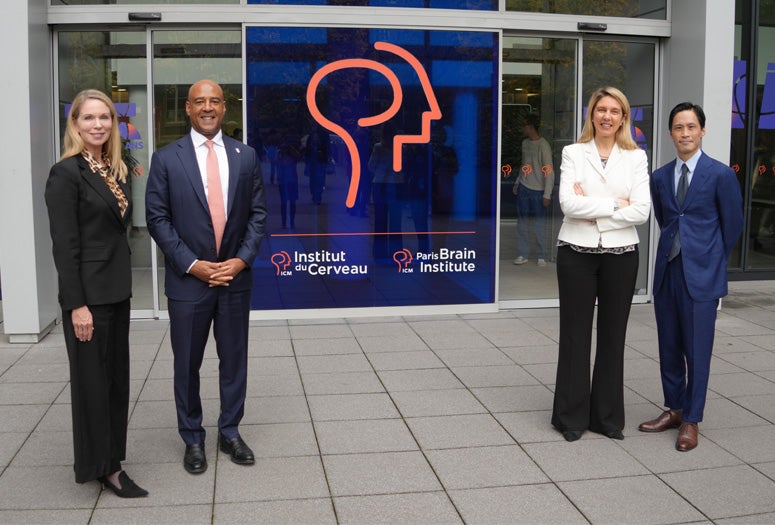
When leaders from Rice University and the Paris Brain Institute (PBI) gathered in Paris Nov. 14, they did more than sign an international agreement. They marked the start of a new era in brain research, one that connects Houston’s growing ecosystem in neuroengineering and health innovation with Europe’s leading center for neuroscience.
The partnership follows the recent launch of the Rice Brain Institute, a universitywide effort to accelerate discoveries in brain science and health. Together, Rice and PBI aim to deepen understanding of the vital organ and advance solutions for neurological and psychiatric disorders through collaborative research, education and innovation.
“We are honored to join forces with the Paris Brain Institute at a moment when brain health is among the most urgent and promising frontiers in science,” Rice President Reginald DesRoches said. “This partnership aligns the distinct strengths of our institution with a shared ambition: to move rapidly from fundamental brain science to meaningful interventions that improve lives.”
Located in Pitié-Salpêtrière Hospital, PBI brings together more than 900 experts to better understand the organ and its pathologies.
“Our collaboration with Rice opens new opportunities for deep interdisciplinary work across continents,” PBI executive director Stéphanie Debette said. “By combining our neuroscience organization with Rice’s engineering-driven approach and societal focus, we aim to address brain disorders and brain health challenges that affect people in Europe, the United States and around the world.”
For Rice, the partnership reflects a broader strategy to strengthen global research ties through the Rice Global Paris Center, located in the heart of Paris. Caroline Levander, Rice’s vice president for global strategy, said the signing underscores the university’s commitment to advancing research that transcends borders.
“This partnership is a natural extension of the Rice Brain Institute’s mission and of our university’s international engagement,” Levander said. “Paris is a hub for neuroscience, and through this collaboration, we’re connecting two vibrant academic communities that share a commitment to innovation and human impact.”
The partnership adds momentum to Rice’s growing research enterprise around human health, said Christopher M. Johns-Krull, interim vice president for research.
“Rice is dedicated to leading innovations in health care, and the brain and brain health represent one of the greatest challenges and opportunities for impactful research at Rice to make a significant difference for people in Houston and around the world,” Johns-Krull said. “This partnership with the Paris Brain Institute will leverage our strength and accelerate the rate of scientific discovery and development of new interventions to improve brain health.”
That vision is already reshaping how Rice researchers approach the brain — not as a single problem but as a network of challenges spanning engineering, biology and human behavior.
Behnaam Aazhang, co-director of Rice’s Neuroengineering Initiative and director of the Rice Brain Institute, said the collaboration will broaden the university’s ability to connect engineering with fundamental brain science.
“The Paris Brain Institute’s deep neuroscience expertise aligns naturally with Rice’s engineering-driven approach,” Aazhang said. “Now that we have the Rice Brain Institute, we have a much broader opportunity to collaborate, not just bringing our engineering expertise but also our expertise in science and the societal impact of brain disorders.”
Pernilla Wittung-Stafshede, professor of chemistry and biosciences, said global cooperation is essential to tackle neurological diseases that affect millions worldwide.
“This partnership is an exciting opportunity to think big and aim for real difference to society,” Wittung-Stafshede said. “Brain diseases, such as Alzheimer’s and other dementia disorders, are a growing problem in all parts of the world with no cures today. To solve this, we need to come together all around the globe.”
The two institutions plan to begin by identifying shared research priorities, laying the groundwork for a long-term transatlantic framework that unites discovery with innovation.
“Ultimately, the work ahead is about improving lives,” Levander said. “That’s the shared mission that unites Rice and the Paris Brain Institute.”