
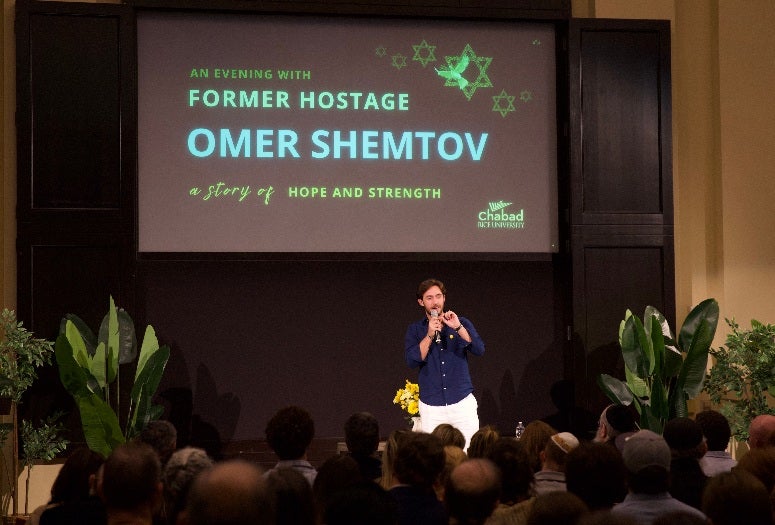
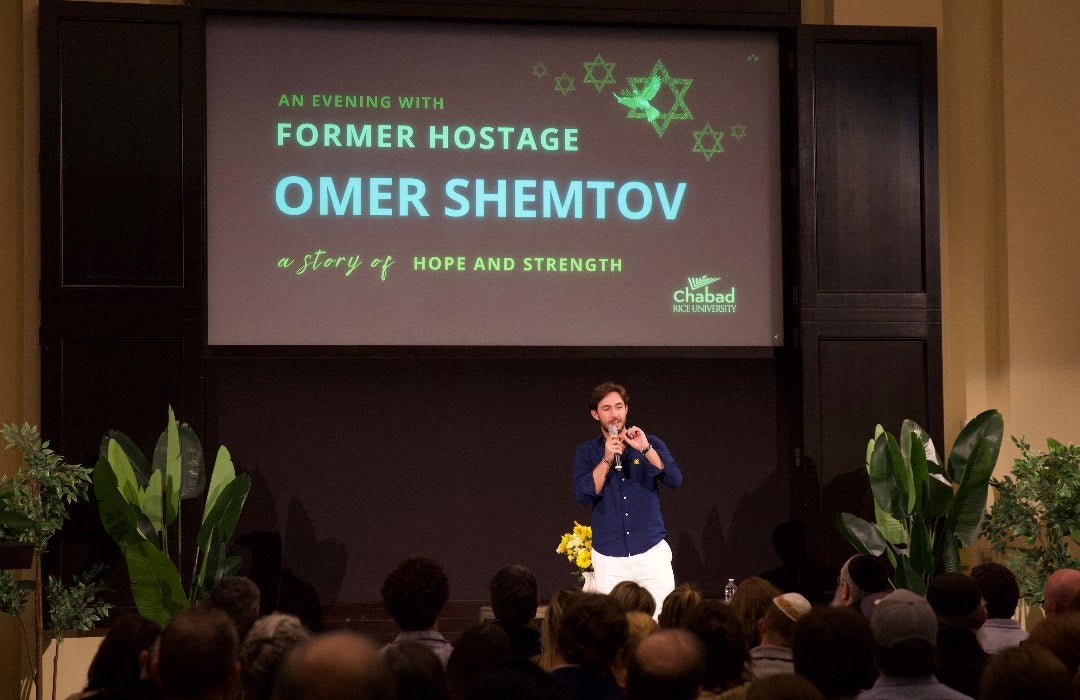
Chabad at Rice University hosted an emotional event Oct. 29 titled “An evening with former hostage Omer Shem Tov: A story of hope and strength,” marking two years since the Oct. 7 attacks in Israel. Owls and community members gathered to honor those lost and to celebrate the strength of faith that continues to unite the Jewish community.
The event, held at Rice’s Baker Institute for Public Policy, featured remarks from students and a keynote address by former hostage Omer Shem Tov, who spent more than 500 days in captivity in Gaza after being kidnapped from the Nova music festival in southern Israel.
Rabbi Shmuli Slonim, co-director of Chabad at Rice, opened the program with words of remembrance and gratitude.
“It has been two years since our world changed forever — two years since Oct. 7 when we witnessed unspeakable cruelty,” Shmuli said. “We have mourned, but we haven’t forgotten, because the Jewish story has never been about what happens to us. It’s about how we respond together.”
Students share experiences on campus
Rice senior Ramy Mizrachi, a statistics major from Panama, reflected on the challenges he’s experienced over the past two years.
“After Oct. 7, it sometimes felt like my grief was being debated,” Mizrachi said. “There were days I hesitated before wearing a Star of David or speaking up in class.”
He said that Chabad became a place of refuge — a space for community, faith and honest discussion.
“Chabad didn’t just give me the space to be Jewish,” he said. “It gave me the strength to be proudly Jewish, to keep learning, keep showing up and keep choosing connection over withdrawal.”
A survivor’s story
The night’s most powerful moment came when Shem Tov, now 23, took the stage. Speaking softly but with unwavering composure, he said, “My name is Omer Shem Tov — and I’m a free man.”
Shem Tov described the night he was kidnapped from the Nova music festival. As the attack began, he and two friends fled through open fields under fire.
“Everywhere we ran, we saw people getting shot,” he said. “We tried to hide, but there were bodies everywhere.”
Eventually, they were captured. One friend was critically wounded. The three were thrown into the back of a pickup truck and driven into Gaza.
Shem Tov described the scene: people cheering in the streets, shouting and celebrating as he was dragged into captivity.
“They were so happy to know that Jews were murdered, that women were raped, that kids were slaughtered,” he said. “I was shocked to see the joy on their faces.”
He was taken to a series of houses and tunnels, often kept in complete darkness. His captors tied his hands, beat him and deprived him of food and water.
“There were days I survived on a single biscuit and a few sips of salty water,” he said. “I didn’t shower for 90 days. I thought I might never see light again.”
Despite the conditions, Shem Tov said he held onto faith through daily prayers.
“Every morning, I thanked God for the air in my lungs and the food on my plate, even if it was a small amount,” he said.
During his captivity, Shem Tov witnessed what he called “miracles,” moments where his faith deepened instead of fading. One missile strike leveled several nearby houses but left his shelter untouched.
He also found strength through friendship with another hostage who had initially lost hope, and Shem Tov prayed for his friend to find perseverance and faith.
“I told him, ‘You have to believe we’re going home,’” Shem Tov said. “The next morning, my friend said, ‘I believe it with all my heart that we’re going back home.’ I was shocked to see how my prayers had been answered so quickly.”
Shem Tov remained underground for months, confined to a cell so small he couldn’t stand up straight.
“For 50 days straight, I was inside that cell in, most of the time, complete darkness,” he said.
At one point, Hamas fighters brought him a pile of Hebrew books, thinking they might contain military information. Among them was a Chabad publication, “Dvar Malchus,” which contained a weekly Torah study about Joseph — another man imprisoned and later freed.
“For me, that was a sign from God that I’m going to come out [of captivity],” Shem Tov said.
After months of negotiations and shifting ceasefires, Shem Tov was finally freed in February 2025.
He described emerging from the tunnels, blindfolded and disoriented, feeling the cold air on his skin for the first time in more than a year.
“It was a rainy day and the skies were gray, but for me, it was the sunniest day of the year,” he said.
He was reunited with his parents soon after. “The first thing my mother said was, ‘My life, my life — you’re safe now.’”
Since returning home, Shem Tov has spoken across Israel and the United States, advocating for the release of remaining hostages and urging people not to lose hope.
“I tell a lighter version of my story because I want people to understand there is still hope,” he said. “You will not be broken.”
A celebration of strength
At the conclusion of the program, co-director of Chabad at Rice Nechama Slonim presented Shem Tov with a “Chitas” — a sacred Jewish text — and a cake as a birthday gift, marking his first birthday as a free man. Guests joined in singing “Happy Birthday.”
“We are overwhelmed with gratitude and honor to be here with you just two days before the first birthday since your release,” Nechama Slonim said. “To be able to learn from you, not defeated but as a modern-day Jewish hero, is a testament to the unending strength you carry in your soul. It is something that unites us all at the deepest core of what it means to be a Jew.”
Shmuli Slonim closed the evening with a message about turning inspiration into action.
“When we are inspired to do something good, we must act immediately before the inspiration fades,” he said. “It is our sincere wish that we all leave here tonight with a renewed hope and a revitalized strength.”
For attendees, the evening was more than a remembrance — it was a call to unity and purpose.
For more information about Chabad at Rice, visit jewishriceu.com.