
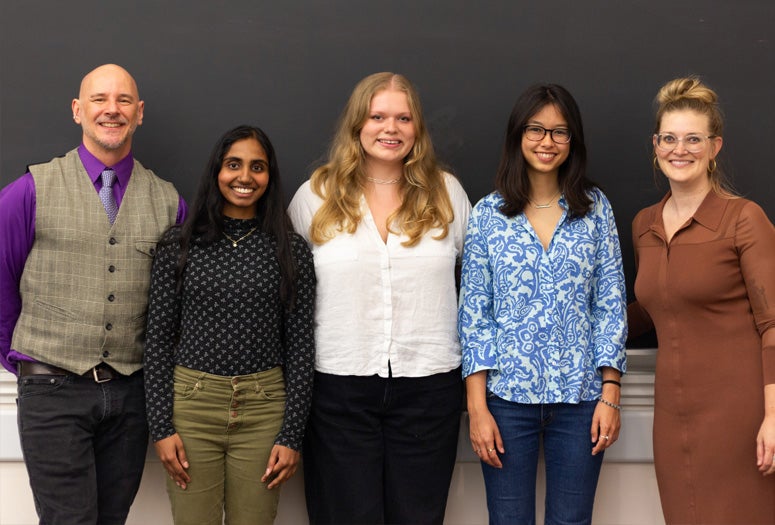
For students in Rice University’s Center for the Study of Women, Gender and Sexuality (CSWGS), research doesn’t begin in a library or a lab. It begins in living rooms, clinics, community centers and conversations across Houston. Each year, the center’s Seminar and Practicum in Engaged Research invites juniors and seniors of all majors to become collaborators with local organizations, working alongside community partners to design research that responds to real needs and generates change that lasts beyond the academic year. First offered in 2008, the course has paired more than 100 students with more than 50 organizations across the region. Most of those students majored in the study of women, gender and sexuality (SWGS).
“These students are not simply given an assignment and told to check some boxes of things they do,” said Brian Riedel, associate director of CSWGS and adjunct assistant professor. “They are intellectual collaborators with the nonprofit agencies. Together, they develop research questions that the students then get to execute.”
The results have been significant. Undergraduate projects have shaped peer-reviewed scholarship including articles co-authored by former students Sophia Haase ’13 and Sara Millimet ’11 through partnerships with the Baylor College of MedicineTeen Health Clinic and Live Consortium. When former student Mingo Almazan ’25 worked with PFLAG Houston to redesign outdated educational materials on transgender inclusion, the updated brochure became a resource the organization continues to use and share. These examples demonstrate that when Rice students contribute research in partnership with community organizations, the work circulates, informs and helps people.
“Many of the students find that the experience of conducting research from initial collaboration to finished product gives them critical thinking skills for understanding what constitutes good research in the first place,” Riedel said.
This year’s cohort, taught by Riedel and postdoctoral associate Anzi Dong, is small by design. Seniors Caitlin Reddig, Joselyn Lwigale and their classmates meet weekly, moving step by step through the early stages of designing community-based research. Much of the fall semester is spent developing background knowledge, writing research plans and navigating the detailed requirements of Institutional Review Board approval.
“It’s a really good cohort,” Reddig said. “It’s me and three other senior girls, which is fun. Brian and Anzi do a really good job of walking us through the steps of everything to get to where we are.”
Reddig, a triple major in psychology, sociology and SWGS, plans to pursue a career in housing policy and social work. Her project focuses on the eviction experiences of women of color who have received services from Coalition for the Homeless of Houston/Harris County.
“I started looking into it and was unaware of how crazy the stats are and how women of color are so disproportionately evicted,” Reddig said. “There was something there that I wasn’t aware of, and I felt like I could dig deeper.”
Reddig spent this semester conducting literature reviews, drafting interview guides and considering the ethical questions that shape research with vulnerable populations. Next semester, Reddig will conduct one-on-one interviews and a focus group to identify patterns in how eviction affects women’s lives.
“This isn’t my story,” Reddig said. “I want to let the conversation flow however it wants to and just hear their experiences.”
Lwigale, a SWGS major with a minor in medical humanities and a Spanish certificate, is studying birth experiences among patients who received midwifery care at Houston Methodist Willowbrook Hospital. Because pregnant people are classified as a vulnerable research population, she developed a project that focuses on women who have already given birth. Next semester Lwigale will lead an in-person focus group followed by individual interviews to understand what shaped each participant’s sense of care, agency and satisfaction.
“I’m really excited to create a space where moms can talk about their birth experiences and maybe share what common experiences they might have or things to look for in future births,” Lwigale said. “Birth stories are something people don’t always get to share. I want to hear what they have to say and what they might say when they’re with each other.”
Both students say their journey toward research began years earlier in the same place. SWGS 100, the department’s introductory course, gave them language for experiences and systems they recognized but had never been taught to analyze. Riedel said that’s why so many students discover the major through that class.
“It shows students names for things they have already been experiencing but never knew how to talk about,” Riedel said. “A gendered, feminist and intersectional perspective alters our ability to see that what happens in your life is like what happens in my life. We’re no longer just individuals having experiences but participants in a pattern. And because it’s a pattern, we could choose to organize to change it.”
The practicum makes that possibility concrete. Students apply humanistic and social science methods to questions developed with community partners, from narrative and linguistic analysis to contextual and visual interpretation. They learn how to design interviews, facilitate focus groups and understand research not only as data collection but as relationship building.
In its 16 years, the practicum has generated partnerships that endure. Organizations return because the work is meaningful, Riedel said, and because the research students produce addresses questions that often exceed the capacity of nonprofit staff. These collaborations also give students insight into how research circulates in the world. Projects have informed programming in local clinics, contributed to policy conversations in Houston and Austin and shaped changing conversations around care and equity.
“Part of what makes the seminar and practicum attractive to students is they recognize that research can have a real-world impact on things they care about right now,” Riedel said.
In the months ahead, this year’s cohort will move from planning to practice as they conduct interviews, analyze narratives and share their findings with their partner organizations. Their work will join a long line of projects demonstrating what undergraduate research can be when students don’t just study the world but help change it in ways that last far beyond the semester.