
Kenneth Payne starts most days with a plan. On Mondays, Wednesdays and Fridays, he heads to the gym then takes his wife Mary out for a burger — a routine built around her needs and his. She was diagnosed with dementia in 2021, and now he’s her full-time caregiver.
“I had never cooked,” Payne said. “Now I cook everything. I clean. I do it all.”
After nearly 62 years of marriage, Payne says it’s a role he never expected but one he embraces, even when the weight of it feels crushing.
“Dementia is a life in a downward spiral,” he said. “All we can do is just try to do the best we can. If you don’t take care of yourself, you can’t take care of your partner. That’s what I’ve learned.”
It’s a lesson he took to heart after participating in a caregiver study led by Rice University’s Christopher Fagundes, professor in psychological sciences and director of the Institute of Health Resilience and Innovation. The study — known as Project REACH — is among the first in the nation to collect real-time data on how stress affects the health and well-being of dementia caregivers.
Payne remembers what it was like to have someone from the research team knock at the door — always on time, always kind.
“I looked forward to the visits,” he said. “Life can get pretty lonely when you’re caring for someone with dementia.”
When Payne, a retired Houstonian, learned the study offered home visits, he signed up. “I can’t leave her,” he said. “That made it possible for me to take part.”
Short for Restore, Enable and Advance Caregiver Health, Project REACH uses wearable heart monitors and daily smartphone surveys to track how caregiving affects the body and mind as it happens. It’s one of the first studies in the country to combine ecological momentary assessment with physiological data, providing a more complete picture of caregiver strain.
“Most studies ask caregivers to recall how they’ve felt over the last week or month,” Fagundes said. “But stress isn’t something you can always remember accurately. It happens moment by moment, and those moments can add up to serious health consequences.”
Fagundes has spent much of his career studying the connection between stress and disease. His previous research has shown that chronic loneliness and caregiving strain can increase inflammation, disrupt sleep, weaken immune function and even shorten lifespan.

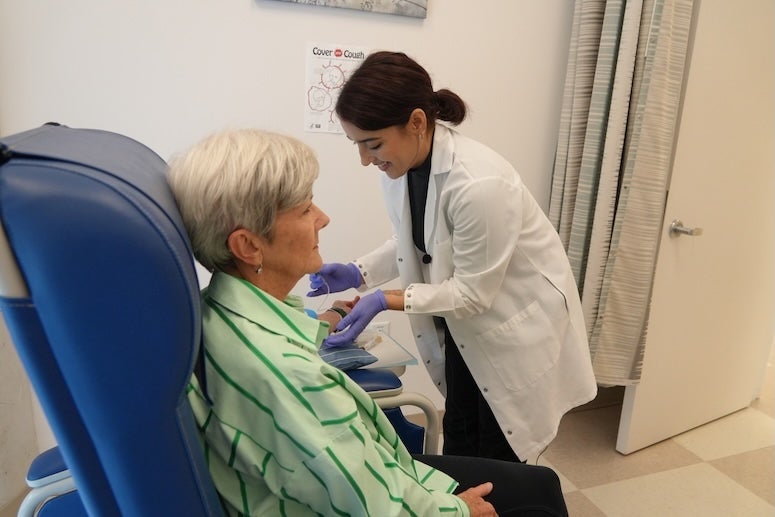
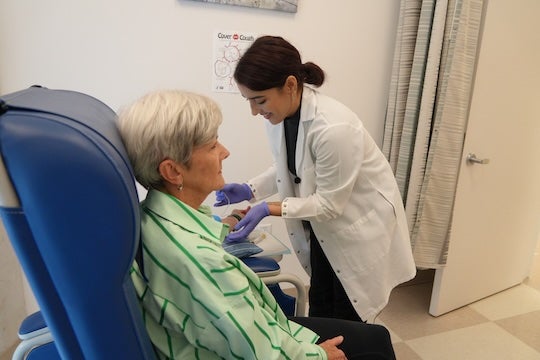
To capture those effects, Project REACH doesn’t stop at surveys and sensors. The research team — including graduate students and clinical staff — also collects blood samples to measure biomarkers of inflammation, one of the most reliable indicators of stress-related health decline.
“It’s a team effort,” Fagundes said. “We’re combining data science, psychology and biomedicine to get a 360-degree view of caregiving.”
The study, funded by the National Institute on Aging, began in 2023 and will continue through 2028. Participants complete three lab visits over six months, wear a lightweight monitor for two weeks and respond to app-based questions about mood, sleep, social connection and caregiving demands.
“We’re not just collecting numbers,” Fagundes said. “We’re learning from caregivers themselves. They’re the experts in their own experience.”
While Project REACH is still in its data collection phase, the ultimate goal is to turn these insights into personalized interventions — practical tools that help caregivers manage stress in real time, improving outcomes for both the caregiver and their loved one.
“Caregivers carry so much — emotionally, physically, financially,” Fagundes said. “We want to build tools that support them, not just in theory but in daily life.”
For Payne, being part of the research gave him a sense of purpose.
“They were kind, helpful, always on time — and it just felt like somebody, somewhere, was trying to help the caregiver,” he said. “That’s why I’m doing this. If I can help someone else, I will.”
In the meantime, he continues his schedule — the gym, lunch dates, tending to his garden — the small routines that keep he and his wife both moving forward.
“She doesn’t always remember,” he said, “but I do.”
Project REACH is currently recruiting participants. If you are a spousal caregiver who lives with and provides daily care for a partner with Alzheimer’s or dementia, you may qualify.
Contact Patty Morales at pm22@rice.edu or 713-348-2468 to learn more.