
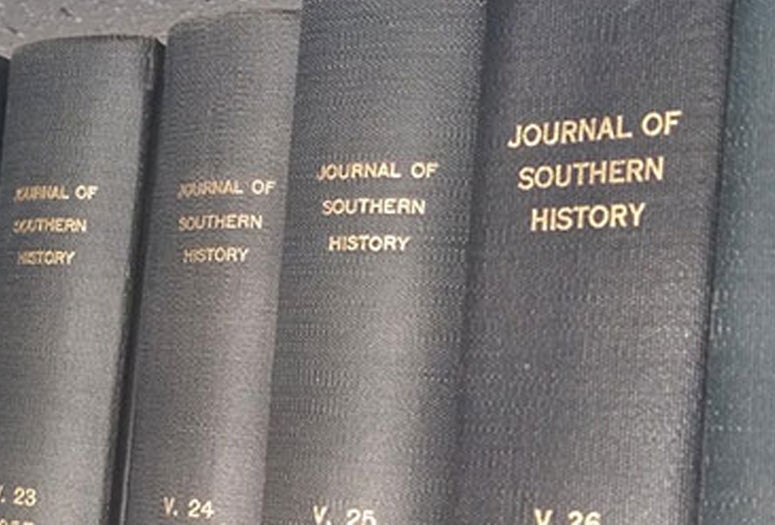
In 1959, Rice’s alumni magazine noted two major arrivals on campus: a powerful new computer and the headquarters of the Journal of Southern History.
“I’d argue that both of those arrivals, and not only the computer, have had a long-lasting and continuing impact on Rice,” said Caleb McDaniel, the Pulitzer Prize-winning historian who will step in as the journal’s next editor. “I’m eager to lead the journal into the newest chapter in its history here.”

That chapter begins at the end of the year, when longtime editor Randal Hall steps down after more than a decade of guiding the publication. McDaniel will become only the fourth full-time editor since 1965, an editorial continuity almost unheard of in academic publishing.
“When a Pulitzer Prize winner commits to stewarding a journal Rice has hosted since 1959, that says something powerful about both the institution and the field,” said Hall, the William P. Hobby Professor of American History. “Caleb’s editorship reaffirms that Southern history matters.”
Hall first worked on the journal as a Rice doctoral student. He later returned to the university as a faculty member and eventually became editor, overseeing the publication during a period of expanding global interest in Southern history.
“The Journal of Southern History has been part of my life since I was a doctoral student, and its long presence at Rice has always been one of its greatest strengths,” Hall said. “Handing off the editorship is a personal milestone, but it’s also a reminder of the remarkable continuity that has defined the journal for decades.”
Founded in 1935 and published quarterly by the Southern Historical Association, the journal has grown into a central forum for research on Southern history.
“Over its nearly 70 years of being headquartered at Rice University, the journal has earned its reputation as one of the best edited and best produced scholarly publications in the historical profession,” McDaniel said. “It is especially revered for its rigorous peer review and fact-checking processes and its commitment to publishing only the most cutting-edge scholarship on the American South, broadly defined.”
McDaniel credits Hall, former editor John Boles and managing editor Bethany Johnson with strengthening the journal’s national and international impact.
“I have seen firsthand how their leadership in these roles, as well as the hard work of everyone on their teams, has increased the international profile of Rice University as a center for historical research,” McDaniel said.

The journal’s broader reach will also be reflected in structural changes to come. As part of the transition, the journal’s book review section will soon be edited at Sam Houston State University. One of the editors there, lecturer of history William D. Jones, worked on the journal during his doctoral studies at Rice, including as the Boles Editing Fellow, a position generously endowed by supporters of the journal at Rice. McDaniel said the move reflects the journal’s expanding institutional network and the growing interest in Southern history across the region.
Hall’s final issue published in November departs from the journal’s usual structure by dedicating the entire publication to a single theme: Teaching about the South. The special issue brings together 21 contributors whose viewpoints span continents and classrooms, from scholars in France, Mexico, Japan and China to specialists in African American history. It also reflects Rice’s extended community through contributions from doctoral alumni and an undergraduate alumna, alongside K-12 educators who show how the region’s history is taught in schools from Appalachian Virginia to Arkansas.
“Southern history is no longer a regional conversation,” Hall said. “It shapes debates about race, politics, migration and climate that reverberate globally. The journal’s work has never felt more urgent.”
Both historians say the journal’s long-term home at Rice remains essential to its success. Generations of Rice students have worked as editorial assistants, participating in fact-checking and learning the mechanics of scholarly research in real time.
“They participate directly in the fact-checking of accepted articles, and they get to see up close how scholarship in the humanities is made,” McDaniel said. “Students who have worked at the journal over the years have turned that experience into careers both in academia and outside of it.”
McDaniel, the Mary Gibbs Jones Professor of Humanities, said he sees the editorship as an extension of Rice’s research mission and the journal’s long-standing dedication to truth seeking.
“I also believe that in our current moment, when solid research is often being drowned out in the public sphere by the noise of A.I. slop and hallucination or worse, the mission of scholarly research journals to seek the truth wherever it may lead, and with a scrupulous attention to evidence and fact, has never been more important,” McDaniel said.
McDaniel said he views the coming chapter as an opportunity to deepen that commitment to evidence-based scholarship at a time when careful historical work is increasingly essential.
“For scholars in the humanities, professional journals like this one are as vital to the university’s research mission as laboratories in the sciences,” McDaniel said. “The rewards are immense, and I believe they contribute directly to Rice’s commitment to bettering our world.”