
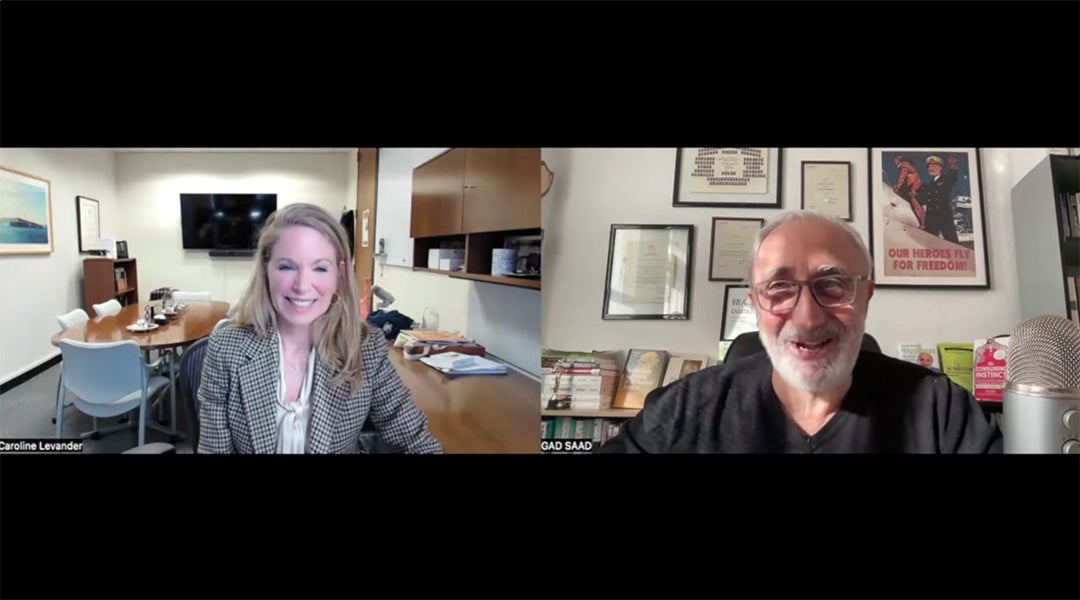
When Rice University’s Caroline Levander joined Professor Gad Saad on The Saad Truth podcast, the conversation quickly expanded far beyond the premise of her new book “Invent Ed: How an American Tradition of Innovation Can Transform College Today.” What unfolded was a candid, often philosophical back-and-forth on why interdisciplinarity matters, how academic culture unintentionally narrows creative possibility and what students misunderstand about the very idea of going to college.
“This is a book that tells the story of creativity and discovery in the United States,” Levander said. “It explores how our tradition of creative discovery can be optimized on university campuses today to ensure that everyone who attends college gets the most out of the experience and develops the kind of educational tools that will help them make the most important discoveries yet to be made in our country.”

Unlike many conversations about innovation in higher education, this one didn’t stay inside the walls of the academy. Saad, an evolutionary psychologist known for pushing guests to make interdisciplinary leaps, kept returning to the intellectual “play” that drives discovery using examples from Samuel Morse the painter-turned-telegraph inventor to philosophers who moonlighted as cryptographers. Levander leaned straight into that theme, arguing that the ability to move fluidly across fields isn’t just an aesthetic preference. It’s a method.
“Creative capability is something we can build — it's not innate,” Levander said. “It's a muscle we can develop, not like the color of your eyes or your height. It's something that we can teach students. And if we teach this to students really well, they're more high value in the marketplace, particularly in an era of AI.”
The podcast also surfaced a tension Levander rarely gets to name publicly. Universities, she said, unintentionally reward speed, polish and disciplinary containment. Even in discussion-based humanities courses, the students who answer quickly and cleanly tend to set the tone. That dynamic sends the wrong message about how discovery actually works.
“Even in those classrooms that we think are more about developing ideas over a long time, we as faculty often take shortcuts,” Levander said. “If we actually are mindful of that and we understand that doing that short circuits the building of a growth mindset …. we can change some of the implicit messages we're sending.”
As the conversation widened, Levander’s global portfolio surfaced in a way that reframed the whole argument. Her work establishing Rice’s presence in Paris and Venice has shown her how differently universities abroad operate and how much American students gain when they’re pushed outside familiar academic and cultural structures. Levander described international experience not as enrichment, but as a necessary lens for understanding how knowledge is produced in the first place.
That perspective also shaped one of the interview’s most practical threads: the way students and families choose colleges. Levander didn’t sugarcoat it. She said most students enter higher education with a passive approach, relying on gut feelings from a campus tour rather than understanding the intellectual ecosystem they’re joining. Her book’s final section tries to fix that, offering a kind of “owner’s manual” for navigating college with intention instead of defaulting to the path of least resistance.