
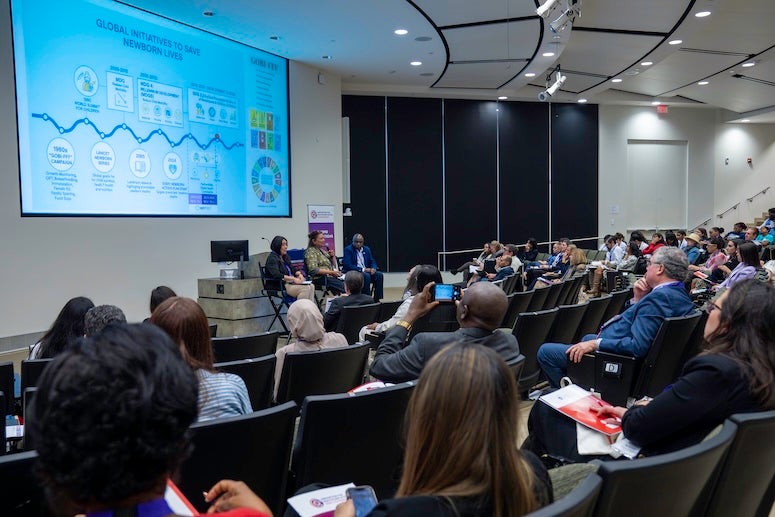
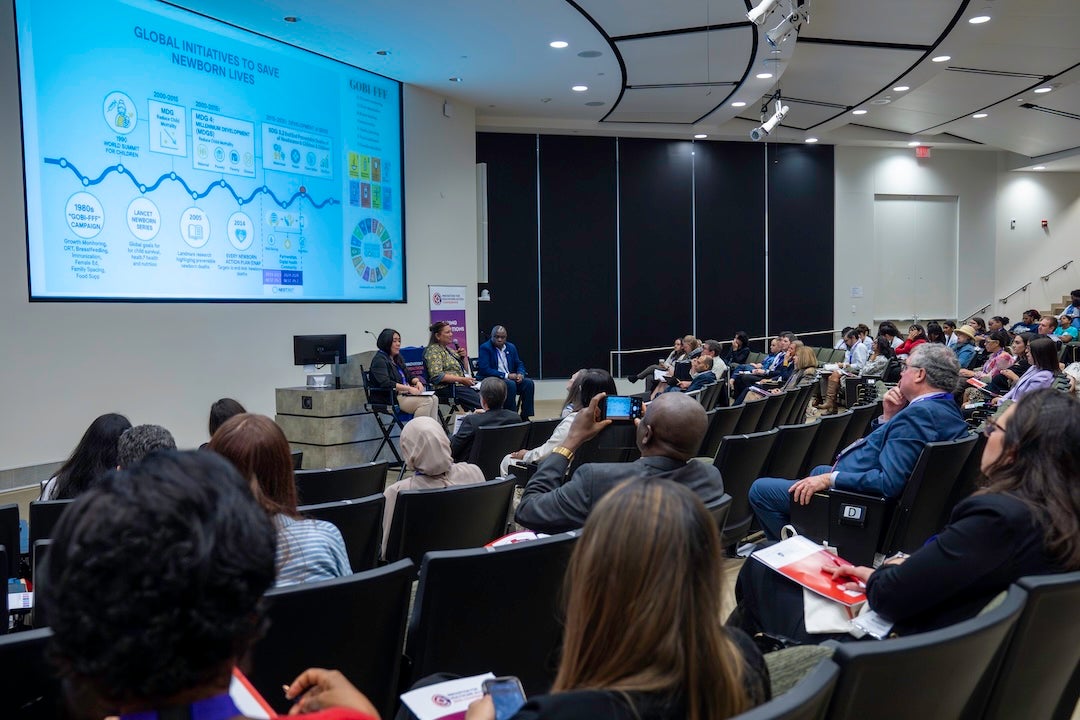
At the 2025 Innovation for Healthcare Access Conference, held Oct. 27-28 at Rice University, leaders from academia, medicine, public health and policy converged to tackle one of the most urgent challenges in health care: how to ensure that innovations not only reach the communities that need them most but also endure long after the pilot projects end.
Organized by the Rice360 Institute for Global Health Technologies, the two-day event focused on translating innovative technologies into sustainable, equitable systems of care across maternal and newborn health and chronic disease prevention in both global and local contexts.
“This conference embodies our vision for the future by bringing together the individuals — both the implementers and the thought partners — to address big challenges with even bigger solutions,” said Amy Dittmar, the Howard R. Hughes Provost and executive vice president for academic affairs at Rice. “Through our strategic plan, we are committed to being the world’s premier teaching and research university, delivering breakthrough discoveries to transform lives and improve humanity.”
The conference opened with a keynote from Kristie Wilburn-Wren, clinical associate professor and medical director of eMCAP at the UT Southwestern Medical Center, who shared both personal and professional insights on postpartum care for underserved patients.
“I was born at a point in time where there were no antibiotics, there were no steroids — there was actually no care for me,” said Wilburn-Wren, adding that she was born prematurely and given a very low chance of survival. “There was a very special nurse who took care of me, and that is the only reason I’m here today.”
Her address underscored the importance of equitable systems of care and noted the particular challenges of health care for mothers with the widening shortage of OB-GYNs across Texas and almost half of counties lacking any at all.
“It is proposed that by 2030 we’ll have 15% fewer OB-GYNs than we actually need within the state of Texas, thereby compounding the problems we already have,” she said, adding that maternal mortality patterns are shifting both in timing and cause. “This has to be reflected in how we are treating and following up with patients.”
Conference sessions on global case studies in pediatric and neonatal care highlighted scalable innovations being implemented successfully abroad and emphasized the importance of embedding health programs into national policy frameworks.
“When it comes to health, especially in these settings, policies are the holy grail,” said Joseph Lubega of Texas Children’s Hospital. “If you can stick an intervention into national policy, you can guarantee it will always be worked on.”
Philanthropic leaders from the Episcopal Health Foundation, The Cullen Trust for Health Care, Texas Woman’s University and the Cancer Prevention and Research Institute of Texas joined an afternoon panel to discuss the critical role of funding partnerships in sustaining health equity initiatives. Other sessions throughout the day focused on a wide range of topics and innovations related to improving maternal health, including an “innovator marketplace” and poster sessions during the lunch hour.
In his closing keynote, Krishna Udayakumar, director of the Duke Global Health Innovation Center, reminded attendees that designing new technologies is only part of the solution.
“Technology without design for equity will actually make things worse,” he said. “… It doesn’t matter how good our innovations are if people don’t want them. At the core is trust — trust in science, in health, in public health.”

The second day began with remarks from Maria Oden, co-director of Rice360, who emphasized the conference’s central mission. “The purpose of us getting together today and yesterday is to forge new collaborations, to share ideas and to find new projects to work on,” Oden said. “These challenges are going to require everyone to work together.”
Keynote speaker Lisa Hirschhorn, director of the Robert J. Havey, MD Institute for Global Health’s Ryan Family Center for Global Primary Care at Northwestern University, spoke on how implementation science can bridge the gap between discovery and delivery.
“Over the last 150 years, we’ve had thousands of innovations that promised to reduce suffering and improve life, but so many of them haven’t actually gotten there,” Hirschhorn said. “It’s not just about developing new innovations; it’s about innovating delivery.”
Sessions on digital and mobile health showcased real-world examples of telehealth, digital monitoring and emergency response programs, while panels on rural health and chronic disease care examined the intersection of technology and accessibility in applications ranging from cardiovascular prevention to diabetes care.
A highlight of the day was the session on global case studies for cervical cancer, featuring Isabel Scarinci of the University of Alabama at Birmingham and Kathleen Schmeler of the University of Texas MD Anderson Cancer Center. Scarinci shared how Alabama became the first U.S. state to adopt a formal plan to eliminate cervical cancer, describing a coalition of universities, public health agencies and civic organizations working together.
“There is only one cancer that we can eliminate, and that is cervical cancer,” Scarinci said. “… Everyone can play a role.”
“Nobody should be dying of this disease if everyone can get the access that they need,” Schmeler added. She described collaborations between MD Anderson and Rice to develop point-of-care HPV tests and advanced imaging technologies designed to simplify diagnosis and expand care in resource-limited settings.
In the conference’s final session, Chethan Bachireddy, former chief health officer of Harris Health and clinical associate professor at the University of Houston’s Tilman J. Frititta Family College of Medicine and Baylor College of Medicine, added reflections on health systems transformation in Houston and beyond. Notably, he spoke to the critical issue of declining public trust in the health care system and how it can be rebuilt through care that emphasizes human connection. Rebecca Richards-Kortum, Rice’s Malcolm Gillis University Professor and co-director of Rice360, closed the event by reaffirming its unifying vision: building collaborations that not only design new health technologies but also ensure they are implemented in ways that create lasting change.