
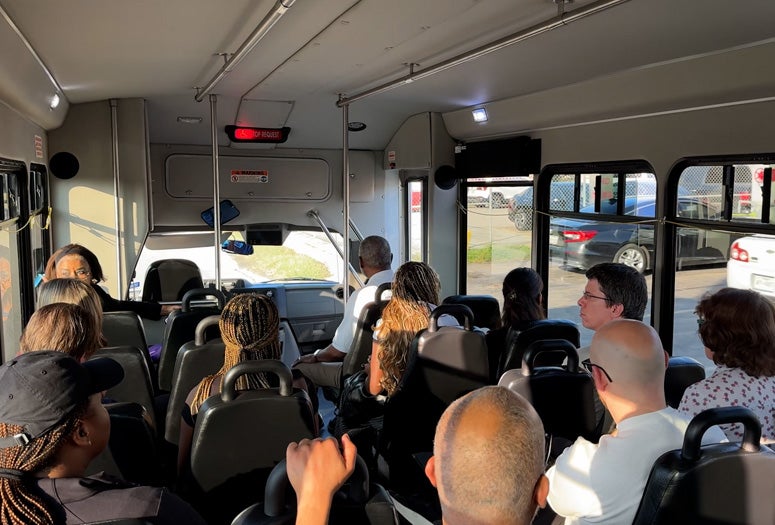
The grass around Evergreen Cemetery looked deceptively peaceful as the tour bus pulled to a stop. The small stretch of land divided by Lockwood Drive and hemmed in by highway traffic holds some of the oldest African American burial grounds in Houston. Standing there at the start of a nearly three-hour tour of Fifth Ward’s toxic history, it was clear this history wasn’t abstract or distant. It was lived, layered into the ground and still unfolding.
“It really reminds me that these are personal stories and that environmental contamination is a personal issue,” said Rice University senior Catherine Cook, who is majoring in health sciences with minors in biochemistry, cell biology and poverty, justice and human capabilities. “It’s not just something that happens in the abstract.”
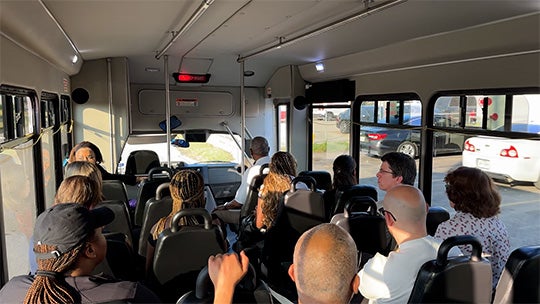
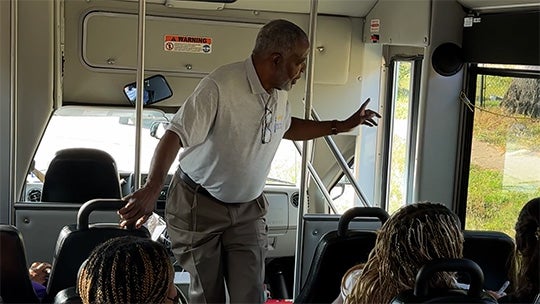
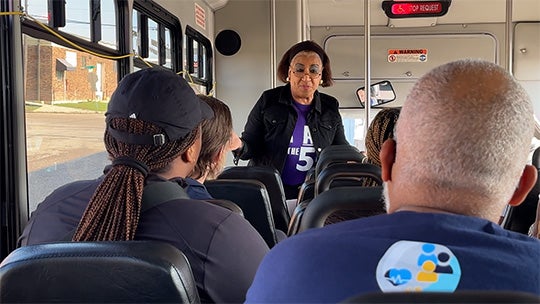
Evergreen was the first stop in an area of the city where environmental hazards sit side by side with everyday life. Over the course of the tour, community advocates the Rev. James L. Caldwell and attorney Algenita Scott Davis led the group through streets where creosote contamination, industrial sites, former schools, air monitors and gentrification pressure overlap in ways that are impossible to ignore once you’ve seen them all in a single line. That kind of clarity is exactly what Cook and fellow senior Shay Olaifa say they hope their multiyear Fondren Fellows project will preserve.
“The program teams undergraduate and graduate student researchers with faculty and library mentors to conduct original research and take on interdisciplinary projects that have a positive impact on the library, university and local community,” said Lisa Spiro, assistant university librarian for digital scholarship and organizational development at Fondren Library and director of the Fondren Fellows program. “The Fondren Fellows program supports inquiry-based projects that advance the library’s priorities, including through developing or improving archives, library services or training.”
Cook and Olaifa’s work centers on documenting the long arc of creosote contamination in Houston’s Fifth Ward and Kashmere Gardens and building a public archive in the Woodson Research Center that makes decades of reports, community records and oral histories accessible to researchers, policymakers and residents.
“They are preserving documents generated by the EPA, the rail companies that caused the spills and most importantly the voices of the people who have lived with the results of the spills,” said Carrie Masiello, the W. Maurice Ewing Professor of Biogeochemistry, Earth, Environmental and Planetary Sciences and faculty mentor of the project. “This information is critical for understanding what happened and what needs to happen next.”
The collection includes groundwater and air quality monitoring reports, regulatory documents, health assessments, historic maps and photographs, along with several oral histories recorded with community members, activists and families who have lived closest to the contamination.
“On the bus going from stop to stop, Catherine and I were like, ‘Oh my gosh, we did an oral history there,’ or ‘Oh, that’s that church,’ or ‘Oh, that’s where Kathy Blueford-Daniels lives,’” Olaifa said.
Olaifa, who grew up in Houston and now studies political science and social policy analysis, said seeing the sites in person deepened her understanding of the structural factors she has spent years studying.
“One of the best things I got from Rice was the ability to be able to put names to all the stuff I observed and lived growing up,” Olaifa said. “I didn’t know what ‘social determinants of health’ were. I didn’t know that all the landfills in my neighborhood were negatively impacting my health. I thought it was normal that me and all my classmates had asthma.”
Each stop sharpened the purpose of the archive: to ensure the stories surrounding this contamination aren’t lost or ignored.
“One thing we also wanted to do was ensure that these stories and voices don’t get dismissed, don’t get erased,” Olaifa said.
That intention sits at the heart of the Fondren Fellows program, which brings together students and faculty from a wide range of disciplines. On this project alone, Cook and Olaifa work alongside advisers in the humanities, library science, engineering and environmental studies.
“These are stories that are so often not heard, not told, that are erased, sometimes deliberately,” said Weston Twardowski, lecturer in environmental studies and one of the project’s mentors, adding that the tour offered a fuller understanding of how environmental injustice takes shape over generations. “This tour took us through not only the sites of contamination but provided a real history of where this place is, what it means to them, what it means to have lived somewhere that’s been subject to infrastructural and environmental challenges for decades.”
The archive, Twardowski said, allows those histories to exist in perpetuity and provides a foundation for future research, policymaking and community advocacy.
As the cemetery faded from view and the bus continued through Fifth Ward, the students’ work felt even more rooted in place. The archive they are building is not just a record of environmental contamination. It is also a record of the people who have carried this history, fought for recognition and refused to let their experiences go unheard.
“I thought it was really powerful to talk to them and hear their stories,” Cook said. “It was a really good balance between the research that we have done and the people who are working to make this issue more visible.”
Learn more about the Fondren Fellows program here.