

Dozens of people crowded into the Moody Center for the Arts Oct. 22, their hands rolling small, lumpy pods of clay and seeds — each one shaped like animal scat. They laughed, compared creations and packed the “seed bombs” to take home or toss into city parks. The exercise wasn’t a prank. It was the participatory prelude to a site visit of “Endangered Feces,” a temporary public art project conceived by New Orleans artist jackie sumell that asks what it means to rebuild an ecosystem starting from the ground up.
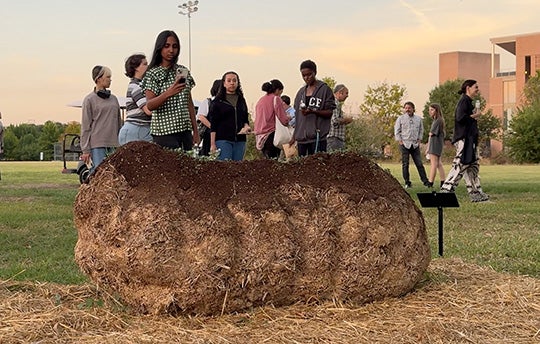
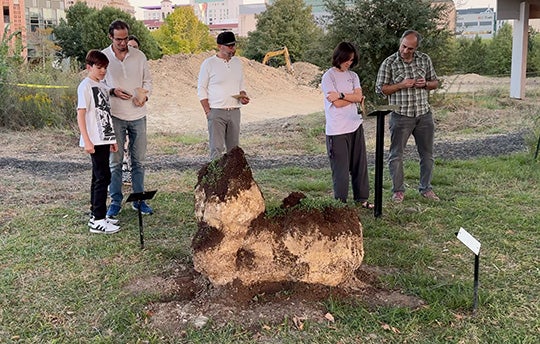
Installed near Rice University’s Harris Gully Natural Area, the work features two decomposable sculptures shaped like the droppings of the Houston toad and the Attwater’s prairie chicken, both endangered species native to the Gulf Coast.
“The sculpture breaks down and creates micro ecosystems that would sustain the species,” said sumell, noting that the pieces are made of soil, hydraulic lime and organic matter.
The project’s irreverent humor cuts through environmental fatigue. The title grabs attention, then redirects it toward a deeper truth: conservation isn’t just preservation; it’s participation. The sculptures don’t symbolize renewal; they perform it.
“I think people are coming because the name ‘Endangered Feces’ is intriguing,” sumell said. “It’s weird. It’s a little gross. It’s interesting. But then also it’s playful. Joy as an act of resistance is, I think, bringing people into this space and hopefully to the sculptures.”
That optimism finds grounding in collaboration. Rice faculty, students and volunteers helped shape the sculptures through a collective building process the artist calls Revolutionary Mortar, an idea rooted in community repair as much as material experimentation. Among them was assistant teaching professor of biosciences Cassidy Johnson, who is also director of the Lynn R. Lowrey Arboretum, the organization overseeing the restoration of Harris Gully.
“Sometimes there's not a very clear connection between environmentalism and art,” Johnson said. “I really feel like art has a huge part to play in connecting people to nature and to the environment. So it was honestly awesome to be able to work with Jackie on this because she does care so much about nature and not just nature itself, but the human connection to nature, which is something I think is very much lost when we talk about environmentalism or biology in general.”
That human connection is exactly what the featured species have lost. The Houston toad, once common across Central Texas, now clings to existence in fragmented habitats. The Attwater’s prairie chicken, which used to number in the thousands, survives only through refuge breeding programs and the rare stretches of tallgrass prairie that remain.
The sculptures’ decay becomes a small act of restoration. As they break down, they release seeds from endangered native plants, enriching the same terrain that inspired the work. For Johnson, the project’s impact extends beyond science into shared stewardship.

“These art installations that do encourage participation in both the art and thinking about nature are so critically important,” Johnson said. “I hope that Rice continues to do these sorts of installations. We have such an amazing campus and the Arboretum really, truly wants to support these types of initiatives that draw different people that think differently together.”
The beauty of “Endangered Feces” is that it refuses permanence. Its purpose is to disappear — to seed, sprout and rot. The work’s slow decomposition becomes a statement about resilience: that what’s dismissed as waste may be what sustains us next.
“We can't save the environment just by doing science,” Johnson said. “It's just not possible. We need to engage people and other mechanisms, and art is absolutely one of those ways to do it.”
Read more about the Platform series and the Moody here.