
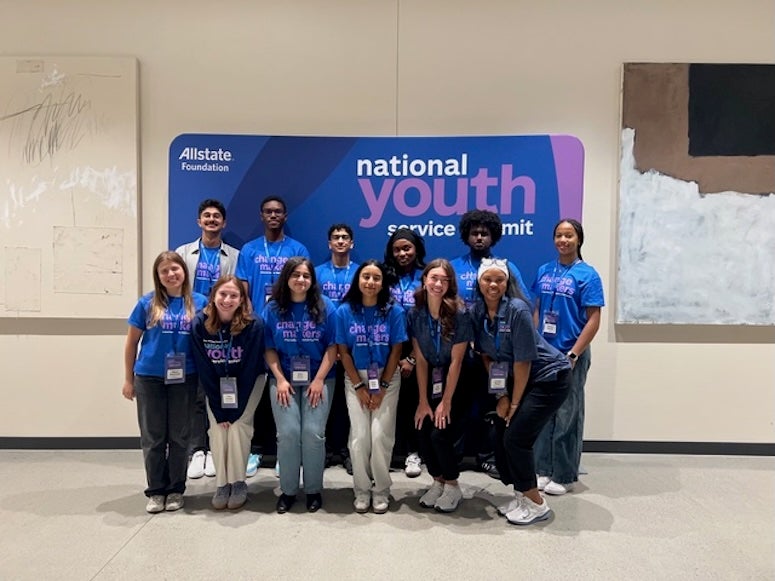
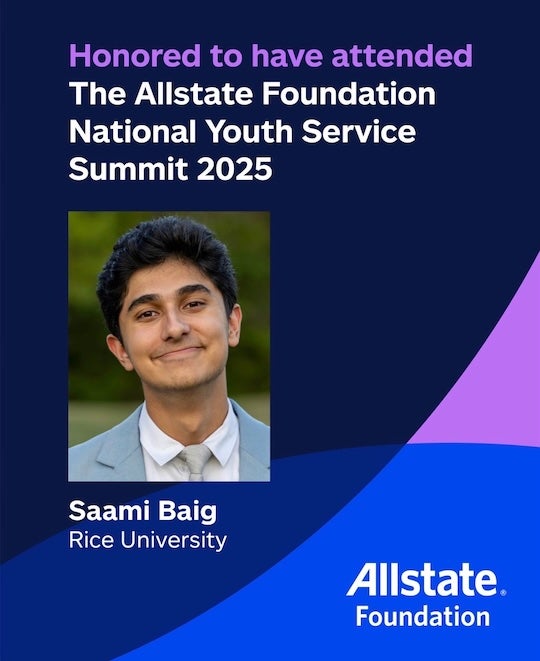
When Rice University sophomore Saami Baig arrived at The Allstate Foundation National Youth Service Summit in Chicago, he wasn’t just stepping into a weekend of workshops — he was joining a national cohort of young leaders working to solve some of the country’s most complex and pressing challenges.
Baig was one of just 65 students selected nationwide from a competitive pool of more than 500 applicants to attend the summit this fall. The program convenes young leaders working across areas including public health, education, climate and civic engagement. For Baig, a Duncan College student studying health sciences and social policy analysis, the summit offered a space to deepen his commitment to gun violence prevention, the focus of his work for nearly four years.
“It can sometimes feel isolating doing public service work,” he said. “Being surrounded by so many people who care about their communities made me feel grounded again.”
Baig’s connection to gun violence prevention began long before he enrolled at Rice. A married couple in Baig’s neighborhood were killed in their home when Baig was a youth, and the shooting reshaped how he understood the impact of violence.
“You see shootings on the news, but seeing your own community reckon with that fear changes your understanding of the issue,” he said.
That personal experience shaped his advocacy, eventually leading him to serve on the Brady United Against Gun Violence executive council and later the youth-led Team ENOUGH. By the time he arrived at Rice, Baig already had a couple years of organizing and policy work behind him, but the urgency didn’t fade. The 2022 Uvalde shooting, he said, only strengthened his commitment.
At Rice, Baig approaches gun violence as a public health issue, a framework reinforced throughout his coursework. In one class, students studied the RISE community violence-intervention network, research Baig said helped him tie academic insights to the realities he sees in Houston.
His work now spans several areas:
- Safe storage education and reducing unintentional injuries.
- School safety efforts with Harris County officials.
- Understanding how local contexts — including Houston’s size, diversity and proximity to the Texas Medical Center — shape community responses to violence.
“Gun violence looks different everywhere,” he said. “In Houston, the intersections of health care access, inequality and safety are really important.”
One moment from the summit particularly stood out: when a former U.S. surgeon general spoke about gun violence as a public health crisis. Hearing that message in person, Baig said, was especially powerful.
“The room just erupted,” Baig said. “To hear that in person — it was validating for everyone in the gun violence prevention space.”
For Baig, the former surgeon general’s presence underscored the level of leadership and influence represented at the summit. He said the experience offered meaningful networking opportunities, connecting him not only with established public service professionals but also with young leaders who are likely to shape the future of community impact work.
Participants spent the weekend working in small “family clusters,” attending workshops and pitching civic initiatives in areas ranging from education to civic engagement. The intentionality of the programming, Baig said, created space for honest conversations about burnout, impact and uncertainty.
“Public service isn’t linear,” he said. “Sometimes you need to rethink how you can make a difference when the path forward isn’t obvious.”
National funding cuts have limited internship and research opportunities in gun violence prevention, forcing many young advocates to rethink their paths. The summit, Baig said, helped him consider the broader landscape of interconnected public health issues — including incarceration and community health — and how they intersect with violence prevention.
“It made me realize that helping communities doesn’t always look like a straight line,” he said. “There are multiple ways to work toward safety and health.”
For students considering applying to programs like the summit, Baig offers simple advice: apply even if you’re unsure.
“You have nothing to lose,” he said. “Whether or not you get selected, you’ll still be doing work that matters because it’s for your community.”