
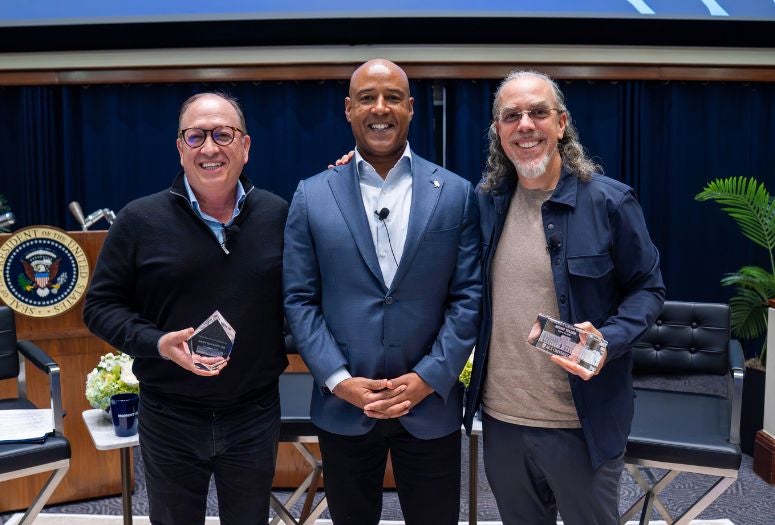
The latest edition of the President’s Lecture Series brought Astro Teller and Rice alumnus Andy Karsner ’89 to the Rice Business Shell Auditorium to speak about technology and innovation for today’s challenges.
Teller, “Captain of Moonshots” at X, the Moonshot Factory (formerly Google X), leads teams on a mission to invent and launch breakthrough technologies. The Moonshot Factory got its start creating the self-driving car Waymo and has numerous other projects in the pipeline that intend to use technology to help people.
“Asking ‘what if’ imagining things differently is the source of making the world better,” Teller said. “It has to start with some sense that things could be better, and asking weird, uncomfortable questions – most of which won't be right. That is the essence of radical innovation. It's the essence of taking moonshots.”
The term “moonshot” has come to represent an ambitious venture intended to produce significant or important results. Its nascence begins with President John F. Kennedy’s speech that took place on Rice’s campus Sept. 12, 1962. President Reginald DesRoches’ office arranged to have the lectern that Kennedy used during that speech brought from its installation at Johnson Space Center to Shell Auditorium to commemorate the through line of American innovation, academia and progress.
“We choose to go to the moon,” the speech reads. “We choose to go to the moon in this decade and do the other things, not because they are easy, but because they are hard, because that goal will serve to organize and measure the best of our energies and skills, because that challenge is one that we are willing to accept, one we are unwilling to postpone, and one which we intend to win, and the others, too.”

X, The Moonshot Factory has systematized how to take audacious ideas and turn them into reality.
“(Kennedy) was daring us to try something you could not prove ahead of time could be done,” Teller explained. “And that makes a fire in all of our hearts when we hear that from somebody else, but it can only happen if we set that fire in ourselves and in each other. So, that's what X does. We practice asking ‘what if?’ and then run it to (the) ground. And we do it with the equivalent of the scientific method – just repurposed for innovation. That doesn't mean that there's no rigor, but we start off with imagination. So, our job is to find opportunities to use technology to make the world a radically better place.”
He and his employees investigate hundreds of promising ideas each year and only a few survive the factory’s rigorous testing and de-risking process to become one of the moonshot projects. The teams are small, which enables them to move quickly. However, the projects that do not survive the testing process are turned into “Moonshot compost” – the teams, their code, hardware, patents and partnerships that might have materialized during the process “go back into the dirt at X and find expression in new things,” Teller said.
Joining Teller on the panel was Karsner, an energy industry leader and an adviser to X, The Moonshot Factory. From 2006 to 2008, Karsner served in the U.S. Department of Energy as assistant secretary for energy efficiency and renewable energy. In 2021, he was elected to the ExxonMobil Board of Directors as one of the first environment-friendly board members.
“You’re never going to survive at X if your ego and your audacity are insufficiently balanced with your humility and your essential yearning to learn,” Karsner said. “If you have sufficient self-actualization to say, ‘This isn’t going where I thought it would. Can you repurpose my intellectual capital?’ you’ll get ahead, further, faster.”
Karsner received his bachelor’s degree in political science and religious studies from Rice, which he referred to as his “academic home.” His education has contributed to his personal investment in ethics in everything X does, he said.
“It's more than what you infuse at the front end of the tool – you will always have, to some degree, a reflection of society's ethical approaches,” Karsner said. “This started as a virtuous race to the moon, but here we (the U.S.) are today, with satellites that are about shooting each other out of the sky.”
Earlier in the day, Teller and DesRoches toured Rice’s research laboratories to view innovations such as light-harvesting nanoparticles in Naomi Halas’ lab, highly efficient perovskite solar cells with Aditya Mohite and the work of Jim Tour’s lab in converting carbon-based waste to advanced materials. Rice is committed to moving innovative technology from lab to market by bringing together world-class research, entrepreneurial training and even early-stage funding to support the next generation of deep tech ventures that can change the world, DesRoches said.

Teller is very familiar with academia and research – he holds a bachelor’s degree in computer science and a master’s degree in symbolic and heuristic computation, both from Stanford University, and a doctorate in artificial intelligence from Carnegie Mellon, where he was a recipient of the Hertz fellowship. Before moving to the business world, he taught at Stanford, and did engineering research for Phoenix Laser Technologies, Stanford’s Center for Integrated Systems and the Carnegie Group Inc.
After the panel, moderated by DesRoches, Teller and Karsner took questions from the audience. One MBA student asked for advice on how the younger generation can deal with the overwhelming information about artificial intelligence, both positive and negative.
“Panic is not going to help, it's going to anti-help,” Teller said in response. “But the other thing I would love to embed in people's brains is what you learn about yourself – your own humanity, what makes you tick, like how you built your personal operating system from when you were 5 years old. That is actually the work.”
“Go seek nature and be grounded in the real world with your device off long enough to be in touch with who you are and who you want to be,” Karsner said. “And never let go – be a vigilant guardian of your ‘inner 8-year-old's’ imagination.”
The President's Lecture Series welcomes nominations for possible future speakers by emailing president@rice.edu. They aim to present lectures that illuminate varied fields and experiences and have historically featured thought leaders in the fields of "letters, science and art." The series is sponsored by the Office of the President and supported by the J. Newton Rayzor Lecture Fund.