
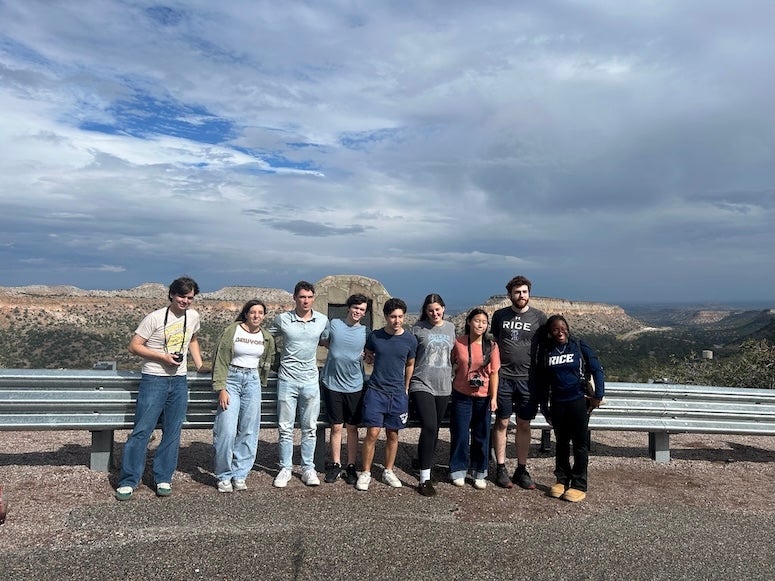
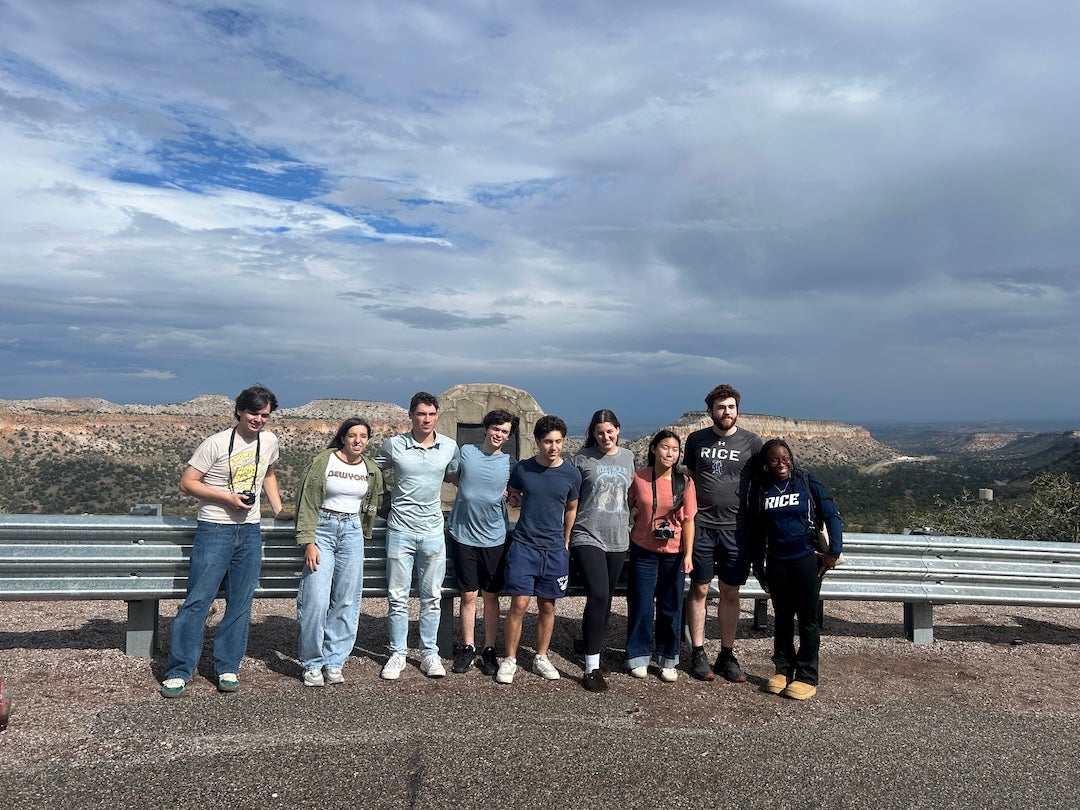
When Rice University history professor Luis Campos asked his students if they wanted to spend fall break driving across New Mexico — visiting uranium mines, nuclear test sites and communities still living with the aftermath — sophomore Denise Walsh didn’t hesitate.
“I already had fall break plans, but I canceled them — this felt way more important,” said Walsh, who studies social policy, political science and economics.
The trip was part of Atomic America, Campos’ trademark course tracing the evolution of the nuclear age — from early fascination with radium to the Manhattan Project and modern policy debates. “You can read about those histories,” Campos said, “but there’s nothing like talking face-to-face with the people whose lives are part of that story.”
Campos led 15 students across New Mexico for a week exploring what he calls the “cradle-to-grave story” of nuclear history — from uranium mining and weapons design to testing and questions of nuclear waste disposal. Students met with Los Alamos National Laboratory scientists and engineers and Santa Fe-based artists and activists, including an antinuclear advocate who has sued the Department of Energy (and won) seven times.
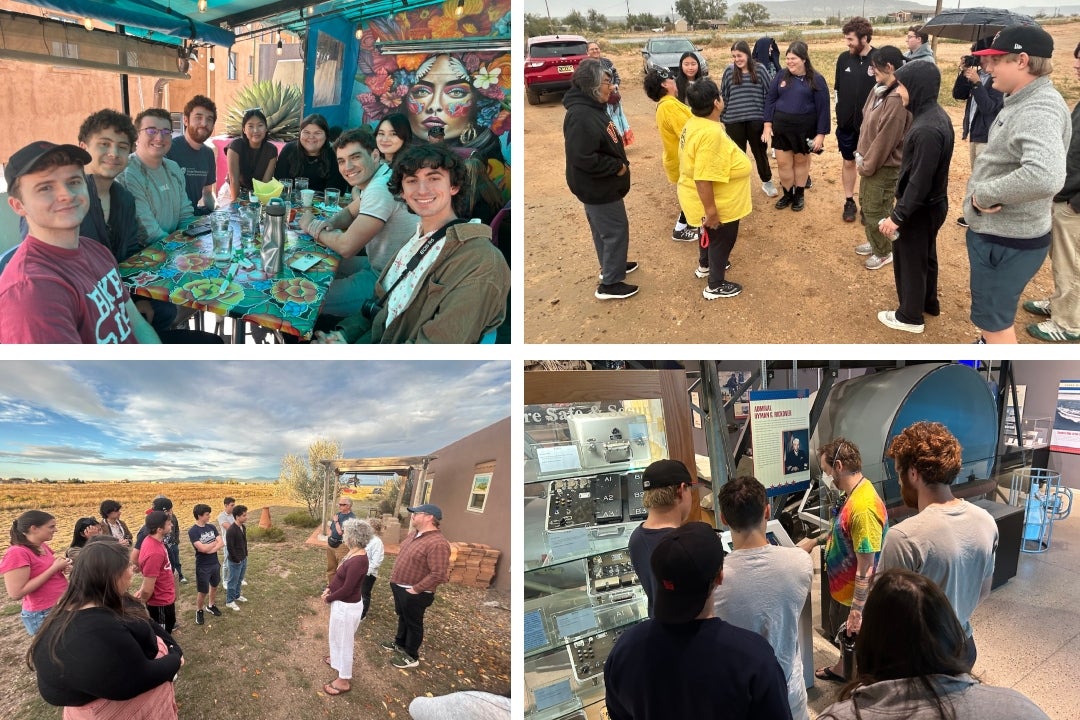
“By the end of the day, the van would erupt into debate,” Campos said. “A social policy major would talk to an astrophysicist about nuclear deterrence or questions of environmental justice — and someone would say, ‘I’m so glad you’re in this class. I never would have thought about it that way.’”
In addition to visiting national laboratories and meeting with “downwinders” affected by the first atomic test in history (the Trinity test), the group also visited the sites of uranium mining and met with residents of nearby affected Indian pueblos.
For Walsh, the experience reshaped how she views energy policy.
“I’d always looked at energy issues on a policy level — how we produce and use it,” she said. “But I’d never talked to people who live with the negative effects. Meeting Indigenous residents and hearing how radiation exposure has devastated their communities was something I’ll never forget.”
Even the smallest moments stayed with her.
“Because we were visiting areas affected by contamination, there was always this awareness in the back of your mind,” Walsh said. “You start to realize what it means to live with that uncertainty every day.”
Supported by Rice’s Center for Civic Leadership (CCL) and the History Department, the project reflects the university’s emphasis on experiential learning.
“When students are immersed together in these kinds of trips, the most powerful learning happens in the conversations that continue long after the day’s activities end,” said Danika Brown, the CCL’s executive director.
Brown said Atomic America exemplifies a “global domestic experience,” connecting civic awareness to U.S. communities deeply affected by global issues. Campos agreed: “It’s what Rice does so well — connecting classroom ideas to real-world experiences in meaningful, human ways.”