
By Raji Natarajan
Special to Rice News
The Data-to-Knowledge (D2K) lab at Rice University’s George R. Brown School of Engineering and Computing is a hub for data science solutions that conducts a semester-long program for undergraduates and master’s students to partner with governmental agencies, industry and community sponsors to solve real-world interdisciplinary challenges of scientific, local and global importance.
Participating student teams receive mentorship from the sponsoring organization to understand the problem and its impact, while a D2K faculty member and a graduate student researcher (known as a D2K Fellow) serve as data science mentors. Faculty grade the students and guide them technically as well as in project management and communications. The program culminates in a project showcase, where all D2K capstone teams present their work. Judges select the top three teams to receive awards. The 2025 D2K Fall Showcase was held Dec. 3 at Duncan Hall, where 15 teams presented their capstone projects.
“I’m extremely proud of our student teams for their hard work and diligence in developing solutions to applied data science problems from our sponsors,” said Chad Shaw, the D2K lab director and professor. “These Rice students are amazing, creative and diligent. Their bespoke artificial intelligence and machine learning solutions are simply exceptional. The D2K capstone is demonstrative of what Rice students have to offer to solve real-world challenges. The D2K capstone is exactly the kind of work Rice University President Reginald DesRoches has outlined in Momentous, the university’s strategic plan. Once again, the fall showcase beautifully highlighted the transformative power of Rice to improve health and safety, enhance natural, cultural and space environments and solve urgent local and global problems facing various partners.”
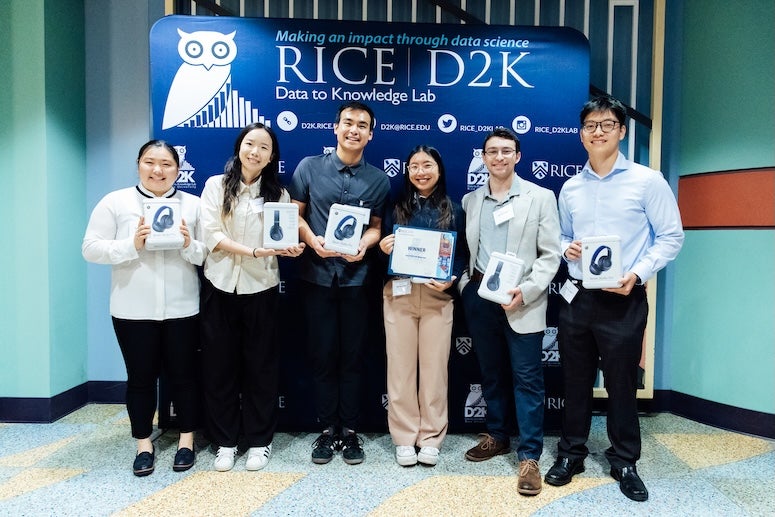
Team See You Crater! won first place for its project, “Lunar Crater Detection for Autonomous Spacecraft Navigation.” The team, comprising Rice undergrads Elaine Ren, Kevin Lei, Quan Tran, Angela Cai, Grace Yu and Owen Panucci, was advised by Kyle Smith from NASA Johnson Space Center; Arko Barman, an associate teaching professor at D2K; and Tony Yu, a D2K Fellow.
The goal of this project was to address the critical challenge of autonomous navigation for spacecraft to operate in the cis-lunar space (the region between the Earth and the moon), which is beyond the reliable coverage range of traditional GPS systems. A rapid increase in the number of space missions has stretched NASA’s ground-based tracking resources, necessitating the development of self-sufficient navigation solutions that will enable spacecrafts to operate longer with minimal communications with the ground. One innovative approach involves using the moon’s craters as distinct landmarks to determine a spacecraft’s precise position. This will involve scanning and cross-referencing the lunar landscape to an exhaustive database of lunar crater images on board the spacecraft. The first step is to accurately identify and catalog lunar craters, which is incredibly challenging using imagery captured under different lighting and geological conditions. To address this challenge, this D2K team created a machine learning model called See You Crater! to act as the “eyes” of an autonomous navigation system. Preliminary testing has shown it performs faster than comparable AI models tested by Johnson Space Center.
“Computers on board spacecraft are not as fast as those on Earth, since they are built to withstand extreme space conditions — such as radiation, cosmic rays and vacuum — and to continue working without interruptions even when some components fail. So it is paramount that the machine learning models used during spaceflight can be implemented quickly,” Smith said. “Overall, the final product delivered by the Rice D2K team is a fine-tuned, bleeding-edge AI model that Johnson Space Center will continue investigating for use in autonomous spacecraft navigation.”
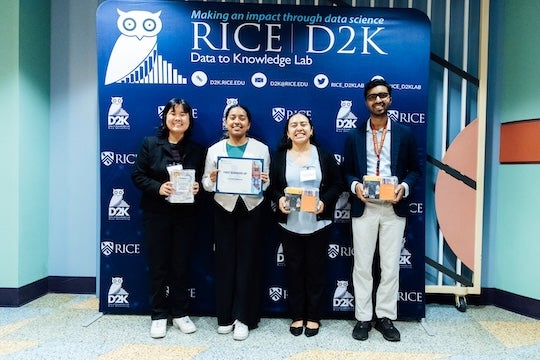
Team Smithsonian Museum Pollen Detection won second prize for its project, “A Supervised Computer Vision Approach for Pollen and Spore Detection in Microscope Slides.” The project was sponsored by the Smithsonian National Museum of Natural History. The team, comprising Rice undergrads Katelanny Diaz, Anna Nyugen, Samhita Vinay and Sanjeev Rajakumar, were advised by Smithsonian curator Scott Wing; postdoctoral fellow Ingrid Romero; Arko Barman, an associate teaching professor at D2K; and Debolina Halder Lina, a D2K Fellow.
The Smithsonian’s large collection of fossilized pollen and spores serves as markers of past climates dating back millions of years and is useful to study climate change. But a single microscopy sample contains thousands of grains, making their classification and cataloging a laborious and time-consuming task, and the scale blocks the utilization of these data for climate analysis. The D2K team used computer vision to create and validate two object detection models — You Only Look Once (YOLO) and RoboFlow Detection Transformer (RF-DETR) — to expedite the classification of these fossils. Moreover, these new models will also provide climate researchers with better annotated datasets to build improved climate prediction models.
“We’ve worked with Rice’s D2K student teams in both spring and fall semesters of 2025 and are very impressed with the students and what they have accomplished,” Wing said. “This collaboration has been deeply impactful. It has helped us learn more about computer vision methods and the problems of wrangling superlarge multifocal microscopy images, as well as exploring different avenues to tackle the challenging task of classifying and annotating these fossils. We are establishing workflows to administer the new methods developed by the D2K team and plan to start using them for large-scale automated recognition and annotation of our vast collection of fossilized pollen and spores beginning January 2026.”
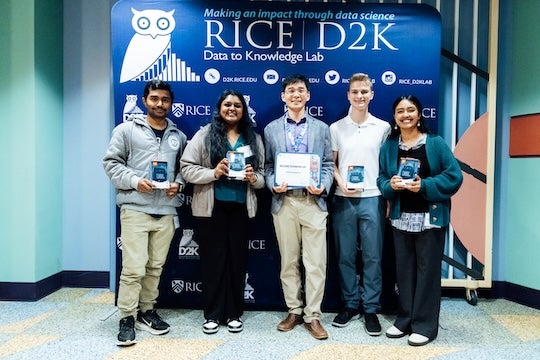
Stream Team: You Flow my Boat won third place for developing data-driven streamflow prediction models that can improve short-term flood forecasting and support local hazard preparedness efforts. The project was sponsored by Rice’s Department of Civil and Environmental Engineering. The team, comprising Rice undergrads Ruchi Tiwari, Misha Gupta, Prashanth Javaji, Divya Murala and Matthew Cihlar, was advised by James Doss-Gollin, assistant professor of civil and environmental engineering; Xinjie Lan, assistant teaching professor at D2K; and Peikun Guo, a D2K Fellow.
This project addressed the urgent, global need for accurate real-time local flood forecasting, highlighted by recent devastating floods in Central Texas. Machine learning models offer a faster alternative to traditional physics-based models for flood prediction on large river systems. However, currently available machine learning models struggle to accurately predict local flash flood events. To tackle this issue, this team developed a new machine learning model that was trained on the comprehensive, large-scale CAMELSH (Catchment Attributes and Meteorology for Large-Sample Hydrology, Hourly) dataset which provides hourly meteorological data and geological attributes for over 9,000 watersheds across the contiguous United States, resulting in enhanced AI models that offer reliable and real-time flood predictions for gauged and ungauged streams and watersheds across the country.
“This new pretrained machine learning model is a huge improvement over the current local flood prediction models and will empower public officials with critical information when they need to issue timely notifications, warnings and to ensure community preparedness,” Doss-Gollin said. “Moreover, it can serve as a test bed for researchers to conduct ‘methodologic fine-tuning’ of specialized functions such as quantifying uncertainties in flood predictions.”
All projects from the 2025 Fall Showcase can be found here.